Maritime Civilization and Modern Nation-Building Through the Perspectives of Korean, Chinese, and Japanese Envoys
A book that explores maritime civilization through the travel journals of diplomatic missions from Korea, China, and Japan is attracting attention.
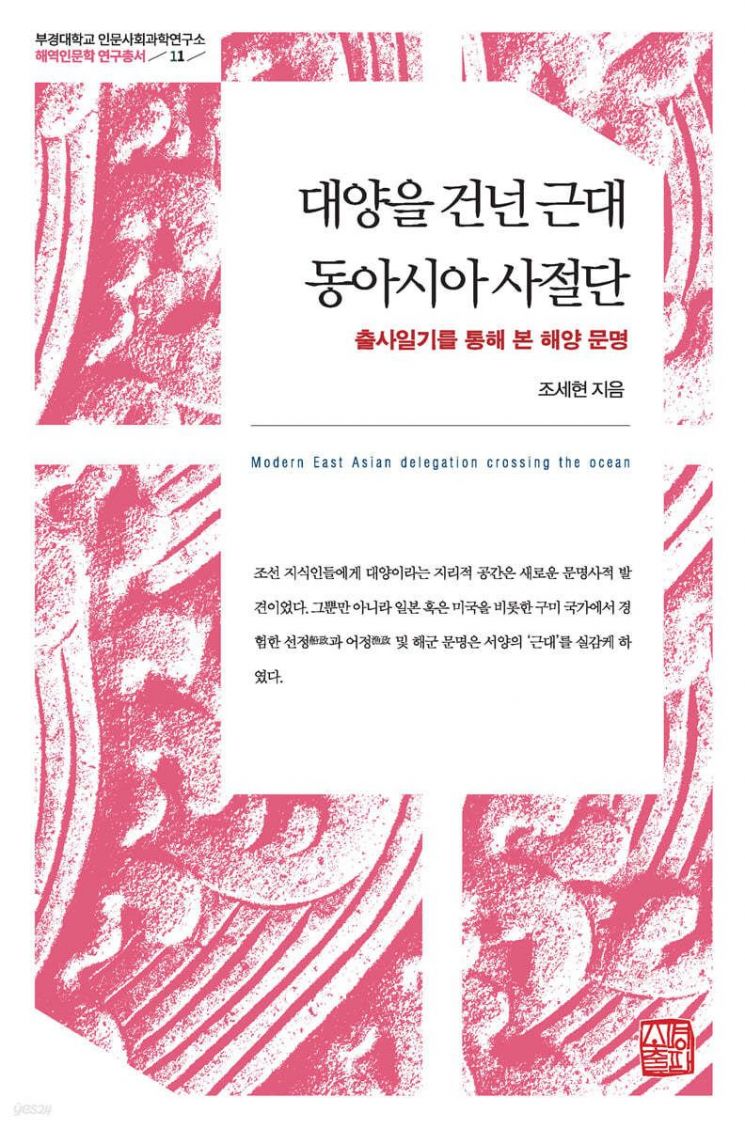
This is "Modern East Asian Envoys Across the Ocean" (Somyung Publishing, 420 pages), published in July by Professor Cho Sehyun of the Department of History at Pukyong National University.
The author notes that while overseas travelogues have received some academic attention, research on maritime civilization is surprisingly rare in the many studies of Korea, China, and Japan’s interactions with the West during the modern era.
Focusing on the fact that envoys and emissaries were the ones who experienced maritime civilization most vividly, Professor Cho Sehyun explores their perspectives on maritime civilization through the travel journals of diplomatic missions dispatched from Qing China, Japan, and Joseon Korea. Through this, the book examines the disintegration of the traditional China-centered world order and the construction of the modern nation-state.
Composed of two parts and seven chapters, the book covers, in Part 1, the world tours of the Burlingame Mission and the Iwakura Mission, and in Part 2, the ocean voyages and maritime civilization experienced by Korean envoys. It sheds light on the dispatch processes, routes, and perceptions of maritime civilization among the missions from Korea, China, and Japan, concluding that "China and Tianxia are different" and "the East of the Orient is the West of the Occident."
In the chapter "China and Tianxia are Different," the author explains, "(The envoys) crossed the Pacific Ocean on steamships, the remarkable invention of the Industrial Revolution, and witnessed firsthand that the earth is round and the sea encircles the land. During their ocean voyages, they came to understand the modern concept of time?that the earth’s rotation and revolution create day and night and the four seasons."
He continues, "Their understanding of the International Date Line?that traveling against the direction of the sun adds an extra day?led to the acceptance of modern concepts of time and distance. Accepting these modern scientific views of the earth and geography inevitably led to a decentering, where no region of the world could be the center, thereby causing cracks in the traditional China-centered world order."
The author, Professor Cho Sehyun, is an expert in modern East Asian intellectual and maritime history, and has published works such as "Qingmo Minchu Wuzhengfupai de Wenhua Sixiang" (Social Sciences Academic Press, 2003), "International Exchange and Solidarity of East Asian Anarchists" (Changbi, 2010), "The History of Busan Chinese" (Sanjini, 2013), "From the Sea of Tianxia to the Sea of the Nation" (Iljogak, 2016), "Maritime Taiwan and Continental China" (Pukyong National University Press, 2017), and "Exploring the Maritime Nation by Modern Chinese" (Somyung Publishing, 2022).
© The Asia Business Daily(www.asiae.co.kr). All rights reserved.
![Clutching a Stolen Dior Bag, Saying "I Hate Being Poor but Real"... The Grotesque Con of a "Human Knockoff" [Slate]](https://cwcontent.asiae.co.kr/asiaresize/183/2026021902243444107_1771435474.jpg)
















