Holding an Economic Issues Meeting... Listening to Economic Sector Difficulties
Gwangju Mayor Kang Gi-jung is seeking solutions for the recovery of the people’s economy and revitalization by engaging directly on the ground.
On the 26th, according to Gwangju City, Mayor Kang held an ‘Economic Issues Meeting’ with local economic organizations and institution heads at the Gwangju Chamber of Commerce and Industry to communicate directly with the people’s economy.
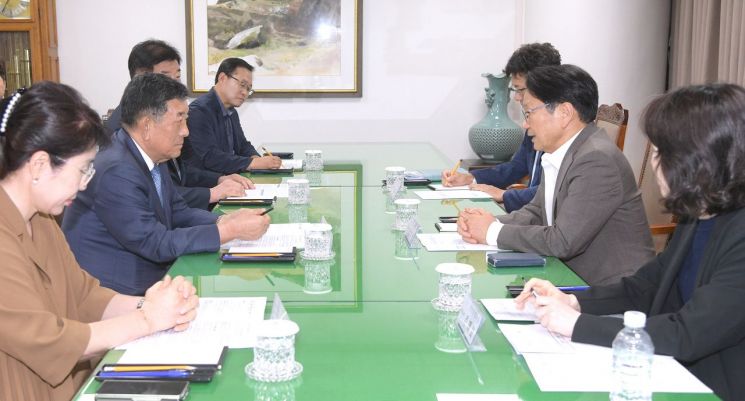
Mayor Kang proposed this meeting to hear the difficulties faced by the economic sector on-site amid worsening business conditions such as prolonged high interest rates and a sluggish domestic economy, which have made the regional economy and people’s livelihoods challenging.
In particular, as an active role of local governments is needed to revive the people’s livelihood, it is known that this meeting was promoted to reflect the voices from the field in next year’s Gwangju City budget and policies.
The meeting was attended by Mayor Kang Gi-jung, Han Sang-won, Chairman of the Gwangju Chamber of Commerce and Industry, Kim Dong-chan, Executive Vice Chairman of the Gwangju Employers Federation, Lim Kyung-jun, Chairman of the Gwangju-Jeonnam Chapter of the Korea Federation of Small and Medium Business, Lee Mi-jin, President of the Gwangju Branch of the Korea Women Entrepreneurs Association, among others.
Mayor Kang shared Gwangju’s economic policy directions covering small business owners, SMEs, and jobs, and exchanged various opinions on key issues related to the people’s economy and employment.
The economic sector stated, “Many companies are facing severe difficulties due to worsening domestic and international conditions such as high interest rates and high prices after COVID-19,” adding, “The economic sector and local governments must work together to find ways to add vitality to the economy by pooling regional efforts. We will actively cooperate on major local issues such as Gwangju Global Motors, a labor-management win-win job project.”
Mayor Kang said, “The economy is difficult and people’s livelihoods are tough; now more than ever, an active role of local governments is necessary,” adding, “Only by first understanding the demands of companies can accurate budget allocation and policy reflection be possible, so we will overcome the endless waves of recession together through continuous communication.”
Mayor Kang plans to continuously hold tailored on-site meetings by industry and company size, focusing on Gwangju’s nine representative industries, to listen to the voices of the economic sector.
Meanwhile, Gwangju City is concentrating administrative capabilities on customized support for small and medium enterprises, small business owners, and startups, focusing on creating tangible changes that can be felt through support for business stability and competitiveness enhancement.
In response to the ongoing economic crisis, Gwangju City is implementing a 50 billion KRW special guarantee for small business owners in the second half of the year to alleviate financial difficulties faced by small business owners and self-employed individuals. To strengthen the social safety net for small business owners, support for social insurance premiums (employment and industrial accident insurance) has been expanded to 900 million KRW, and 1.1 billion KRW is provided as incentives for joining the Yellow Umbrella Mutual Aid.
Additionally, the city is providing 265 billion KRW in business stabilization funds and 35.5 billion KRW in SME development funds to support stable business management, while promoting technology innovation projects to enhance competitiveness. It is also supporting projects tailored to alleviate price burdens, stimulate consumption, and support neighborhood commercial districts.
© The Asia Business Daily(www.asiae.co.kr). All rights reserved.
![Clutching a Stolen Dior Bag, Saying "I Hate Being Poor but Real"... The Grotesque Con of a "Human Knockoff" [Slate]](https://cwcontent.asiae.co.kr/asiaresize/183/2026021902243444107_1771435474.jpg)











