Opposition: "Public Media Collapsing" vs Ruling Party: "Media Takeover"
Vote on Broadcasting Communications Commission Act at 5:30 PM
Filibusters Planned for Broadcasting Act and Others
On the 26th, the National Assembly is experiencing a filibuster (unlimited debate) initiated by the People Power Party in opposition to the Democratic Party of Korea's attempt to forcibly pass the so-called 'Broadcasting Four Acts' (amendments to the Korea Communications Commission Act, Broadcasting Act, Korea Broadcasting Culture Promotion Agency Act, and Korea Educational Broadcasting System Act). The Democratic Party maintains that the amendment to the Korea Communications Commission Act was proposed to properly maintain the five-member system of the Korea Communications Commission and prevent its manipulation into a two-member system. However, the People Power Party counters that the Democratic Party is trying to seize control of the media.
According to the National Assembly on the 26th, the filibuster related to the amendment of the Korea Communications Commission Act, which People Power Party lawmaker Choi Hyung-do started at 5:30 p.m. the previous day, has been continued by Democratic Party lawmaker Han Jun-ho, People Power Party lawmaker Park Dae-chul, Democratic Party lawmaker Mo Kyung-jong, People Power Party lawmaker Lee Sang-hwi, and as of 10:19 a.m. on the day, by Innovation Party lawmaker Lee Hae-min.
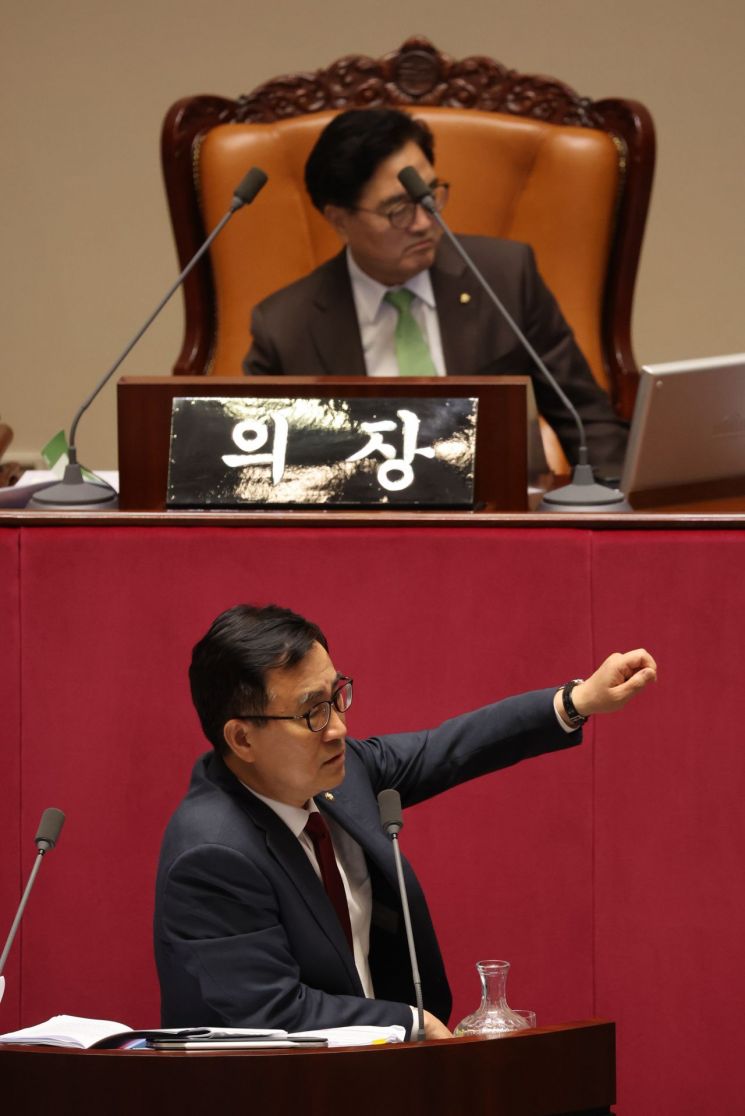
Earlier, Speaker Woo Won-shik accepted the Democratic Party's request and tabled the amendment to the Korea Communications Commission Act at the plenary session around 5:29 p.m. the previous day. Choi, the ranking member of the Science, Technology, Information and Broadcasting Committee, began the filibuster at 5:30 p.m. and spoke for a total of 6 hours and 37 minutes until 12:07 a.m. that day. Choi pointed out, "If the Democratic Party recommends two members and the People Power Party recommends one, and the president appoints two, the five members can form a majority with four or more as the Democratic Party claims in this bill. The Democratic Party, which caused this situation, has not recommended any commissioners but is acting as if the former and current vice-chairmen of the Korea Communications Commission are acting arbitrarily."
Han, who led the MBC strike in 2017 and was an MBC announcer in 2008, took the podium after Choi and spoke for 2 hours and 52 minutes, saying, "The purpose is to prevent the Korea Communications Commission's five-member system from being manipulated into a two-member system, and this could happen again in the future. Why oppose it?" He added, "The amendment to the Broadcasting Four Acts was proposed to properly maintain the five-member system." He specifically mentioned the names of journalists who were disciplined for protesting and striking against the appointment of public media presidents and government criticism during the Lee Myung-bak and Park Geun-hye administrations at KBS, MBC, YTN, and others, rebutting, "Where do they talk about media control and public broadcasting?" He also claimed that discussions on reforming the governance of public broadcasting stalled during the Moon Jae-in administration due to the People Power Party's non-cooperation.
In contrast, Park cited numerous distorted and provocative reports and fake news under the current Broadcasting Act, including coverage of mad cow disease, the Cheonan sinking, the Sewol ferry disaster, the Terminal High Altitude Area Defense (THAAD) system, and impeachment coverage, saying, "We need to talk about these first." He questioned, "Do you know how many members the media union has? Do you think the members will report according to the president's code just because the president changes? Do you think the president can interfere with news programming?" He emphasized for 2 hours and 55 minutes that "The Broadcasting Four Acts pushed by the Democratic Party are laws that permanently allow the Korean Confederation of Trade Unions' media union to completely control MBC, KBS, and EBS." He also criticized the amendment to the Korea Communications Commission Act, saying, "The quorum for decision-making is more than four-fifths, and the voting quorum is more than three-fifths of the five members. I have never seen such an abnormal quorum requirement in any government agency, National Assembly, or judiciary."
On the other hand, Mo, who spoke in favor for 1 hour and 21 minutes, emphasized, "Since the Yoon Seok-yeol administration, the value of public broadcasting as a public service has collapsed," and said, "The Broadcasting Four Acts are the first step to making public broadcasting fair." He added, "It is not important which government the Korea Communications Commission was launched under, but how neutral and public-oriented public broadcasting as a public service can be operated. However, the Korea Communications Commission abused its authority for the ruling party. It launched a fake news eradication task force and started censoring the media one by one under the pretext of verifying the fact-checking system of broadcast media."
Lee Sang-hwi, the People Power Party's special media committee chairman, argued in the debate, "The nature of public broadcasting is not partisan, not the National Assembly, not the administration, but entirely belongs to the people. It is wrong to discuss governance with the arrogance of lawmaking." He added, "If we talk about governance, the absolute evil must come first. The absolute evil is the existing legal system and structure that have been created, inherited, promoted, and introduced. It must be clearly and unequivocally proven as an illegal system. If it is not proven, it is the wrong direction."
The Democratic Party submitted a consent form to end the unlimited debate on the bill just two minutes after the filibuster began at 5:32 p.m., so the filibuster on the bill will be forcibly ended after a secret ballot vote around 5:30 p.m. on the 26th, 24 hours later, and the bill will immediately proceed to a vote. However, whenever individual bills such as the Broadcasting Act, Korea Broadcasting Culture Promotion Agency Act, and Korea Educational Broadcasting System Act are tabled, the People Power Party plans to respond with filibusters. Accordingly, it is expected to take at least four nights and five days for all four broadcasting laws to be passed. However, since the Democratic Party plans to continue the filibuster without forced termination on the 27th, when its party convention is scheduled, the plenary session schedule may extend to more than five nights and six days.
 Lee Sang-hwi, a member of the People Power Party, continued his filibuster (unlimited debate) on the partial amendment bill concerning the establishment and operation of the Korea Communications Commission at the National Assembly on the 26th. Photo by Kim Hyun-min kimhyun81@
© The Asia Business Daily(www.asiae.co.kr). All rights reserved.
!["The Woman Who Threw Herself into the Water Clutching a Stolen Dior Bag"...A Grotesque Success Story That Shakes the Korean Psyche [Slate]](https://cwcontent.asiae.co.kr/asiaresize/183/2026021902243444107_1771435474.jpg)

















