2nd Quarter GDP Growth Rate at 2.8% Driven by Increased Consumption
Core PCE Inflation Slows to 2.9%
June PCE Inflation Data to be Released on 26th
The three major indices of the U.S. New York stock market showed mixed trends in early trading on the 25th (local time). Following the sharp decline in big tech stocks the previous day, selling pressure on tech stocks continued on this day as well. The U.S. Q2 economic growth rate was stronger than expected.
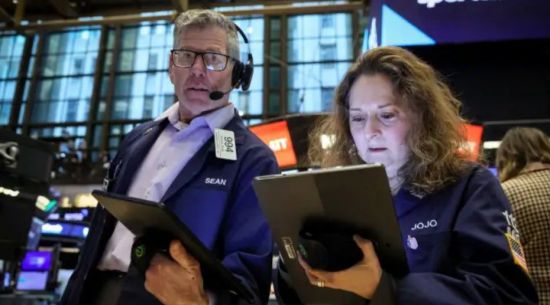
As of 10:33 a.m. at the New York Stock Exchange (NYSE), the Dow Jones Industrial Average was up 0.5% from the previous close, standing at 40,051.91. The large-cap focused S&P 500 index was down 0.13% at 5,420.18, and the tech-heavy Nasdaq index was trading 0.73% lower at 17,216.65.
By individual stocks, weakness in tech shares continued. Alphabet, Google's parent company, and Tesla, which released their Q2 earnings on the 23rd, failed to meet investors' expectations, amplifying doubts about the AI rally. Alphabet, which fell 5.03% the previous day, was down 1.3%, while Tesla, which plunged 12.33%, was up 3.32%. AI leader Nvidia was down 2.59%. Microsoft (MS) was also down 1.56%. Ford fell 17.67% due to earnings below market expectations, and Chipotle declined 2.11% despite reporting better-than-expected results.
The trend in tech stocks is expected to face another turning point depending on the earnings reports of other Magnificent 7 companies such as MS and Apple, which will be released next week.
Case Runner of Truist said, "The recent volatile market movements are as expected and will continue," adding, "The basic forecast is that the long-term bull market will remain intact." He further noted, "The pattern of often taking two steps forward and one step back will continue."
The U.S. Q2 economic growth rate announced this morning was stronger than expected. According to the U.S. Bureau of Economic Analysis (BEA), the preliminary estimate of real GDP for Q2 grew at an annualized rate of 2.8% compared to the previous quarter. This is double the Q1 growth rate of 1.4% and significantly exceeds the Wall Street Journal (WSJ) experts' forecast of 2.1%. Household spending, which accounts for two-thirds of the U.S. real economy, increased by 2.3% compared to the previous quarter, showing a strong recovery from Q1's 1.5%. Both goods and services expenditures rose.
The core Personal Consumption Expenditures (PCE) price index, excluding food and energy, rose at a slower pace from 3.7% in Q1 to 2.9% in Q2. Investors are expected to gain more detailed insights into inflation trends through the June PCE price index to be released the next day.
The Commerce Department stated, "The Q2 GDP growth rate rose thanks to increased private inventory investment and expanded consumer spending," but added, "However, the growth was partially offset by a slowdown in residential fixed investment."
Stephen Brown, an economist at Capital Economics, said, "With Q2 GDP growth at 2.8%, exceeding expectations, the Federal Reserve (Fed) will likely feel somewhat comfortable maintaining its policy at next week's Federal Open Market Committee (FOMC) meeting." However, he analyzed, "Recent easing in labor market conditions and signs of slowing inflation suggest strong grounds for a rate cut at the September FOMC meeting."
Last week, new U.S. unemployment claims came in below market expectations. According to the U.S. Department of Labor, new unemployment claims for the week of July 14-20 totaled 235,000, below both the expert forecast of 237,000 and the revised figure of 245,000 for the previous week. Continuing claims, which count those claiming unemployment benefits for at least two weeks, stood at 1,851,000 for the week of July 7-13, also below the market forecast of 1,860,000 and the revised previous week's figure of 1,860,000.
The stronger-than-expected Q2 GDP and employment data have not affected expectations for a rate cut in September. According to the Chicago Mercantile Exchange (CME) FedWatch, the federal funds futures market on this day reflected a 99.9% probability that the Fed will cut rates by at least 0.25 percentage points at the September FOMC meeting.
U.S. Treasury yields are declining. The 10-year U.S. Treasury yield, a global benchmark for bond yields, fell 4 basis points (1 bp = 0.01 percentage points) from the previous day to 4.24%. The 2-year U.S. Treasury yield, sensitive to monetary policy, remained around 4.42%, the same level as the previous day.
International oil prices are falling. West Texas Intermediate (WTI) crude oil dropped $0.39 (0.5%) from the previous trading day to $77.20 per barrel, and Brent crude, the global oil price benchmark, fell $0.55 (0.67%) to $81.16 per barrel.
© The Asia Business Daily(www.asiae.co.kr). All rights reserved.
![Clutching a Stolen Dior Bag, Saying "I Hate Being Poor but Real"... The Grotesque Con of a "Human Knockoff" [Slate]](https://cwcontent.asiae.co.kr/asiaresize/183/2026021902243444107_1771435474.jpg)
















