Wear after microwaving for 3 minutes as per product instructions
Material bursts upon wearing, releasing hot and sticky substance
A woman’s story has come to light after she suffered burns on her face and neck when a 'neck warmer' she was wearing to keep her neck warm in cold weather suddenly exploded.
On the 24th, SBS reported the story of Kim (female), an elementary school sports team coach, who was burned after wearing a neck warmer in January. At the time, Kim was heating the neck warmer in a 700W microwave for 3 minutes as per the product instructions, and the accident occurred the moment she tried to wear it around her neck. The explosion caused hot, sticky substances to spill out and stick to Kim’s face and neck, which were difficult to remove.
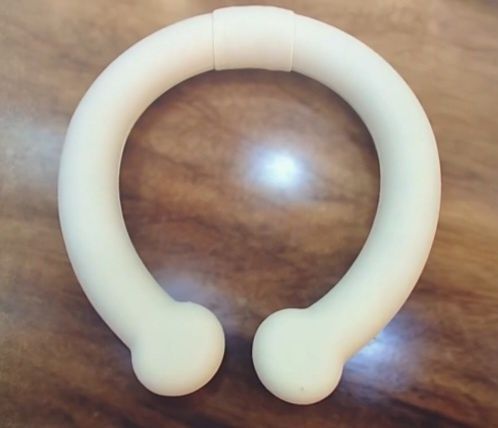 A neck warmer containing PCM inside, used after heating in a microwave oven
[Image source=Screenshot from SBS news broadcast]
Kim told SBS, "My face started to sting so badly that I couldn’t even tell where exactly it hurt," adding, "I threw off my jumper and rinsed with water, but it wouldn’t wash off. It was stuck to my skin..." She was told by doctors that she would need treatment for over a year and that the scars might never fully disappear. This was devastating news for Kim, who is about to get married.
The substance inside the product was a Phase Change Material (PCM). PCM has the property of absorbing and storing heat when it changes from solid to liquid at a specific temperature (phase change temperature). SBS reported that the company importing and selling this product from China appeared to have been aware of the risk of explosion when heating it in a microwave. However, there were no warnings about explosion risks anywhere in the product manual or promotional materials. Furthermore, the product sold domestically instructed users to heat it in a 700W microwave for up to 3 minutes, whereas similar products sold in Japan advised heating in a 500W microwave for 1 minute. Another issue is that even if the cause of the accident is identified and responsibility assigned, there are currently no safety standards established for PCM.
An official from the National Institute of Technology and Standards explained to SBS, "(PCM) is understood to have no international (safety) standards." It is also reported that government agencies find it difficult to investigate because it is a new material. Currently, Kim is preparing to file a compensation claim against the importer.
© The Asia Business Daily(www.asiae.co.kr). All rights reserved.

![Clutching a Stolen Dior Bag, Saying "I Hate Being Poor but Real"... The Grotesque Con of a "Human Knockoff" [Slate]](https://cwcontent.asiae.co.kr/asiaresize/183/2026021902243444107_1771435474.jpg)















