Statistics Korea Announces First Residential Population Estimate
The registered population in nationwide population-decreasing areas has been declining. The number of staying population within the total living population reached four times that of the registered population. In particular, the multiplier of staying population compared to registered population was notable among economically active males and those in their 30s and 40s.
On the 25th, Statistics Korea announced this after estimating the living population in 89 population-decreasing areas nationwide for the first quarter. The living population refers to people who reside or stay in a specific area. It includes the resident registration population, foreigner registration population, and those who stayed for a total of three hours or more in a city, county, or district other than their registered address for at least once a month (staying population).
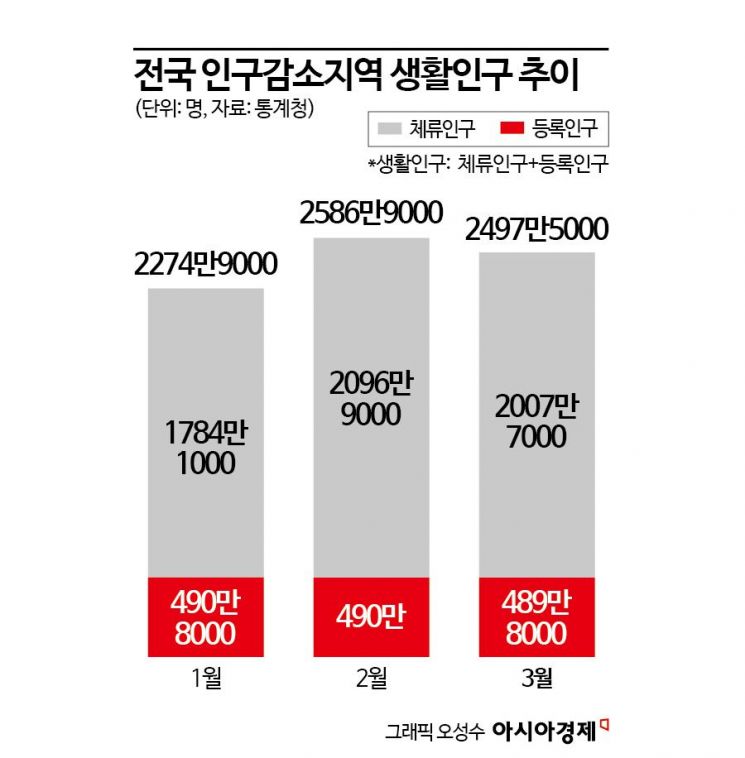
Statistics Korea combined resident registration and foreigner registration data from the Ministry of the Interior and Safety and the Ministry of Justice with mobile data from the three major telecom companies?SK Telecom, KT, and LG Uplus?using pseudonymized linkage to estimate the living population for the first time this year. They analyzed not only the size of living and staying populations by region according to the official announcement but also various demographic characteristics and activities of each population-decreasing area.
As a result, while the living population in population-decreasing areas fluctuated from January to March, the registered population continuously decreased. In all population-decreasing areas, the number of staying population exceeded the registered population. As of March, the living population was approximately 25 million, of which about 20 million were staying population and about 4.9 million were registered population. The number of staying population was 4.1 times that of the registered population.
Statistics Korea pointed out that the difference between registered and staying populations tended to widen due to population movement as spring arrived. In particular, Gurye-gun in Jeonnam, where the Sansuyu Festival was held in March, showed a large deviation with the staying population increasing up to 18.4 times the registered population compared to other regions.
Additionally, the multiplier of staying population compared to registered population was relatively large among males and those in their 30s and 40s. In the Gyeongbuk and Gangwon regions, characteristics such as the proportion of residents from other cities and provinces among the staying population and average staying time stood out compared to other areas.
To expand the effectiveness of living population analysis, Statistics Korea plans to additionally combine regional card usage data from credit card companies and workplace information from credit information companies starting from the second quarter. Lee Hyung-il, Commissioner of Statistics Korea, said, "We will devote efforts to producing useful statistics such as living population to faithfully support data-driven policies of the digital platform government."
© The Asia Business Daily(www.asiae.co.kr). All rights reserved.

















