Defensive Stocks in Gyeonggi and Dividend Stocks Show Solid Returns This Month
Volatile Market Expected to Continue Due to US Presidential Election Impact
"Risk Management Needed from Absolute Return Perspective"
Recently, increased volatility in the stock market has heightened investors' concerns. The securities industry analyzed that it is a time when defense is more effective than aggressive buying. They advised incorporating defensive stocks and dividend stocks that can maintain returns relative to the index decline into portfolios or managing risks until some of the uncertainties surrounding the stock market are resolved.
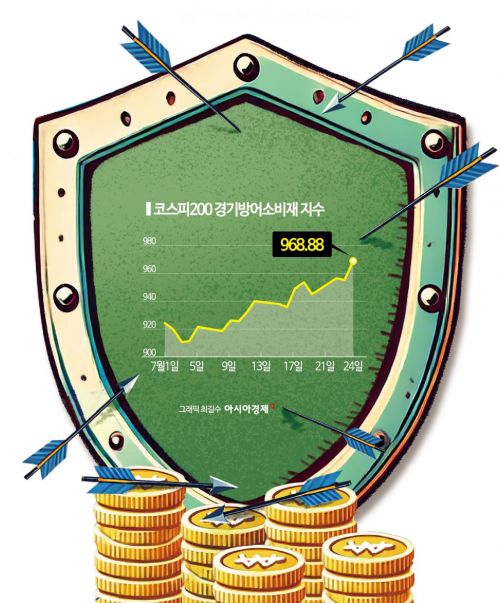
According to the Korea Exchange on the 25th, the TIGER Defensive ETF, which tracks the KOSPI200 Defensive Consumer Staples Index, rose 6.17% this month as of the closing price on the 24th. This ETF diversifies investments in stocks belonging to consumer staples, healthcare, and utility sectors such as Celltrion, Samsung Biologics, KT&G, KT, SK Telecom, Korea Electric Power Corporation, and CJ CheilJedang. It appears that some investment funds have moved to 'defensive stocks,' which are less affected by external variables and economic conditions, in preparation for uncertainties such as the U.S. presidential election and economic slowdown.
KOSPI Shaken by U.S. Big Tech Decline... "Need to Find Sectors That Fall Less Than the Index"
The Korean stock market, entering the Q2 earnings season, has recently been influenced by the sluggish U.S. stock market. The IT and communication sectors, which led the U.S. market, have declined, causing a larger drop in the semiconductor sector, which has a high market capitalization weight in the KOSPI. Kim Dae-jun, a researcher at Korea Investment & Securities, said, "Generally, the Korean market tends to experience increased volatility just before the U.S. presidential election," adding, "It is necessary to keep the KOSPI downside open. A defensive approach to the market seems necessary."
Researcher Kim forecasted that differentiated flows among sectors would continue in such a volatile market. He advised, "In a situation where benchmark volatility has increased, it is important to find options that can move differently from the market. We need to find sectors that fall less than the index." He continued, "It is necessary to check whether profitability can be maintained at a high level based on solid earnings. Sectors such as food and beverages, utilities, and telecommunications should have a return on equity (ROE) higher than the cost of equity (COE) and a low beta." Beta refers to the volatility of a specific stock relative to the overall market volatility. For example, if a stock's beta is 0.8, it will fall 8% when the market drops 10%.
Economic Strength Weakening from Employment to Consumption... "Risk Management Needed"
There is also an analysis that the recent stock market decline is due not only to uncertainties surrounding the U.S. presidential election but also to weakening macroeconomic and corporate profit outlooks. Kang Hyun-ki, a researcher at DB Financial Investment, explained, "Investors tend to think that the cause of the market decline is the news that appeared in recent days, but in fact, market changes merely reflect changes in the underlying fundamentals." He added, "The stock market moves slightly slower than fundamentals when turning downward. Since 2022, the number of job openings in the U.S. has decreased, leading to reduced employment and weakening consumption momentum. Regardless of who becomes the next U.S. president, the possibility of further deterioration in the U.S. economic fundamentals remains unchanged."
Researcher Kang recommended reducing the proportion of existing leading stocks such as AI-related stocks and increasing the proportion of dividend stocks. He said, "Leading stocks record the highest returns when the market rises, but they suffer the most damage when it falls. It is necessary to be cautious about AI industry-related stocks." He added, "On the other hand, dividend stocks tend to be relatively less volatile during increased market volatility. Selecting stocks with particularly low beta among those included in high-dividend indices is one method." Furthermore, he emphasized, "From an absolute return perspective, it is necessary to step back from the market and manage risks until uncomfortable situations are resolved."
© The Asia Business Daily(www.asiae.co.kr). All rights reserved.

















