Recycling Waste Intermediate Treatment Facility 'Incineration Zero Store'
Aiming to Raise Interest and Awareness in Separate Disposal
Mapo-gu "We Need to Find a Macroscopic Solution to Reduce Waste"
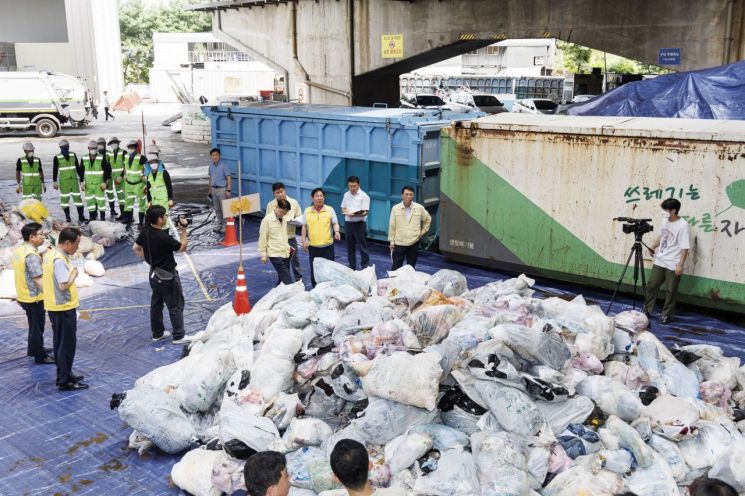 Park Gang-su, Mayor of Mapo District, visiting the cleaning vehicle garage last year for a composition inspection to reduce household waste. Provided by Mapo District.
In front of the Mapo Central Library in Seoul stands the ‘Zero Incineration (ZERO) Store’. This facility, unique to Mapo nationwide, serves as an intermediate processing center for recyclable waste commonly found in apartment complexes.
The facility for sorting and processing recyclables is housed inside a container measuring 9 meters in length and 3 meters in width, making it possible to install anywhere with available space and allowing for mobility.
Equipment is provided to sort recyclable waste such as cans, plastics, and paper, and to perform washing, crushing, pressing, and shredding. When aluminum cans or PET bottles are placed in the small press, they are flattened and slit, reducing the volume of recyclable waste by up to one-eighth. Residents who bring their recyclable waste here earn points based on weight per item, which can be redeemed for cash or points to use.
Seogang Moon (70), who works here as an environmental security officer, said, “People come to the Zero Incineration Store to dispose of recyclable waste, but they also naturally learn the importance of separating waste,” adding, “Personally, I gain a job as a senior citizen and find great fulfillment in the work I do.”
Until last month, there was only one Zero Incineration Store, but six more have been added this month. Mapo-gu plans to expand the Zero Incineration Stores to 32 locations centered around apartment complexes by the end of the year and to 50 locations by next year. Kim Hwayoung, head of the Mapo-gu Resource Circulation Team, said, “The Zero Incineration Store greatly increases interest and awareness in waste separation,” and added, “We will focus on installing Zero Incineration Stores mainly in small apartment complexes with fewer than 200 households and support and promote convenient waste separation.”
Mapo-gu is the district waging the fiercest war against waste in Seoul. While waste reduction and efficient recycling are important issues for all autonomous districts, Mapo-gu’s stance opposing the additional construction of the Sangam-dong Regional Resource Recovery Facility (waste incineration plant) is more urgent. This urgency underlies Mapo-gu’s designation of key waste reduction projects such as strengthening business waste emitter reporting, recycling coffee grounds and discarded sewing fabrics, expanding recycling of clothing, and expanding operation of Zero Incineration Stores, with a goal to reduce household waste by more than 10,000 tons this year.
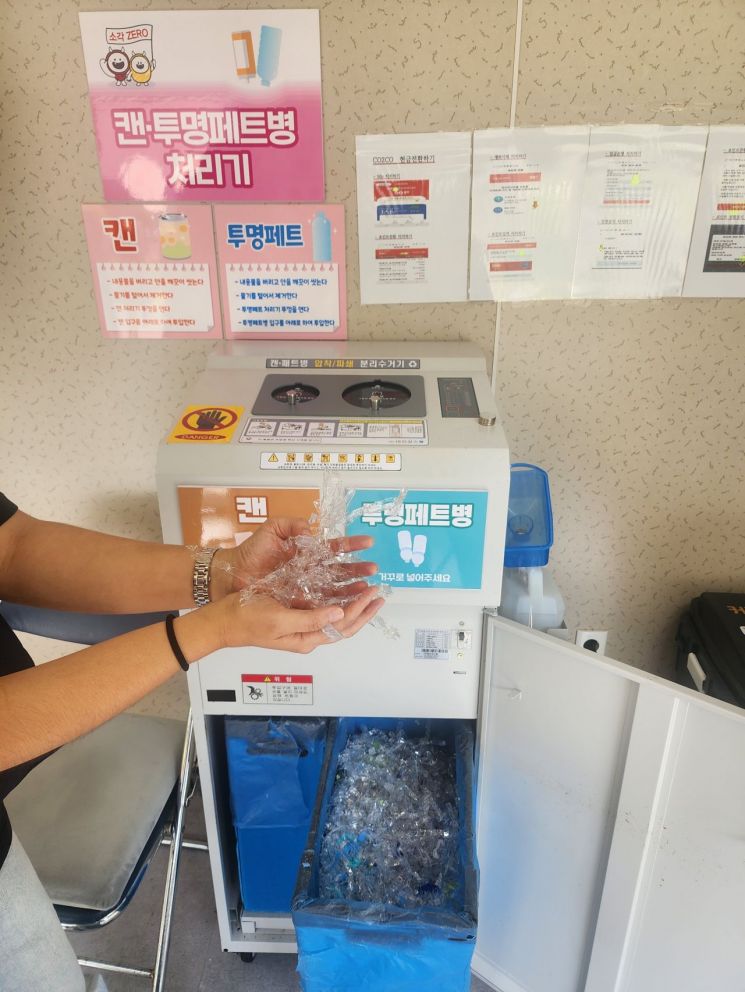 An employee from the Mapo-gu Resource Circulation Department is showing plastic waste that has passed through a PET bottle compactor installed at a zero-incineration store. Photo by Minjin Kim enter@
The district’s target to reduce household waste by 10,862 tons this year corresponds to 21.4% of last year’s waste generation, a significant amount. Park Gangsoo, mayor of Mapo-gu, asserts, “If we drastically reduce burnable waste, we won’t need to build additional incineration plants, and Mapo-gu will clearly demonstrate that alternative,” and is steadily implementing measures to achieve this.
The first Zero Incineration Store, initially installed in the Mapo-gu Office plaza and recently relocated in front of the Mapo Central Library, symbolizes this commitment. Mayor Park emphasized, “We must move away from the outdated idea of simply landfilling or incinerating waste and find a macro solution to properly manage and reduce waste.”
© The Asia Business Daily(www.asiae.co.kr). All rights reserved.


















