First Public Appearance After Early French General Election
"Forming New Government Before Olympics Causes Confusion"
Criticism of Stalling to Avoid Cohabitation Government
French President Emmanuel Macron has expressed his intention not to appoint a new prime minister until the conclusion of the 2024 Paris Olympics. He argues that forming a coalition government ahead of an international event could cause confusion. The opposition parties have launched a full-scale offensive, calling it a denial of democracy.
In an interview with France 2 on the 23rd (local time), President Macron stated that forming a new government before the Paris Olympics could "cause confusion" and that "the current government will run the country until the Olympics end." He indicated that he will not appoint a prime minister candidate recommended by the opposition until August 11, when the Paris Olympics conclude.
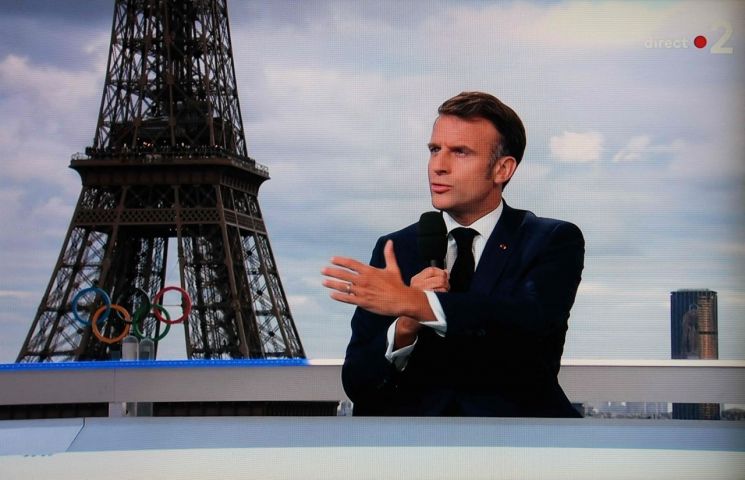
Earlier, the left-wing coalition New Popular Front (NFP), which came first in the French early general election, recommended Lucie Castet, the head of the Paris City Hall Finance Department, as the next prime minister candidate after internal disputes. President Macron responded by saying, "What matters is not the name put forward by the party, but securing a majority in the parliament to govern stably," adding, "(In this election) no one won, and no one can implement their agenda alone." Since all parties participating in the election failed to secure a majority, resulting in a parliamentary deadlock, he appealed to the centrists to support the current government through an agreement.
The NFP immediately pushed back. Jean-Luc M?lenchon, leader of La France Insoumise (LFI), the far-left faction within the NFP, criticized on X (formerly Twitter), "(Macron) the president is refusing to accept the election results and is forcing a new republic front on us." Other members of the same party, including Manuel Bompard, also condemned it as "an unacceptable denial of democracy," urging "Macron to stop his authoritarian moves and either accept the results or resign." Representatives from the Socialist Party and the Green Party also criticized it as "denial of reality" and "the worst politics that does not respect election results."
However, some assessments suggest that President Macron's actions are an unavoidable choice to maintain control over state affairs during the remaining three years of his term. The NFP has expressed dissatisfaction not only with the repeal of the pension reform pushed by Macron but also with his pro-business policies. On the same day, President Macron emphasized, "We must continue to create wealth and become the most attractive country in Europe by enhancing competitiveness through reindustrialization," adding, "Not turning back the clock is the top priority."
Meanwhile, according to the French Ministry of the Interior, in the general election held on the 7th, the NFP secured 182 out of 577 seats, President Macron's centrist coalition won 168 seats, and the far-right RN and allied forces obtained 143 seats. Under the French constitution, the president has the right to nominate the prime minister, but since the parliament holds the power to pass a vote of no confidence, it has traditionally been the practice to appoint the prime minister recommended by the party holding the majority. In a 'hung parliament' like this election, where no party has a majority, it is customary for the largest party to recommend a prime minister and for the president to approve. However, there is no fixed deadline for nominating the prime minister.
© The Asia Business Daily(www.asiae.co.kr). All rights reserved.
![User Who Sold Erroneously Deposited Bitcoins to Repay Debt and Fund Entertainment... What Did the Supreme Court Decide in 2021? [Legal Issue Check]](https://cwcontent.asiae.co.kr/asiaresize/183/2026020910431234020_1770601391.png)