The Netherlands research reactor modification project (hereinafter referred to as the OYSTER project) has been successfully completed after more than 10 years of effort. This project is significant as it marks the first time Korea has entered Europe with domestic nuclear technology.
On the 23rd, the Korea Atomic Energy Research Institute announced that it had finalized the OYSTER project last month, confirming the normal operation of the newly installed cold neutron production facility by modifying the reactor.
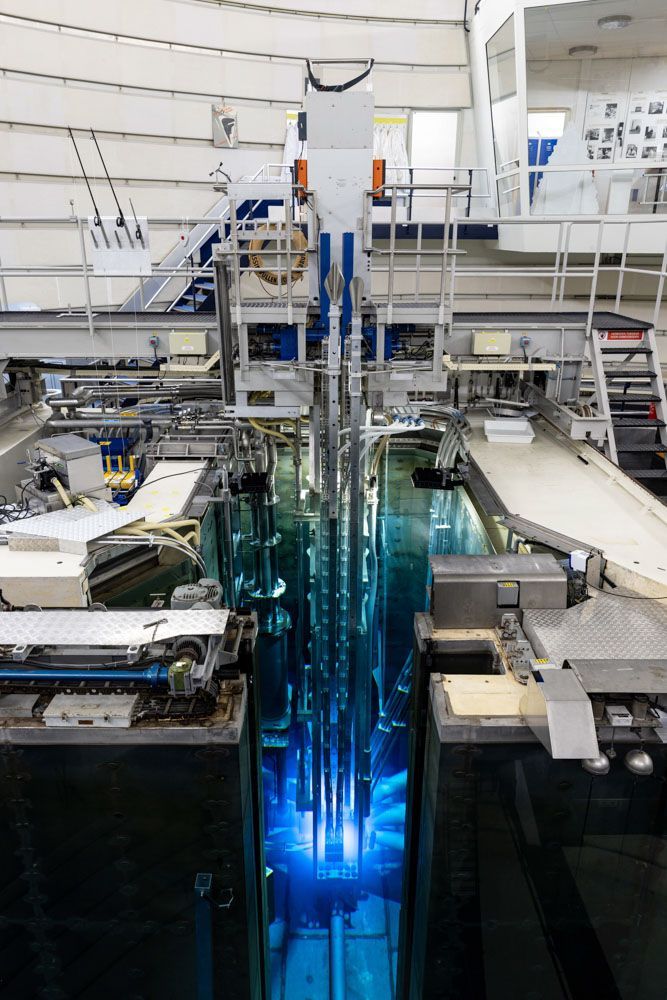 Exterior of the HOR reactor and in-pool equipment remodeled for the OYSTER project. Provided by the Korea Atomic Energy Research Institute.
The OYSTER project involves modifying the beam tube of a research reactor (2.3MW) operated by the Technical University of Delft in the Netherlands and newly constructing a cold neutron production facility.
The Korea Atomic Energy Research Institute formed a consortium in 2015 and won the project. After completing the first phase (basic design) in October of the year the project was awarded, it began the second phase in 2017, which included detailed design, equipment manufacturing, installation, and commissioning.
During the detailed design and equipment manufacturing stages of the core devices, the Korea Atomic Energy Research Institute collaborated with domestic small and medium-sized enterprises such as Mujin Giyeon Co., Ltd., a specialized nuclear power plant equipment manufacturer, to carry out the project.
Although the manufacturing period was extended due to the COVID-19 pandemic, the Korea Atomic Energy Research Institute succeeded in manufacturing the equipment in July last year. They developed the installation method using a mock-up of the in-pool equipment in cooperation with BNG (Bilfinger Noel GmbH), a German nuclear power plant equipment service company, conducted simulations, and successfully completed the installation of the main in-pool equipment and beam tube in the reactor in November last year.
Subsequently, earlier this year, they began commissioning the refrigeration system, hydrogen system, and vacuum system of the cold neutron production facility, confirmed its performance, and from May conducted cold neutron production tests, verifying that the performance of the produced cold neutrons met the contractual requirements.
Through this process, the HOR (Hoger Onderwijs Reactor) at the Technical University of Delft in the Netherlands has become one of six research reactors in Europe capable of conducting cold neutron research.
The newly established cold neutron research facility is expected to be utilized in scientific and technological research and educational programs in fields such as bio, nano, and new materials.
The Korea Atomic Energy Research Institute emphasized the significance of successfully completing the OYSTER project through cooperation among the government, government-funded research institutes, and private companies.
They explained that exporting research reactor technology to Europe for the first time with technology developed through national research and development projects and operational experience, and successfully completing equipment manufacturing in collaboration with domestic small and medium-sized enterprises, will remain a model case of public-private-academic cooperation.
Jung Young-wook, director of the Hanaro Quantum Science Research Institute, said, “The successful completion of the OYSTER project is a joint product that combines the Korea Atomic Energy Research Institute’s accumulated research reactor technology, supported continuously by the government, with the excellent manufacturing technology of domestic nuclear companies.”
© The Asia Business Daily(www.asiae.co.kr). All rights reserved.

















