Regional Private Universities' Financial Support Up 139.5% Year-on-Year
Tuition Increase Rate at Metropolitan National Universities Around 15%
Tuition Hikes Exceed Legal Ceiling
Yejeongcheo "Difficult to Maintain Financial Support Policy"
As university tuition fees have been frozen for 16 years, it has been analyzed that if university finances continue to be compensated by government support, the annual expenditure will range from at least several hundred billion won to over 1 trillion won.
According to the 'Education Committee Settlement Analysis Report' by the National Assembly Budget Office on the 23rd, the office analyzed that "if the 3% tuition increase is compensated by the budget (based on 2022 tuition revenue), 323 billion won will be required; for a 5% increase, 538.3 billion won; for a 7% increase, 753.6 billion won; and for a 10% increase, 1.0765 trillion won may be needed."
This is due to the government expanding financial support to universities to compensate for their deteriorating revenues caused by declining school-age populations and the risk of regional extinction. Last year, the government established a special account for higher and lifelong education support worth 9.7 trillion won to support universities. The Higher Education Special Account takes a portion of the education tax previously used by education offices for kindergarten, elementary, and secondary education and reallocates it to universities.
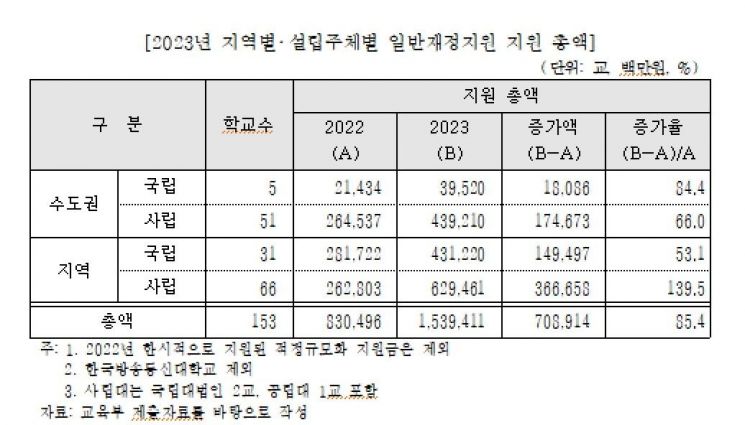
Looking at the distribution status of general financial support to universities last year, the funding allocated to universities has increased. Five national universities in the metropolitan area received 39.52 billion won, an 84.4% increase from the previous year; 51 private universities in the metropolitan area received 439.21 billion won, a 66.0% increase. Thirty-one regional national universities received 431.22 billion won, a 53.1% increase, and 66 regional private universities received 629.461 billion won, a 139.5% increase. The support rate was highest for regional private universities, while the support amount was highest for regional national universities.
This level of support exceeds the possible range for tuition increases. Last year, the legal cap on tuition increases (1.5 times the average consumer price inflation rate over the previous three years) was about 4.05%. Since 2012, the government has only provided the 'National Scholarship Type II (scholarships given by universities based on their own criteria)' to universities that froze or lowered tuition, so universities can only raise tuition within the cap to receive support funds. This year, the cap increased to 5.64%, about 1% higher than the previous year.
However, when the Budget Office compared 2022 university tuition revenue and the increase in general financial support, metropolitan national universities received 15.9%, metropolitan private universities 3.1%, regional national universities 11.9%, and regional private universities 9.6%. Except for metropolitan private universities, all received support exceeding the legal cap.
Universities have long demanded the government ease tuition increase regulations. In fact, some universities have started raising tuition even at the cost of foregoing government subsidies. According to the Korea Council for University Education's analysis of university information disclosure in April, 26 out of 193 four-year universities raised tuition this year. Last year, 17 four-year universities increased tuition.
At the Korea Council for University Education's summer university presidents' seminar last month, presidents expressed opinions such as "The Higher Education Special Account is a three-year temporary measure, and two years have already passed; is there any follow-up?" and "Tuition increases are necessary for university innovation." In response, the Ministry of Education stated, "We will do our best to expand higher education finances without directly increasing the financial burden on students and parents."
Regarding the analysis results, the Budget Office pointed out, "It seems difficult to maintain the policy of supporting university finances through government financial support projects instead of tuition increases," and emphasized, "There is a need to establish sustainable university policies, including tuition normalization."
© The Asia Business Daily(www.asiae.co.kr). All rights reserved.

![Clutching a Stolen Dior Bag, Saying "I Hate Being Poor but Real"... The Grotesque Con of a "Human Knockoff" [Slate]](https://cwcontent.asiae.co.kr/asiaresize/183/2026021902243444107_1771435474.jpg)















