Concerns Over Increasing Strikes and Labor-Management Conflicts
Decline in Global Competitiveness...Possibility of Domestic Corporate Exodus
Economic Organizations Unite in Calling for Immediate Withdrawal
As the so-called 'Yellow Envelope Act,' referring to the amendment to the Labor Union and Labor Relations Adjustment Act, passed the National Assembly's Environment and Labor Committee, economic organizations immediately expressed strong concerns. They warned that an increase in strikes and the transformation of businesspeople into potential criminals would not only stifle management activities but, in the worst case, could lead companies to relocate overseas. They urged the suspension of the legislative push for the amendment even now.
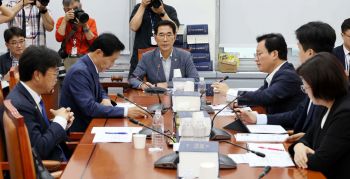 Kim Ju-young, Chair of the Employment and Labor Law Review Subcommittee of the National Assembly Environment and Labor Committee, is discussing the matter with lawmakers, including Kim Hyung-dong, the ruling party's floor leader, who protested against the media blackout during the Environment and Labor Committee's agenda coordination meeting held at the National Assembly on the 18th. Photo by Kim Hyun-min kimhyun81@
The Korea Employers Federation (KEF) issued a statement on the 22nd immediately after the Environment and Labor Committee's resolution, saying, "The National Assembly should stop the amendment discussions even now." The Yellow Envelope Act had passed the full committee meeting of the Environment and Labor Committee, led by opposition lawmakers including the Democratic Party of Korea.
KEF stated, "Since the 21st National Assembly, the business community has appealed that the passage of the amendment would lead labor-management relations to an irreparable breakdown, but the opposition party has thoroughly ignored the business community's opinions," adding, "As soon as the 22nd National Assembly convened, it forcibly passed a more severe regressive amendment than the one vetoed by President Yoon Suk-yeol in the 21st National Assembly, endangering the national economy."
The law had also passed the plenary session led by the opposition in the 21st National Assembly but was discarded after President Yoon Suk-yeol exercised his veto power and the National Assembly went through a re-deliberation process. The amendment includes strengthening the primary contractor's responsibility for subcontracted workers, expanding the scope of labor disputes, and limiting companies' claims for damages against striking workers. Economic organizations pointed out that the amendment's content is more stringent than the bill discarded in the 21st National Assembly.
KEF criticized, "The amendment virtually blocks claims for damages, encouraging extreme illegal labor disputes," and added, "By expanding the concept of employers in an abstract manner, it turns our businesspeople into potential criminals and significantly restricts management activities." They further emphasized, "We must reconsider the confusion the bill will bring to industrial sites and the problems within the legal system once again," stressing, "Only then can we at least prevent the collapse of companies and the economy."
Lee Sang-ho, Head of the Economic and Industrial Division at the Korea Economic Association, said, "The amendment expands the concept of employers, allowing subcontracted unions to engage in labor disputes against primary contractors, which poses a great risk of collapsing the industrial ecosystem," adding, "As the scope of labor disputes expands, conflicts and confrontations between labor and management will intensify, leading to more frequent strikes." He also requested, "We hope the legislative push for the union law amendment, which dampens corporate motivation, will be halted."
Kang Seok-gu, Head of the Research Division at the Korea Chamber of Commerce and Industry, said, "The business community has emphasized that the Yellow Envelope Act is a bill difficult to find a precedent for worldwide and is highly likely to make our economic environment even more barren," expressing concern, "If the union law passes the National Assembly as it is, it is clear that our global competitiveness will regress." He added, "We strongly urge the National Assembly to reconsider the adverse effects the union law will have, even now."
The Korea International Trade Association also expressed concern, saying, "The amendment will further provoke illegal strikes by unions and conflicts at workplaces," and warned, "The increased legal risks for companies will not only lead to management contraction but also increase the possibility of domestic companies fleeing abroad."
© The Asia Business Daily(www.asiae.co.kr). All rights reserved.

















