Alibaba.com to Launch Export-Only Platform 'Pavilion' Next Month for Korean SMEs
Annual Fee $199...Exposure on Alibaba Global Platform
"The Pavilion is a milestone project by Alibaba.com aimed at lowering trade entry barriers for Korean small and medium-sized enterprises (SMEs) and accelerating their global sales. We hope that 'Made in Korea' will spread worldwide."
Andrew Jung, Vice President of Alibaba.com, said this on the morning of the 22nd at a press briefing held at The Plaza Hotel in Jung-gu, Seoul, titled 'Support for Accelerating Global Sales of Korean SMEs.' The purpose is to support the global expansion and development of domestic SMEs through a dedicated B2B (business-to-business) service exclusively for Korean SMEs.
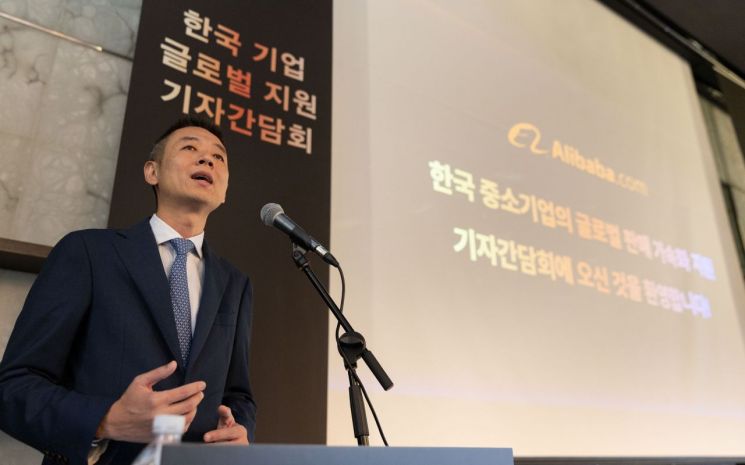 Andrew Jung, Vice President of Alibaba.com, is giving a presentation at the "Press Conference on Supporting the Acceleration of Global Sales for Korean SMEs" held on the morning of the 22nd at The Plaza Hotel in Jung-gu, Seoul. [Photo by Alibaba.com]
Alibaba Launches Korea-Exclusive Platform 'Pavilion'... Annual Fee 300,000 KRW
Chinese e-commerce company Alibaba.com is launching a B2B platform for overseas sales of domestic SME products. The Korean Wave, which started with K-pop, has extended to 'K-beauty' and 'K-food,' and Alibaba aims to distribute Korean products worldwide. Since Korean products have already been recognized globally for their technology and brand awareness, this is seen as a strategy to expand Alibaba Group's global presence, which has supplied low-priced Chinese products.
At the briefing, Alibaba.com announced that it will officially launch the dedicated B2B website for domestic companies, 'South Korea Pavilion,' on the 8th of next month. This site, exclusively for Korean companies, supports B2B transactions using Alibaba.com's e-commerce platform. Through this platform, domestic companies will be able to sell their products to buyers in over 190 countries worldwide.
The South Korea Pavilion acts as an intermediary between B2B buyers using Alibaba.com's e-commerce platform and domestic companies. Unlike Alibaba.com's general B2B platform, the key difference is that it gathers only Korean companies' products in one place. When domestic companies registered in the South Korea Pavilion list their products, these are exposed to buyers using Alibaba.com's e-commerce platform. Since it is a B2B transaction, large-scale transactions with minimum purchase quantities per product are the focus.
The South Korea Pavilion does not charge sales commissions. Payment for goods is made offline directly between sellers and buyers, not through Alibaba.com's online payment system. Instead, an annual membership fee of $199 (approximately 276,000 KRW) is charged to participating companies. By paying the annual fee on a yearly basis, companies can register unlimited products on the South Korea Pavilion and receive AI-powered sales assistance features and marketing tools. However, an Alibaba.com official added, "If the B2B model matures and online transactions occur, online brokerage fees may be charged separately."
"Over 5,000 Korean SMEs to Expand Overseas"
Alibaba.com is building a dedicated B2B platform for the first time in Asia in the Korean market. The goal is to help more than 5,000 domestic SMEs enter the global B2B market through this platform. Earlier in March, Alibaba.com introduced services to support domestic companies' exports, such as the 'AI Smart Assistant' and the 'Industry Leader Project.' Andrew Jung, Vice President of Alibaba.com, stated, "Various e-commerce platforms of Alibaba Group, including Alibaba.com, will leverage their unique business strengths to help the development of Korean SMEs and brands."
According to Alibaba Group, over the past four years, a total of 7,600 Korean brands have entered the Chinese market through e-commerce platforms such as Taobao and Tmall. Each year, nearly 100 million Chinese consumers purchase Korean products on these platforms. In addition to China, Korean products are exported through the Southeast Asia-specialized e-commerce platform Lazada. From 2020 to last year, the scale of Korean products exported through platforms such as Taobao, Tmall, and Lazada reached 34.3 trillion KRW.
In the B2B business sector, over the past four years, more than 2,550 domestic SMEs have entered the global market through Alibaba.com, recording exports worth approximately 130 billion KRW. Particularly, K-beauty products have shown high interest in countries such as Brazil, Germany, and India, according to Alibaba.com.
The Global Power of Made in Korea
In fact, Korean products are selling rapidly not only in China but also worldwide. Domestic SME cosmetic brands such as Chosun Beauty dominate the Amazon beauty category. Instant noodles and frozen gimbap, including Samyang Foods' Buldak Bokkeum Myun, have caused sell-out phenomena in the U.S. market. Silicon Two, which distributes domestic indie cosmetic brands overseas, recorded sales of 342.9 billion KRW last year and is expected to grow more than double (108%) this year, showing rapid growth. For this reason, Olive Young has also launched overseas direct purchase services for domestic cosmetic brands through its global mall.
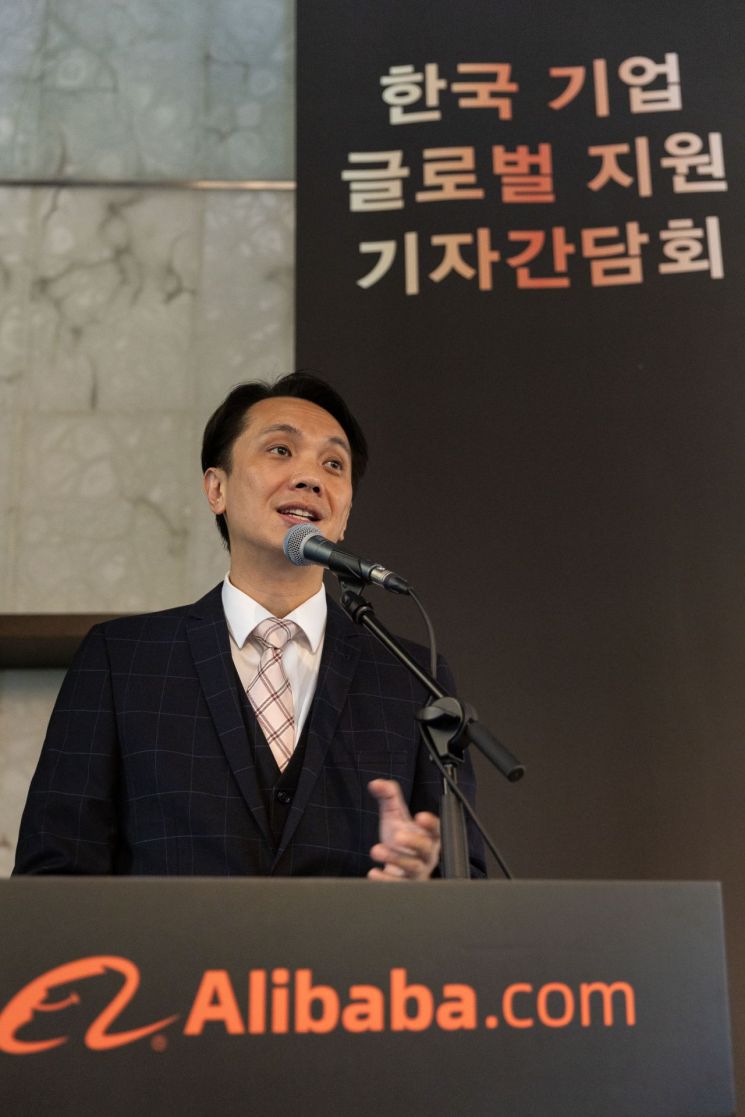 Marco Yang, Head of Alibaba.com Korea, is giving a presentation at the "Press Briefing on Supporting the Acceleration of Global Sales for Korean SMEs" held on the morning of the 22nd at The Plaza Hotel in Jung-gu, Seoul. [Photo by Alibaba.com]
Marco Yang, Head of Alibaba.com Korea, said, "Korean products are evaluated as attractive to global consumers and global B2B buyers, but it is a challenging task for relatively resource-limited SMEs to enter the global market. Alibaba.com will officially open a dedicated B2B website for Korean sellers and support Korean SMEs to enter the global market more easily."
Another method to help domestic SMEs expand overseas includes support for logistics and payment systems. Vice President Andrew Jung explained, "As mentioned earlier, we will provide services, tools, and support measures to help Korean SMEs enter overseas markets. Logistics and payment methods are among the areas where we want to provide solutions, and if new solutions are launched, we will share the details."
Some functions of the Pavilion website provide a 'Korean-English simultaneous translation API' developed with the participation of PlayAuto, a domestic company under Connect Wave Group. The goal is to reduce the language burden for domestic SMEs. Lee Hyun-chul, Head of PlayAuto Business at Connect Wave, said, "We hope this collaboration with Alibaba.com will help expand sales channels for domestic sellers in the global B2B market and strengthen their competitiveness. We will do our best to provide stable service support."
Meanwhile, Alibaba Group is also implementing a commission exemption policy for domestic companies through the Chinese e-commerce (C-commerce) platform AliExpress. Sellers registered in 'K-Venue,' which has been operating since October last year, do not pay listing or sales commissions. Additionally, policies such as subsidies for sellers and consumers are also being implemented.
© The Asia Business Daily(www.asiae.co.kr). All rights reserved.


















