Hankyung Association's 'Improvement Plan for Power Supply and Demand in National Advanced Strategic Industry Specialized Complexes'
Power Dependence of Advanced Industries like Semiconductors and Displays About 8 Times That of Traditional Industries
"Legislation of Special Power Grid Act, Including Nuclear Power in 'Carbon-Free Energy' Sources"
In 2042, it is analyzed that the power demand of seven national advanced strategic industry specialized complexes, including semiconductors, secondary batteries, and displays, will reach 20% of the national average usage. There have been calls for urgent measures such as promptly enacting the Special Act on National Power Grid and including nuclear power generation as a carbon-free energy procurement source.
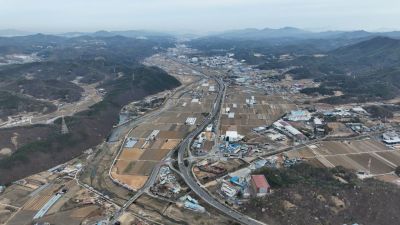 A panoramic view of Idong-eup and Namsa-eup in Cheoin-gu, Yongin-si, where the national advanced industrial complex for the system (non-memory) semiconductor cluster will be established.
 [Photo by Yongin-si]
On the 22nd, the Korea Economic Association (KEA) released a report titled "Improvement Plan for Power Supply and Demand Difficulties in National Advanced Strategic Industry Specialized Complexes." KEA estimated that the daily new power demand required for the specialized complexes to be established in seven locations nationwide?Yongin and Pyeongtaek in Gyeonggi, Gumi in Gyeongbuk (all semiconductor), Cheongju in Chungbuk (secondary battery), and Cheonan and Asan in Chungnam (display)?would exceed 15GW (gigawatts). This is about 20% of the national maximum daily average power of 72.5GW as of last year. The maximum power refers to the moment of highest power demand during the year.
KEA explained that the power dependency of advanced industries such as semiconductors is up to eight times higher than that of traditional industries like mining, non-ferrous metals, petrochemicals, and steel. Analyzing power dependency by industry over nine years from 2011 to 2019, the order was display (85%), semiconductor (83%), mining (62%), non-ferrous metals (44%), cement and ceramics (35%), petrochemicals (14%), and steel (11%).
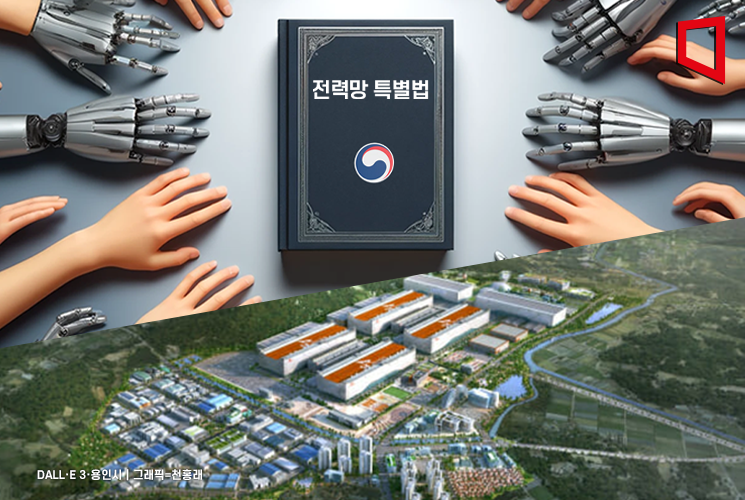
The speed of constructing the necessary transmission and substation networks to handle the power demand is slow. The slower the construction of transmission and substation networks, the greater the possibility of disruptions to corporate investments. According to last year's national audit data, the on-time completion rate of transmission and substation construction projects over the past five years was only 17%. The project duration was delayed by an average of 3 years and 5 months, with a maximum delay of 7 years and 6 months compared to plans. Complaints from residents near transmission and substation facilities and delays by developers hindered progress. For example, the transmission and substation network construction project for the Incheon Songdo Bio Cluster, which was scheduled for completion last year, was postponed by three years to 2026.
KEA proposed alternatives such as legislating the Special Act on Power Grid, including nuclear power in carbon-free energy sources, and mitigating price volatility in small modular reactor (SMR) power sales. They emphasized the urgency of promptly legislating the Special Act on Power Grid, which was discarded in the 21st National Assembly, to simplify the construction process and licensing procedures for power grid development.
They argued that nuclear power generation should be included in the scope of procurable carbon-free energy in line with the government-led "Carbon-Free Energy (CFE) Initiative." The Ministry of Trade, Industry and Energy has announced that nuclear power will be included in CFE. However, nuclear power is excluded from the global campaign "RE100," which encourages 100% power procurement from renewable energy sources such as solar and wind power.
KEA also pointed out the urgent need for government support for companies' carbon-free energy procurement costs. According to the specialized complex power supply plan announced by the Ministry of Trade, Industry and Energy in February, carbon-free energy will be supplied to the specialized complexes after 2037. However, domestic companies are currently required to procure large amounts of carbon-free energy immediately due to greenhouse gas reduction demands from global big tech (large information technology companies) prime contractors. The problem lies in the "renewable energy surcharge," which accounts for about 80%.
Under the system, only the amount of power corresponding to the purchase scale of Renewable Energy Certificates (REC) can be recognized as renewable energy (carbon-free energy). Last year, the average REC price was 83.1 KRW per 1 kWh. From 2013 to 2022, the average industrial electricity sales price was 107 KRW per 1 kWh. Companies had to pay an additional REC cost equivalent to 77.7% of the industrial electricity sales price per 1 kWh.
KEA also urged mitigating power sales price volatility to increase the utilization of SMRs. SMRs are small nuclear reactors with outputs of 300 MW (megawatts) or less. Although their output is lower than that of large nuclear reactors (1400 MW), they have the advantage of shorter manufacturing periods and reduced dependence on long-distance transmission lines. KEA suggested introducing a "Contract for Difference (CfD)" system that fixes power sales prices during the contract period. In this regard, the European Union (EU) announced a power market reform plan in May that includes CfD as part of its nuclear investment promotion measures.
© The Asia Business Daily(www.asiae.co.kr). All rights reserved.


















