Passed Away on the 21st While Battling Stomach Cancer
Singer Kim Min-gi, who operated the symbol of Daehangno's small theater 'Hakjeon' for over 30 years and nurtured junior artists, passed away on the 21st at the age of 73.
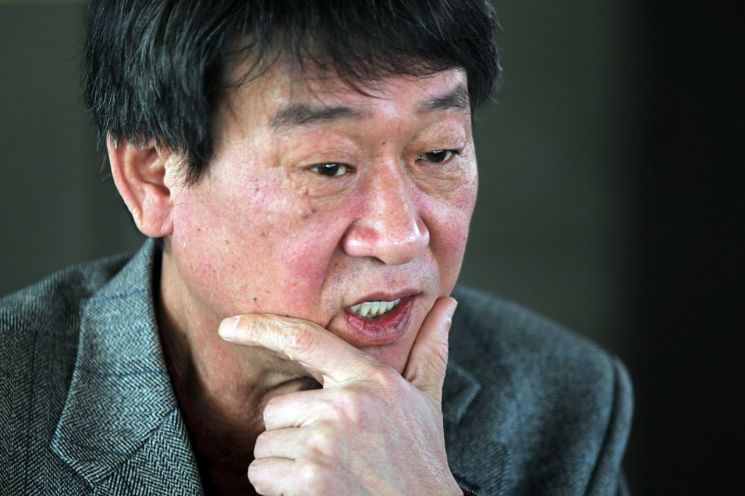 Singer Kim Min-gi, who operated the symbol of Daehangno's small theater 'Hakjeon' for over 30 years and nurtured junior artists, passed away on the 21st due to an illness. He was 73 years old.
 On February 21, 2011, to mark the 20th anniversary of the founding of the theater company 'Hakjeon,' the late held a press conference in Dongsung-dong, Jongno-gu, Seoul, in Daehangno. [Image source=Yonhap News]
According to the performing arts community on the 22nd, Kim Min-gi passed away the day before due to worsening symptoms of stomach cancer, a chronic illness.
He was known as the 'godfather of folk music,' symbolizing youth culture in the 1970s and 1980s with songs like 'Achim Isul' and 'Sangnok-su.'
Born in 1951 in Iksan, Jeonbuk, as the youngest of ten siblings, he moved to Seoul and graduated from Jaedong Elementary School and Gyeonggi Middle and High Schools. During his time at Gyeonggi Middle and High Schools, he was active in the art club, and in 1969, he entered the Department of Painting at Seoul National University College of Fine Arts. However, as he did not quite fit in with the school curriculum, he focused more on music than painting.
In 1970, he formed the folk duo Dobidoo with his friend Kim Young-se and began his music career. On August 28, 1970, he released his representative song 'Achim Isul.' This song was included in Yang Hee-eun's first album and was widely circulated among the public in its early days. In 1971, it received the 'Healthy Song Seoul City Cultural Award,' but in 1972, it was suddenly designated as a banned song. At that time, following Kim's performance of 'Haebangga' at an event at Seoul National University's College of Liberal Arts, all copies of the album were confiscated, broadcasting was banned, and he himself was immediately detained.
Despite government oppression making his songs targets of control, even now, for those who spent their youth in the 1970s, songs like 'Chingu,' 'Areumdaun Saram,' 'Bonguri,' and 'Gaeul Pyeonji' remain deeply engraved memories of passionate times.
In particular, the song play 'Gongjang-ui Bulbit' (Factory Lights), released in 1978, is regarded as a 'song drama' dealing with the lives of workers and is evaluated as a documentary on the labor realities of the time. However, Kim himself never actually fought; he humbly denied being a fighter and repeatedly waved his hands to refuse the label.
He also did not like the public frequently listening to his songs. He often said, "I want to live in an era where my songs are not needed."
Moreover, he was reluctant to leave his voice on records. However, in 1993, he released the 'Complete Works of Kim Min-gi,' a collection of four albums compiling his previously released songs. The advance payment from this album contract was used to open Hakjeon in 1991. It is said that he struggled greatly during the album production.
Hakjeon, which opened in this way, established itself not only as a venue for the performing arts but also as a gateway to the cultural world. In recognition of his contributions to the cultural and artistic community, he received the '30th Ho-Am Prize in the Arts' awarded by the Ho-Am Foundation in 2020.
However, due to accumulated financial difficulties over a long period, Hakjeon closed on its 33rd anniversary, March 15, after the 'Hakjeon, Again Concert.'
The funeral hall is set up at Seoul National University Hospital Funeral Hall (Rooms 2 and 3) in Daehangno, Seoul. Condolences can be paid from 12:30 PM on the 22nd. According to the bereaved family, in accordance with the deceased's wishes, monetary condolences and floral tributes are respectfully declined. The funeral procession will be held at 8 AM on the 24th, and the burial site is Cheonan Park Cemetery.
© The Asia Business Daily(www.asiae.co.kr). All rights reserved.

















