China's central bank defied expectations of maintaining rates and cut the loan prime rate (LPR), the de facto benchmark interest rate, for the first time in five months. This move is interpreted as a more proactive liquidity supply effort amid weakening economic growth momentum due to sluggish domestic demand.
On the 22nd, the People's Bank of China announced it would lower the 5-year LPR to 3.85% and the 1-year LPR, which serves as the general loan benchmark, to 3.35%, each by 0.1 percentage points (p). The 5-year LPR had been held steady for four months from March to last month, while the 1-year LPR had been frozen for ten months from September last year to last month.
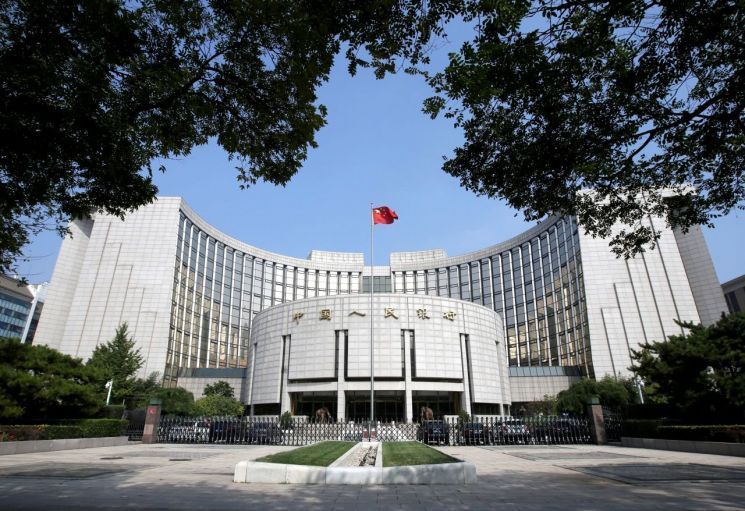
The LPR is calculated by aggregating the loan rates offered to the best customers by 18 designated banks. Since local financial institutions base their lending rates on this, it effectively functions as the benchmark interest rate in China. The 1-year rate affects general loans, while the 5-year rate influences mortgage loans.
The market had expected the People's Bank of China to keep the LPR unchanged this month as well. The central bank reinforced this expectation by holding the Medium-term Lending Facility (MLF) rate steady at 2.50% for the 1-year term on the 15th.
The unexpected rate cut is seen as a decision prioritizing liquidity supply in light of the recent sluggish economic trends. According to the National Bureau of Statistics, China's gross domestic product (GDP) grew by only 4.7% year-on-year in the second quarter, falling short of both expert forecasts (5.1%) and the previous month's figure (5.3%). The underperformance of domestic demand, which had been a pillar of the Chinese economy, had a significant impact. In June, China's retail sales increased by 2.0% year-on-year, missing both the forecast (3.3%) and the previous month's growth (3.7%). The 2.0% retail sales growth rate was the weakest since December 2022 (-1.8%).
© The Asia Business Daily(www.asiae.co.kr). All rights reserved.
![A Woman with 50 Million Won Debt Clutches a Stolen Dior Bag and Jumps... A Monster Is Born [Slate]](https://cwcontent.asiae.co.kr/asiaresize/183/2026021902243444107_1771435474.jpg)
















