Battery Companies Halt Consecutive Production Investments
Prolonged Decline in Electric Vehicle Sales
Benefits Disappear if Trump Wins Re-election
'Is the Electric Vehicle Chasm a Grey Rhino?'
Warning signals are sounding in the domestic battery industry, which is about to announce its first-half performance, suggesting it may fall into a long-term slump. Battery companies have encountered a Grey Rhino, meaning that signs of danger have continuously appeared and could have been sufficiently anticipated in advance, yet the impact was overlooked and no response was made.
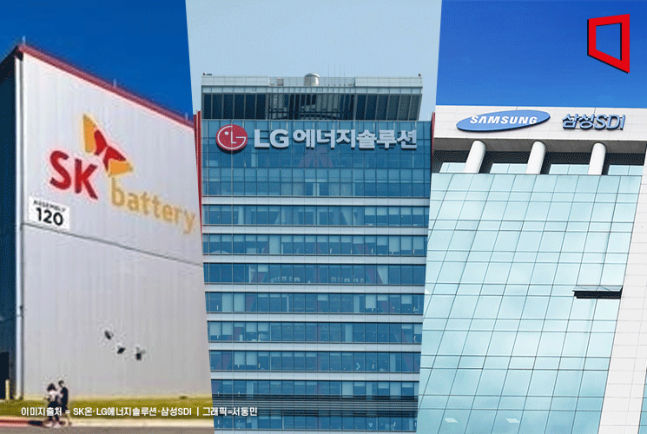
According to the industry on the 22nd, the construction of the third electric vehicle battery plant in the U.S., jointly built by LG Energy Solution and global automaker General Motors (GM) under the joint venture Ultium Cells, has been temporarily halted. This EV battery production base, with a total investment of $2.6 billion (approximately 3.6 trillion KRW), was scheduled to be completed in the second half of this year. The plan was to start the first phase of mass production early next year and expand the annual production capacity to 50 GWh (gigawatt-hours).
Earlier, GM reduced its electric vehicle production volume for this year due to concerns about the EV chasm, cutting it from the original plan (400,000 units announced in 2022) by more than 100,000 units to a level of 200,000 to 300,000 units in February, and then further reducing it by 50,000 units last month to a level of 200,000 to 250,000 units.
As EV sales decline, investment plans are inevitably being revised. Ford, which is building a joint battery plant in the U.S. with SK On, also announced that it would reorganize its Canadian plant, which was supposed to produce electric SUVs, into a production base for internal combustion engine pickup trucks.
Eugene Investment & Securities has further lowered its forecast for U.S. electric vehicle sales from this year through 2030 by an additional 9-12% compared to previous estimates. In particular, it expects that if former U.S. President Donald Trump is re-elected, EV sales will decline further during his term. Eugene Investment & Securities noted, "During Trump's first term, the effective repeal of fuel efficiency regulations caused two years of negative growth," adding, "Trump repeatedly pledged that if elected, he would repeal Biden's fuel efficiency regulations in his first year."
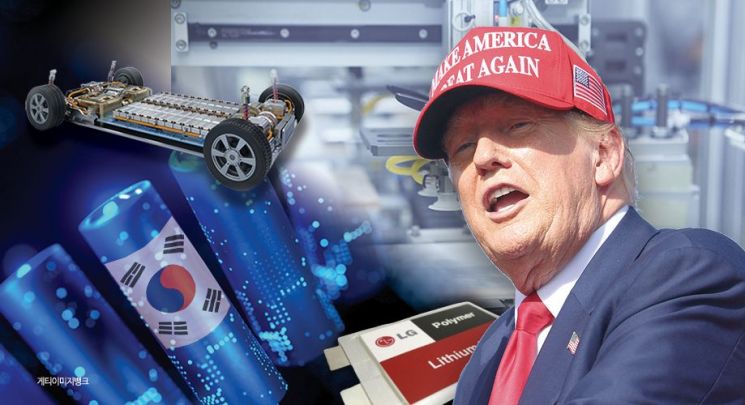
Candidate Trump maintains a stance opposing the transition to electric vehicles. The domestic battery industry has expanded its North American operations through policies such as the Inflation Reduction Act (IRA) Advanced Manufacturing Production Tax Credit (AMPC), but concerns are growing that these policy benefits may disappear.
Battery companies are adjusting the pace of investments and shifting production systems to energy storage system (ESS) batteries, but this is insufficient to replace the EV market. There are criticisms that the burden from large-scale investments made over the past few years will come back like a boomerang.
LG Energy Solution also temporarily halted construction just two months after starting to build an ESS lithium iron phosphate (LFP) battery production plant alone in Arizona, USA, last month. At the end of last year, it also converted part of the production line at its Nanjing plant in China exclusively for ESS.
Concerns are also emerging that the recent performance slump could be prolonged. According to FnGuide, Samsung SDI's operating profit for the second quarter is expected to be around 320 billion KRW, down 28% from 450 billion KRW in the same period last year. SK On, which has recorded losses for 10 consecutive quarters, is also expected to face losses in the thousands of billions of KRW. LG Energy Solution's consolidated operating profit for the second quarter was 195.3 billion KRW, a 57.6% decrease compared to the same period last year.
© The Asia Business Daily(www.asiae.co.kr). All rights reserved.
![Clutching a Stolen Dior Bag, Saying "I Hate Being Poor but Real"... The Grotesque Con of a "Human Knockoff" [Slate]](https://cwcontent.asiae.co.kr/asiaresize/183/2026021902243444107_1771435474.jpg)

















