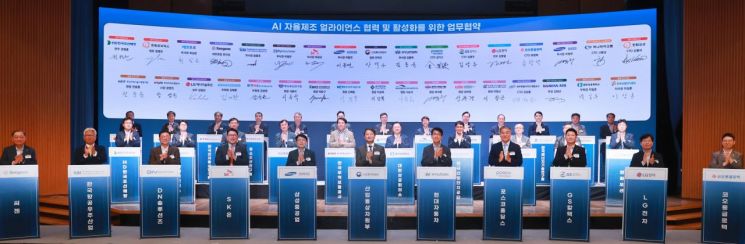
 The Ministry of Trade, Industry and Energy announced on the morning of the 22nd that it held the 'AI Autonomous Manufacturing Alliance Launch Ceremony' at the International Conference Hall of the Korea Chamber of Commerce and Industry in Jung-gu, Seoul. Participants are signing and taking commemorative photos at the AI Autonomous Manufacturing MOU signing ceremony held that day. Photo by the Ministry of Trade, Industry and Energy
A total of 153 leading domestic companies and institutions are participating in the 'AI Autonomous Manufacturing Alliance,' launched with the aim of integrating artificial intelligence (AI) into manufacturing. Twenty projects will be promoted this year alone, with a combined public-private investment of 2.5 trillion KRW expected. The government has committed to providing 10 trillion KRW in policy financing over five years.
On the morning of the 22nd, the Ministry of Trade, Industry and Energy announced that it held the 'AI Autonomous Manufacturing Alliance Launch Ceremony' at the Korea Chamber of Commerce and Industry in Seoul, attended by Minister Ahn Deok-geun and about 250 representatives from industry, academia, and research sectors.
The 'AI Autonomous Manufacturing Alliance' was established with the purpose of introducing AI into manufacturing to enhance productivity and safety, while also achieving carbon neutrality. The alliance includes 153 companies and institutions across 12 industries. The Ministry of Trade, Industry and Energy stated, "The combined sales of participating companies account for nearly 40% of the entire manufacturing sector."
The alliance is organized into 12 divisions by industry. Each division includes anchor companies representing the industry along with small and medium-sized enterprises that form the core supply chain. Large enterprises account for 21%, medium-sized enterprises 23%, and small enterprises 56%. Specialized research institutions serve as secretariats for each division to support activities.
For example, in the automotive division, Hyundai Motor Company and Kia serve as anchor companies, with the Korea Automotive Technology Institute acting as the secretariat. In the electronics division, LG Electronics is the anchor company; in the shipbuilding division, HD Korea Shipbuilding & Offshore Engineering, Samsung Heavy Industries, Hanwha Ocean, HD Hyundai Heavy Industries, HD Hyundai Mipo Dockyard, and Hanwha Robotics serve as anchors; and in the secondary battery division, LG Energy Solution, Samsung SDI, and SK On are anchor companies. Additionally, POSCO Holdings anchors the steel division, Hanamicron the semiconductor and display division, and GS Caltex the refining and petrochemical division.
The alliance plans to identify and promote 200 projects by 2028, starting with more than 10 leading AI autonomous manufacturing projects this year. The Ministry of Trade, Industry and Energy explained that in a demand survey conducted last June, 213 proposals were submitted for 10 tasks, showing high interest from companies and related research institutions. Accordingly, the ministry plans to expand the number of projects to be promoted this year from the original 10 to around 20. The ministry stated, "The public-private investment in AI autonomous manufacturing for about 20 projects is estimated to exceed 2.5 trillion KRW," and added, "The projects to be promoted this year will be finalized in September after expert evaluations."
Up to 10 billion KRW in budget support is expected per leading project. To support the development of core technologies necessary for the spread of AI autonomous manufacturing, the ministry plans to design a large-scale research and development (R&D) project worth 300 billion KRW this year and aim to include it in next year’s budget. The Korea Trade Insurance Corporation will provide 10 trillion KRW in financing over five years for AI autonomous manufacturing-related projects of companies participating in the alliance. Through this support, the government plans to raise the adoption rate of AI autonomous manufacturing in manufacturing sites from the current 5% to over 40% by 2030, increasing manufacturing productivity by more than 20% and boosting gross domestic product (GDP) by over 3%.
At the launch ceremony, leading companies representing various industries such as Hyundai Motor Company, LG Electronics, DN Solutions, POSCO, EcoPro, GS Caltex, Korea Aerospace Industries (KAI), and HD Korea Shipbuilding & Offshore Engineering announced strategies to expand AI autonomous manufacturing.
Hyundai Motor Company is exploring solutions to overcome the issue of customers having to wait several months from new car purchase to delivery through AI autonomous manufacturing plants under the theme of 'Software-Defined Factory (SDF).' SDF refers to digitizing all data in the manufacturing process and applying AI technology based on this data to minimize production preparation time, enabling agile responses to market changes.
LG Electronics explained that it achieved production efficiency improvements of 17% in productivity, a 30% reduction in logistics area, and a 96% decrease in line idle time by building LG Smart Park, a 'Lighthouse' factory that integrates autonomous manufacturing technologies. EcoPro expects to significantly reduce costs for maintaining quality and improve product defect causes by introducing an AI autonomous manufacturing system in the cathode material production process.
Minister Ahn Deok-geun said in his opening remarks, "The introduction of AI in manufacturing sites is not a choice but an essential strategy for survival," and added, "Through the alliance, we will establish a major turning point for innovation in South Korea’s manufacturing industry."
© The Asia Business Daily(www.asiae.co.kr). All rights reserved.


















