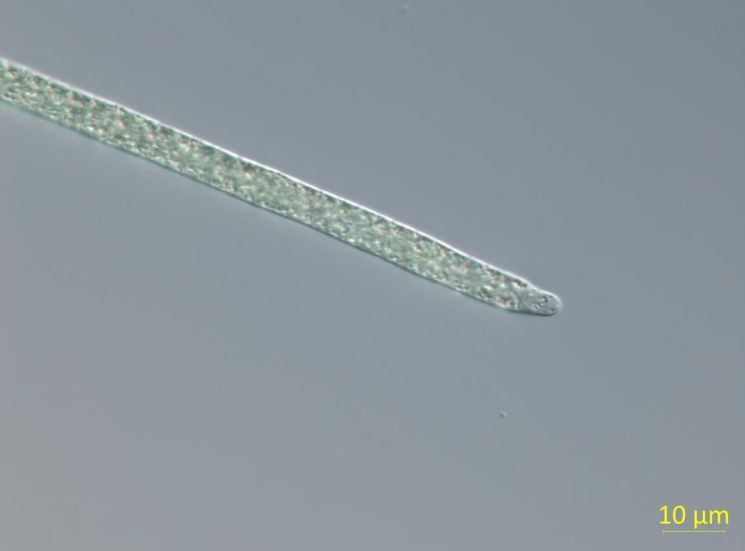
 The Gyeonggi-do Institute of Health and Environment has become the first in Korea to successfully analyze the complete genome sequence of the cyanobacterium Planktothricoides raciborskii, which causes moldy odors in tap water.
The Gyeonggi-do Institute of Health and Environment Research has succeeded for the first time in Korea in analyzing the whole genome sequence of the cyanobacterium ‘Planktothricoides raciborskii,’ which causes moldy odors in tap water.
The institute had previously analyzed the whole genomes of two species of Raphidopsis (Raphidopsis raciborskii, Raphidopsis curvispora), cyanobacteria originating from tropical regions, and in 2018, the whole genome of Pseudanabaena yagii, a cyanobacterium causing moldy odors in tap water sourced from the Bukhan River, for the first time in Korea.
This cyanobacterium species mainly appears in low-latitude regions such as China, Thailand, and Singapore, and possesses the biosynthesis genes for 2-methylisoborneol (2-MIB), a compound that causes off-flavors and odors in water.
This study established a foundation for understanding the physiological characteristics and metabolic activities of the organism by analyzing the types and composition of its entire genes, thereby enabling the elucidation of the biosynthesis process of unusual taste and odor substances at the genetic level.
The Gyeonggi-do Institute of Health and Environment Research plans to continuously conduct research on the impact of climate change on ecosystems and the biosynthesis of odor substances by cyanobacteria.
Hwang Chan-won, head of the Water Environment Research Department at the institute, stated, "This result is significant in that it completely elucidates the genome of cyanobacteria causing odors in tap water," and added, "We will continue to promote research to effectively manage cyanobacteria issues and ensure the safe supply of tap water."
© The Asia Business Daily(www.asiae.co.kr). All rights reserved.

















