On the 21st (local time), U.S. President Joe Biden abruptly withdrew from the Democratic presidential race, making Vice President Kamala Harris the top candidate for the so-called 'post-Biden' era. As Biden's running mate, she can continue his policies and manage existing campaign funds, while also expected to consolidate votes from people of color and women. If Vice President Harris is confirmed as the Democratic presidential candidate, she will challenge the dream of becoming the 'first female president in history,' a goal that former Secretary of State and 2016 Democratic presidential candidate Hillary Clinton was unable to achieve eight years ago.
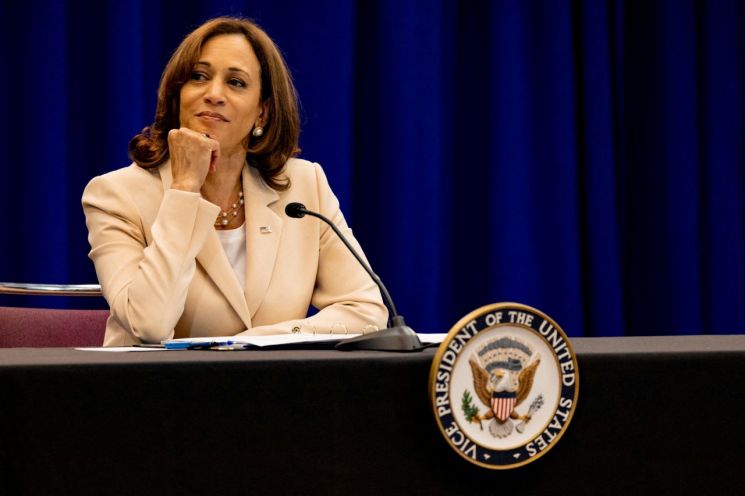
Vice President Harris is the first Black, Asian American, and female vice president in U.S. history. Born in 1964 in California to an African Jamaican immigrant father and an Indian immigrant mother, Harris is racially classified as both Black and Asian American. Her father was a professor of economics at Stanford University, and her mother was a scientist. Her maternal grandfather also came from an elite family of high-ranking Indian government officials. However, it is reported that she experienced significant identity confusion growing up in a predominantly white community.
Harris majored in political science and economics at Howard University, a prestigious historically Black university in Washington, D.C. This period is also seen as when her identity as a Black and Indian mixed-race individual became more firmly established, moving beyond the white community. She then attended the University of California, Hastings College of the Law, and in 1990, she began her legal career as a local prosecutor in Alameda County, California. In 2004, she became the first Black woman to serve as San Francisco District Attorney, and in 2011, she was elected California Attorney General and chief prosecutor. After serving six years as state attorney general, Harris entered national politics in 2017 when she was elected as a U.S. Senator from California. Known for her passionate speaking style, she earned the nickname 'female Obama' both inside and outside political circles.
In 2020, then-presidential candidate Biden selected her as his running mate, and she became vice president with the inauguration of the Biden administration in January of the following year. She broke the glass ceiling in a U.S. society dominated by white males, making history as the first in many respects and rising to the second-highest office.
Currently, with President Biden and other prominent Democrats expressing their support one after another, Vice President Harris is the most likely candidate to be nominated for the presidency. If so, Harris will carry the symbolic significance of being the first presidential candidate who is a woman of color. It is expected that she can appeal to and consolidate votes from minority groups and women, who are considered non-mainstream in American society. Particularly for the Democratic Party, there is hope that she can reclaim the votes of people of color, including Black voters, who have recently shown signs of drifting toward former President Trump. She is also seen as a strong card to bring key election issues such as race and abortion to the forefront of the campaign.
With the presidential election on November 5th approaching quickly, if a politician other than Vice President Harris becomes the presidential candidate, not only would existing campaign funds be unusable, but legal and political controversies over the validity of delegates could arise. Local media reported that with President Biden's withdrawal from the race, Vice President Harris can currently use the existing campaign funds. The fact that she can continue policies as Biden's running mate over the past four years is also positive for the Democratic Party.
However, concerns have been raised that she has not shown a significant presence during her vice presidency. Despite her sharp rhetoric, she is evaluated as lacking charisma and popular appeal as a politician. This is why, amid ongoing debates about Biden's advanced age, there has been no consensus within the party on Harris as an alternative. According to 11 polls conducted after the TV debates, even if Vice President Harris were to run as a replacement candidate, she would not change the current election landscape where former President Trump is leading. On the same day, former President Trump expressed confidence in victory if Harris became the candidate, saying, "It would be easier to beat her than President Biden."
Other potential Democratic contenders for the post-Biden era include California Governor Gavin Newsom, Michigan Governor Gretchen Whitmer, Illinois Governor J.B. Pritzker, Transportation Secretary Pete Buttigieg, Pennsylvania Governor Josh Shapiro, and Michelle Obama.
In a statement released on the same day, U.S. Vice President Harris said, "I am honored to have President Biden's support," and added, "My goal is to become the candidate and win the election on November 5th." She emphasized, "I will do everything in my power to unite the Democratic Party and the United States to defeat former President Donald Trump and his extreme 'Project 2025' agenda. We will fight together. And we will win together."
© The Asia Business Daily(www.asiae.co.kr). All rights reserved.
![Clutching a Stolen Dior Bag, Saying "I Hate Being Poor but Real"... The Grotesque Con of a "Human Knockoff" [Slate]](https://cwcontent.asiae.co.kr/asiaresize/183/2026021902243444107_1771435474.jpg)
















