Revealed at the Korea Chamber of Commerce Press Conference
"HBM Could Face Crisis Like Batteries"
"One Fab Costs 20 Trillion Won... Tax Benefits Are Insufficient"
"We Must Build AI Data Centers Now"
On STEM Workforce Shortage: "Workforce Development Is Crucial"
On Trump: "Words and Actions May Differ"
Choi Tae-won, chairman of SK Group and the Korea Chamber of Commerce and Industry, emphasized that SK Hynix, which is currently showing strength in the high-bandwidth memory (HBM) market, could also face a crisis and that preparations are necessary.
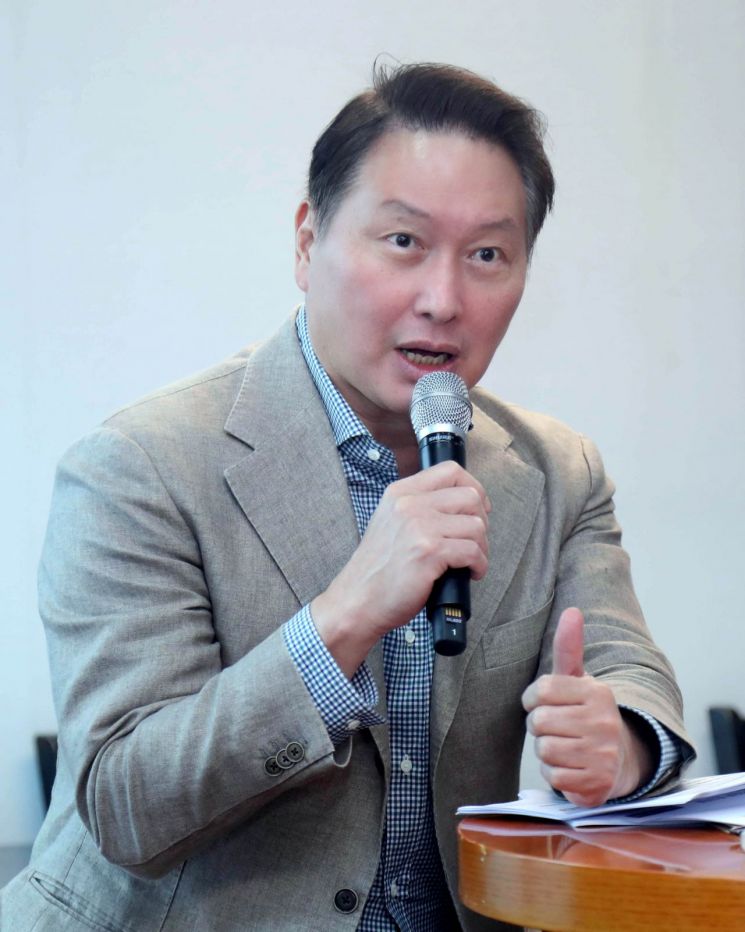 Choi Tae-won, Chairman of SK Group and the Korea Chamber of Commerce and Industry, is answering questions from the press at a Korea Chamber of Commerce and Industry press briefing held at an undisclosed location in Jeju on the 19th. Photo by Korea Chamber of Commerce and Industry
According to the business community on the 21st, Chairman Choi held a "press conference" on the 19th at a location in Jeju Island where the Korea Chamber of Commerce and Industry forum was held, saying, "There is no guarantee that the crisis that occurred in batteries will not happen in HBM as well," and added, "We need a program to overcome such a crisis well. It is necessary to discuss and create what kind of support is needed from the government and what we can do together."
SK Hynix has dominated the global HBM market and established itself as a flagship affiliate within the group. Global tech companies, including Nvidia, which leads the AI chip market, have shown high responsiveness to the HBM produced by SK Hynix. As demand for artificial intelligence (AI) chips has greatly increased, the required amount of memory has also risen. HBM is also gaining attention. Building on this, SK Group recently focused its rebalancing strategy on AI semiconductors, placing SK Hynix at the forefront.
Chairman Choi said, "Our concern is that no matter how much money we make, we have to invest more than what we earn now," adding, "SK Hynix has its strengths, but although we produce a lot of HBM, HBM investment is, in a way, an expensive investment. Honestly, continuing to invest more in this is not an easy story for us." He further emphasized that "while it is a good and happy concern that HBM sells well, the investment is too aggressive and large," highlighting the risks involved in producing HBM.
Regarding the "semiconductor subsidies" that the industry insists must be provided to semiconductor companies such as SK Hynix, he stressed, "There is a problem that cannot be handled by tax benefits alone." Chairman Choi explained, "We have to increase factory capacity by investing in facilities according to market demands. We have to keep building fabs. The cost of building one fab is about 20 trillion won. It takes 20 trillion won to build a new fab. In the case of HBM, it costs even more to create a structure suitable for the fab." He added, "For this reason, other countries like the U.S. and Japan provide support," and said, "I think our country has no choice but to follow this."
Chairman Choi also emphasized Korea's strategy to prepare for the AI era, saying, "There is a need to build more AI infrastructure in our country." This means establishing an environment and structure to research and develop AI. He said, "If we fall too far behind, big tech and AI-related companies may not choose Korea, and we risk becoming hollowed out. Ultimately, we would become dependent," and proposed, "Although the economy is tough, we need to start by building AI data centers and nurturing AI warriors." He explained that AI warriors "refer to people who adapt to the AI era and open new businesses and innovations within it, and in the AI era, they may not necessarily be engineers."
Regarding AI data centers, he said, "Microsoft, OpenAI, then Amazon and Google should be able to use part of our data centers, and the remaining parts should be open to our citizens and students so they can perform computations and create models. Eventually, it will reach a point where individuals can create personalized models themselves." He added, "Before AI data centers, there is the issue of gathering data. Even if we gather data in Korea, the size will probably be small. We need to cooperate with other countries like Japan to increase data size and move toward joint use." He also emphasized the need to consider cooperation between companies. Chairman Choi said, "In our case, SK is a company focused on building infrastructure, and Naver is a company that creates applications. Naver holds a good position. If they create new applications and many software frameworks for AI and make them available globally, that would be a very good thing. Kakao is the same."
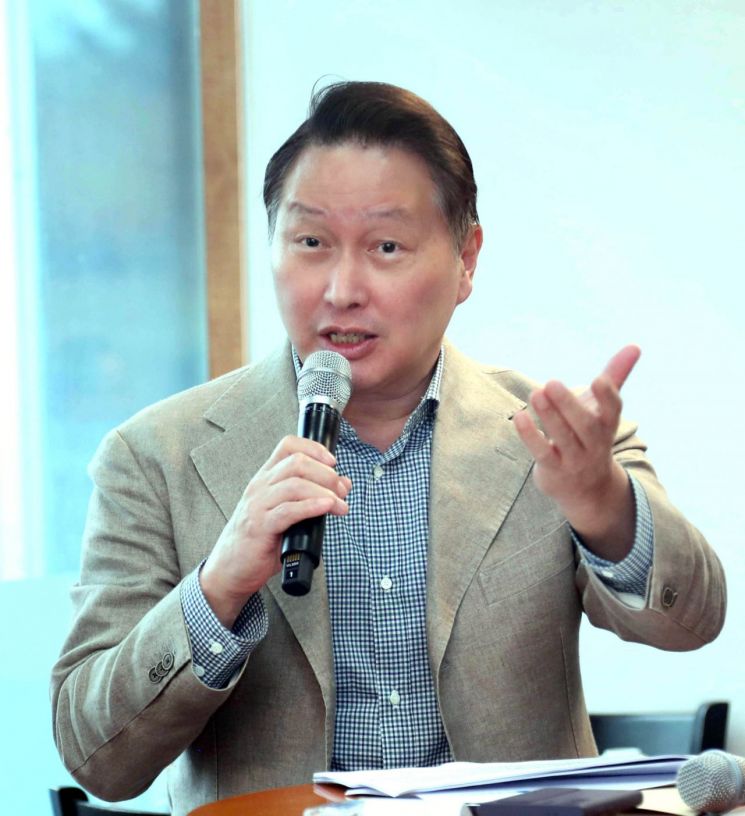 Choi Tae-won, Chairman of SK Group and the Korea Chamber of Commerce and Industry, is answering questions from the press at a Korea Chamber of Commerce and Industry press briefing held at an undisclosed location in Jeju on the 19th. Photo by Korea Chamber of Commerce and Industry
Regarding the "shortage of science and engineering personnel," which many companies are recently concerned about, he emphasized, "We need to break down the dichotomy between science and liberal arts." Chairman Choi said, "I do not think that science can do certain things and liberal arts cannot," adding, "What is important is how to develop human resources more, and this requires cultivation. A miracle where previously nonexistent personnel appear and work within 2-3 years will not happen."
He continued, "We need to sow the seeds from now," and predicted, "We need to create a school education system where specialized education can be received through specialized university and high school courses, and from elementary school, AI training and education will be necessary to produce capable people." He added, "If the elementary school semester starts, I think usable personnel can emerge within 10-15 years. We need to think on that scale." He also said, "If it is urgent, we have to bring people from other countries," and added, "India still has many personnel, so we can bring them in and consider ways to supplement the immediate shortage of personnel."
Regarding the increasingly heated competition between Donald Trump and Joe Biden ahead of the U.S. presidential election in November, he answered, "It is difficult to predict." Recently, after an "assassination attempt" incident in the U.S., the "Trump election theory" has gained weight.
Chairman Choi said about Trump, "There is a part where I believe 'he says so,' and when it comes to practice and action in detail, I think he will always sufficiently propose alternatives from below. So I do not think it is dangerous," adding, "I think the U.S. market is the largest in AI and will continue to lead it, and even if Trump is elected, I think that will continue."
He added, "Relatively, our SK has not yet made large investments in U.S. semiconductors," and said, "The investment in Indiana is not for building a large fab but an advanced packaging type. It is not completely decided yet, and if subsidies are not provided, we will probably have to reconsider everything." He added, "We will be able to give a precise answer about the impact of the election only after the November election and next spring." SK Hynix is building an advanced packaging production base for AI memory in West Lafayette, Indiana, U.S. The investment scale is $3.87 billion (about 5.2 trillion won).
© The Asia Business Daily(www.asiae.co.kr). All rights reserved.
!["The Woman Who Threw Herself into the Water Clutching a Stolen Dior Bag"...A Grotesque Success Story That Shakes the Korean Psyche [Slate]](https://cwcontent.asiae.co.kr/asiaresize/183/2026021902243444107_1771435474.jpg)

















