Interview with Voice AI Expert Jo Hyung-sil, CEO of SiLnD
"AI Will Express Its Own Characteristics"
"Europe Will Lead AI Ethics and Regulation Even If Development Is Delayed"
"Rather Than Celebrating Korea's Associate Membership in Horizon Europe, Focus on Expanding Local Networks First"
Jo Hyeong-sil, CEO of SiLnD (Speech into Language and Data), majored in French at university. After more than 30 years, he now runs an AI-related consulting company in the Netherlands and is regarded as a leading Korean scientific scholar in the field of voice artificial intelligence (AI) in Europe.
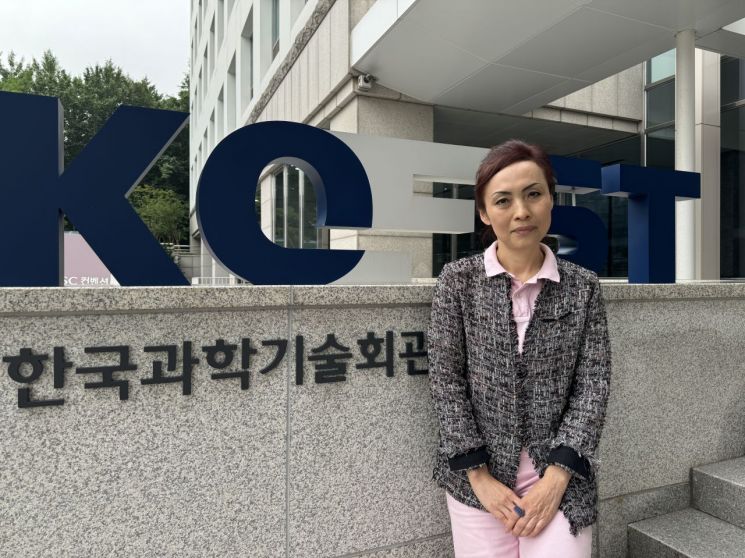
Having built his career in voice AI through collaborations with major companies such as Microsoft and Volkswagen, CEO Jo recently returned to Korea briefly for the Korean Scientists Conference held in Seoul. In an interview with Asia Economy, he predicted that the development of voice AI will go beyond merely imitating humans and will create its own unique way of speaking. He also explained why Korean AI research needs to observe the European situation and offered advice on expanding cooperation with Europe.
Transforming from a linguistics student to a voice expert and then to an AI specialist, CEO Jo said, "Until now, AI has imitated human pronunciation and intonation, but if it becomes too natural or human-like, it can actually reduce trust in the information." He predicted, "In the future, AI will evolve on its own to easily convey or understand the basic information humans want." He also foresaw the emergence of AI’s own distinctive speech styles or slang, rather than language mixed with various people’s speech patterns, intonations, or dialects.
CEO Jo noted that just as each person has different pronunciation, intonation, and speech style, there are limits to developing voice AI by imitating specific individuals. However, he expressed concern that if AI development progresses excessively, it could influence human language habits. As conversations with machines increase, there could certainly be changes in human language activities. In particular, dependence on spoken language might decrease.
He also emphasized that AI research should not focus solely on the United States. CEO Jo introduced, "Unlike the US or China, Europe is concentrating on the social ethics of AI." While it is true that the US leads AI utilization and development, Europe could take the lead in AI ethics and regulation. Observing Europe’s AI regulatory trends is important to maintain overall balance in research.
As a leading Korean scientist in Europe, CEO Jo also suggested ways to strengthen cooperation with Europe. Although Korea has joined ‘Horizon Europe,’ the world’s largest multilateral research program, as an associate member, he advised that instead of rushing to secure research projects, Korea should build a foundation by developing relationships with local researchers.
He advised, "Locally, Korea’s associate membership in Horizon Europe has not brought about significant changes. Institutions without prior ties to Korea may be reluctant to cooperate with a distant country like Korea." He recommended, "Rather than aiming for grand collaborations first, priority should be given to strengthening networking with local researchers through attending conferences and sharing research topics." He reiterated the simple truth that having a basic relationship is essential to respond quickly when research projects are announced.
© The Asia Business Daily(www.asiae.co.kr). All rights reserved.
!["The Woman Who Threw Herself into the Water Clutching a Stolen Dior Bag"...A Grotesque Success Story That Shakes the Korean Psyche [Slate]](https://cwcontent.asiae.co.kr/asiaresize/183/2026021902243444107_1771435474.jpg)
















