Sotheby's New York Auction Features Stegosaurus Fossil
Nearly Perfectly Preserved 'Apex'... Sold for 61.6 Billion Won
Planned Loan to a US Institution... Paleontology Community Expresses Concerns
A record high price for dinosaur fossils at auction was set at Sotheby's New York auction. According to the Associated Press and others on the 17th (local time), the star of the auction was a nearly perfectly preserved Stegosaurus fossil. This gigantic dinosaur, called "Apex," stands 3.4 meters tall and measures 8.2 meters from snout to tail.
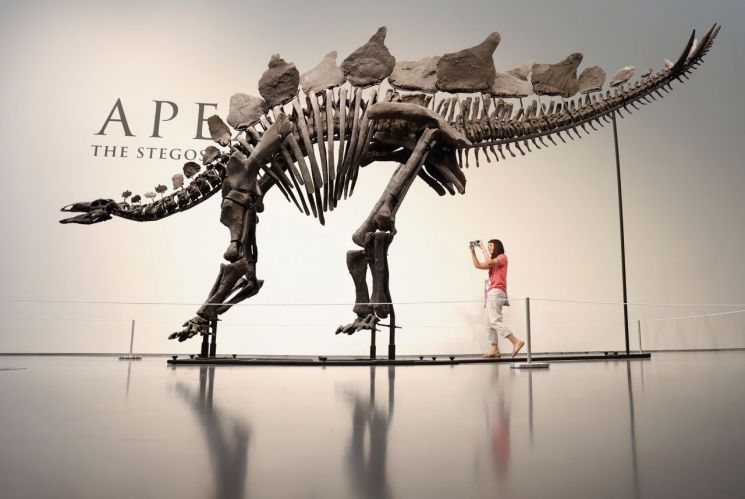
Apex was sold at auction for $44.6 million (approximately 61.6 billion KRW), far surpassing the previous highest price for a dinosaur fossil, the $31.8 million paid for a Tyrannosaurus rex in 2020. The final price exceeded the pre-auction estimate ($4 million to $6 million) by about ten times. The bidding competition lasted more than 15 minutes, and the identity of the winning bidder, who outbid six competitors, was not disclosed except that they are American. Sotheby's stated that the buyer plans to loan Apex to an American institution, alleviating concerns about the fossil being taken abroad.
According to Sotheby's, Apex is the best-preserved Stegosaurus fossil discovered to date. Of the 319 Stegosaurus bones, 254 are preserved, and its size is more than 30% larger than "Sophie," the Stegosaurus fossil displayed at the Natural History Museum in London, UK. It is a robust adult fossil and shows signs of having suffered from rheumatoid arthritis, suggesting it lived to an old age.
Apex was discovered in 2022 by paleontologist Jace Cooper on private land in Moffat County, Colorado, USA. It is reported to have been found in the Morrison Formation, a sedimentary rock formation centered around Colorado and Wyoming. Some in the paleontology community have criticized the auction, expressing concerns that selling Apex to a private individual could hinder research access, given its exceptional preservation at the time of excavation.
The Stegosaurus was a herbivorous dinosaur that mainly inhabited the North American continent during the Late Jurassic period (approximately 155 to 150 million years ago). It is characterized by four sharp spikes on its tail and hexagonal-shaped plates along its back.
© The Asia Business Daily(www.asiae.co.kr). All rights reserved.