Determining New Public Facility Uses with Integrated Information Without Departmental Barriers
Comprehensive View of Current and Planned Public Facilities in the Area... Increased Policy Utilization Through Objective Data Analysis
Zero Budget Spent on Departmental Collaboration... Resolving Information Asymmetry Between Departments Through Data Collection and Sharing
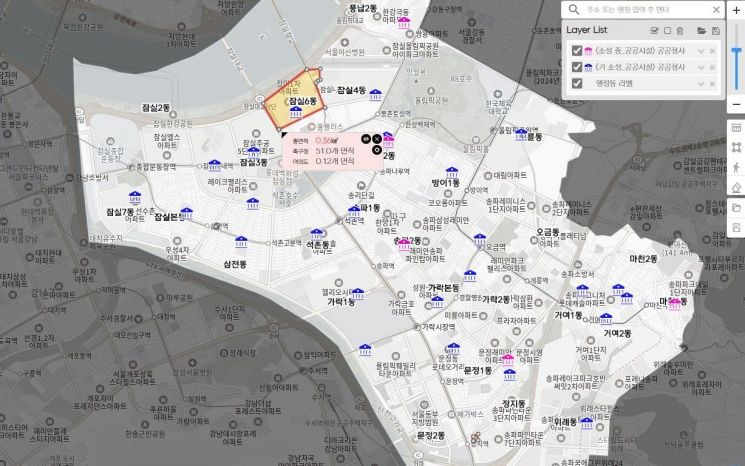
Songpa-gu (District Mayor Seo Gang-seok) announced that it has established an integrated database (DB) that allows for a comprehensive map-based understanding of the status of public facilities within the area and upcoming sites for donation-based contributions, and that it will utilize this DB for administrative tasks such as usage review starting from the end of July.
Recently, redevelopment and reconstruction projects in the area have gained momentum, leading to a rapid increase in facilities expected to be donated. While the administrative role of rationally deciding the use of new public facilities is emphasized, it has been practically difficult to collect and analyze information before deciding on usage because the departments managing facility status are different.
In response, the district built an integrated DB for donation-based facilities that all departments can easily share and utilize in their work, keeping pace with the big data era. By removing departmental barriers and enabling universal use of data, it is expected to resolve information asymmetry among practitioners.
The newly established DB comprehensively includes ▲the status of public facilities such as cultural facilities and parking lots within the area ▲the status of various development projects such as maintenance projects ▲and information related to donation-based facilities that were scattered across departments. It is installed on the existing map-based system (GIS) operated by the district and visualized clearly on the map.
In particular, the data is multilayered by item so that various information can be combined layer by layer and viewed at a glance according to the purpose of browsing. Various information registered in the existing system DB, such as population density and traffic volume, can also be viewed simultaneously, creating a synergy effect.
A district official stated, “If the person in charge can identify information such as new donation-based facility sites or redevelopment timing in advance, it will be possible to timely establish or relocate necessary public facilities,” adding, “By efficiently predicting and managing the supply and demand of public facilities, more rational decision-making has become possible,” highlighting the significance of the DB establishment.
Additionally, this project’s major advantage is that it is a ‘non-budget solution’ achieved through interdepartmental collaboration by expanding the functions of the existing system without any budget. The district plans to maintain the reliability of information through regular monitoring and updates, continuously keeping changes up to date and managing the system thoroughly.
Seo Gang-seok, Mayor of Songpa-gu, said, “This DB establishment is a good example of creativity and innovation achieved through the collaboration of public officials without a separate budget,” and added, “We will actively promote the introduction of advanced technologies such as big data in the public sector and continue smart policy decisions for the public interest.”
© The Asia Business Daily(www.asiae.co.kr). All rights reserved.

















