Urban Planning and Architecture Committee Review... Impact Assessment and District Unit Plan Approved
Next Month, 'The Hyundai Gwangju' Design and Construction Permits... Construction Scheduled for Early Next Year
Landmark Luxury Hotel Project Requires 20% Deposit... Safety Measures Secured
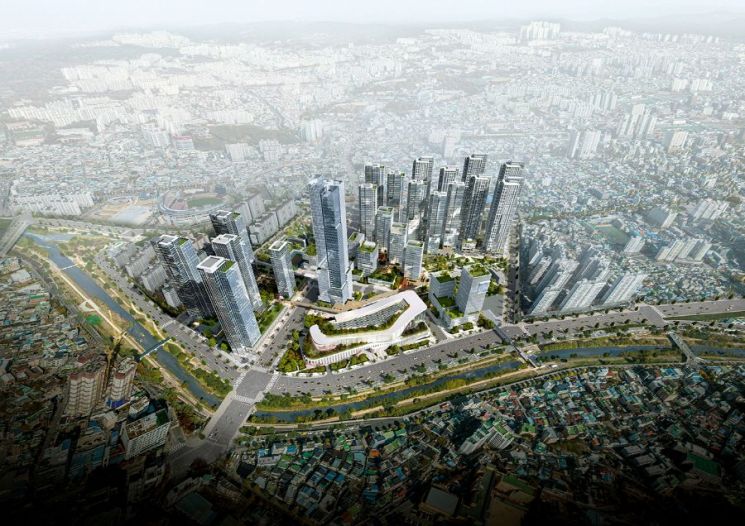
The ‘Former Jeonbang and Ilsin Textile Site Development Project,’ a core initiative of Gwangju City’s 8th term administration, has completed all urban planning procedures and is entering full-scale implementation along with design and permits.
Gwangju Metropolitan City (Mayor Kang Gi-jung) held the ‘Gwangju City Urban Planning and Architecture Joint Committee’ on the afternoon of the 18th in the city hall’s medium conference room. The committee reviewed and approved the district unit plan, which incorporated traffic impact assessments, strategic environmental impact assessments, disaster impact evaluations, residential policy reviews, and measures reflecting residents’ opinions.
Gwangju City has been conducting various reviews and administrative processes based on the principles of ‘speed, transparency, and fairness,’ and as promised, held the final review stage of the ‘Urban Planning and Architecture Joint Committee’ in July.
With the approval from the Urban Planning and Architecture Joint Committee, the ‘Former Jeonbang and Ilsin Textile Site Development Project’ is expected to accelerate as the land use plan for a complex shopping mall, landmark towers including a luxury hotel, residential complex facilities, and parks takes shape.
During the review, various impact assessments and the district unit plan were approved. The review included provisions on the schedule for installment payments of the private developer’s public contributions amounting to 589.9 billion KRW and the performance guarantee plan for the landmark tower, including the luxury hotel.
The public contributions consist of in-kind contributions worth 289.9 billion KRW and cash payments of 300 billion KRW.
Most in-kind public contributions, such as roads, parks, and public land, will be completed before the opening of the complex shopping mall to establish public infrastructure promptly. The 300 billion KRW in cash will be paid in installments over five years by the private developer to Gwangju City between the start and completion of construction, in accordance with relevant laws, to ensure project execution capability.
Accordingly, 85% of the total public contributions, amounting to 500.7 billion KRW, will be paid when the public infrastructure is established.
With the final approval of various impact assessments and the district unit plan, Gwangju City plans to sign an ‘Agreement on Public Contributions and Project Plan Implementation’ with the private developer and announce the district unit plan area and decisions, which correspond to the development project approval, within July.
Once the district unit plan is announced, the approximately 90,000 pyeong (300,000㎡) of idle land resulting from the relocation of the former Jeonbang and Ilsin Textile sites from the city outskirts will be rezoned from general industrial areas to general commercial areas, semi-residential areas, and green spaces.
After the land use change, the private developer will begin design and construction permit procedures in August for the landmark tower including the luxury hotel, coexistence complex facilities, residential-commercial complexes, office facilities, and commercial facilities as reflected in the district unit plan.
The landmark luxury hotel has secured a safety device with the private developer providing a performance guarantee of 60 billion KRW, equivalent to 20% of the project cost, to Gwangju City.
Considering that the typical performance guarantee for development projects is about 10% of the total project cost, this project’s guarantee is twice that amount, strengthening the private developer’s commitment to constructing the landmark luxury hotel.
Once the design and construction permits for ‘The Hyundai Gwangju,’ a complex shopping mall designed by world-renowned architects Herzog & de Meuron, are completed in the second half of this year, construction is scheduled to begin early next year. The landmark luxury hotel will also start construction concurrently before the shopping mall’s completion.
The residential-commercial complexes to be built on two residential complex sites will begin construction in the second half of 2025 and the second half of 2026, respectively. Administrative procedures for public infrastructure within the district, including roads, two parks, and school installations, will also proceed swiftly in the second half of this year.
Mayor Kang Gi-jung of Gwangju said, “The approval by the Urban Planning and Architecture Joint Committee means that this project has stably entered its main track,” adding, “It marks an important turning point that will open the era of 30 million urban users, enhance the city brand value of ‘Fun City Gwangju,’ and inject new vitality.”
He continued, “With the promised opening of the complex shopping mall, payment of public contributions, and safety measures for the assured implementation of the landmark tower including the luxury hotel, we will actively support related permit procedures so that this project can proceed quickly and stably.”
© The Asia Business Daily(www.asiae.co.kr). All rights reserved.

















