Market Size Grows with Applicability Across Various Industries
Apple Launches XR Device Vision Pro... Preparing Affordable Version
Samsung Electronics Announces XR Platform Release Within the Year
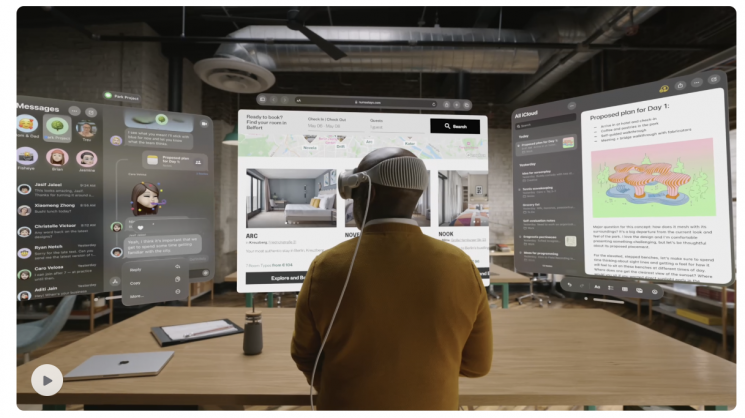
The increasing participation of big tech companies in the extended reality (XR) market is due to its vast potential applications. Especially as analyses continue to show its applicability across various industries such as entertainment, education, and healthcare, growth is accelerating.
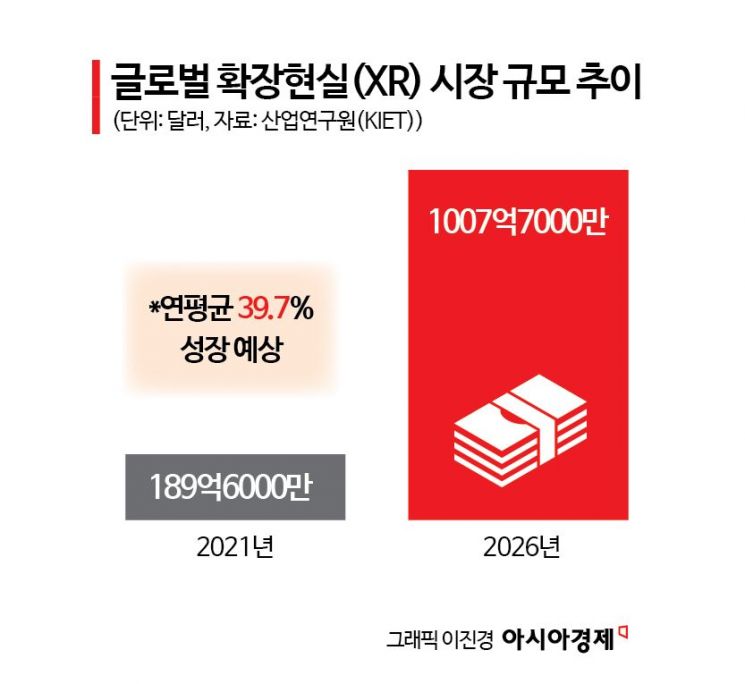
According to the Korea Institute for Industrial Economics & Trade (KIET), the global XR market size was only $18.96 billion (approximately 26.2 trillion KRW) as of 2021. However, with an expected compound annual growth rate approaching 40%, it is projected to grow to $100.77 billion (approximately 139.2 trillion KRW) by 2026.
The remarkable market growth is driven by expectations that XR technology can be applied across diverse industries. Currently, XR is utilized in entertainment sectors such as gaming, exhibitions, and performances. Users can experience activities as if they are the protagonist in a game or feel as though they have directly visited an exhibition hall or concert venue in a virtual world.
The market leader is Meta, which is recognized as leading the entertainment and metaverse XR market. The company changed its name from Facebook to Meta to reflect its influence in this market. Since launching the XR device Meta Quest 3 in 2022, Meta has been developing additional devices. Besides Meta, ByteDance, the parent company of TikTok, acquired the VR startup Pico in 2021 and has been developing related devices, growing as a competitor to Meta.
The scope of XR applications is expected to expand into education and healthcare sectors. It offers experiences of educational settings that are difficult to access directly and prospects for pharmaceutical development through medical research in virtual worlds. Additionally, virtual communities in the metaverse may emerge as XR technology advances, making virtual spaces more similar to reality. However, since the XR industry is still in its early stages, the range of applicable industries is expected to broaden further.
Efficiency improvements in manufacturing processes are also anticipated. Kim Sung-jin, a researcher at KIET, explained in the report "Global Trends and Policy Implications of the XR Device Industry" that "Currently, XR devices are mostly used for entertainment, but their use is expanding into manufacturing, education, and healthcare purposes. In manufacturing processes, XR is applied to product design, prototype production and collaboration, and external remote support. Developing prototypes in virtual reality can reduce production costs." He further noted that XR can be introduced in virtual development labs and quality evaluation and verification systems, playing a role in reducing costs during prototype development in manufacturing processes.
Until now, the XR market has been hindered by a lack of content and expensive devices. The intertwined issues of content scarcity and delayed device development have caused stagnation in XR advancement. However, with market growth and expansion prospects, and the entry of capital-rich big tech companies one after another, the situation is improving. Naver's recent move to add XR services and content to Chijijik appears to reflect expectations for the development of the XR ecosystem. If XR applications for Chijijik compatible with Google's Android operating system (OS) and Apple's iOS are developed and distributed through their app markets, users will be able to experience content as if they are seeing it right in front of their eyes.
Apple, which entered the market first, is focusing on improving XR devices. In June last year, Apple unveiled the XR headset "Vision Pro." However, its price exceeding 4.5 million KRW and weight of 450g raised concerns about convenience. Apple is reportedly preparing to release a more affordable entry-level headset model targeting next year.
Samsung Electronics plans to launch the Galaxy XR platform within the year in collaboration with Google and others. The XR platform consists of an operating system, developer tools, libraries, and resources necessary for program developers or creators to produce XR content, and new devices are expected to be introduced in the future. Through the XR platform, Samsung aims to develop and distribute related services and content to secure a leading position in the market.
At the recent "Galaxy Unpacked 2024" event held in Paris, France, Samsung Electronics MX Division President (CEO) Roh Tae-moon said, "We are steadily preparing development as planned with Google, Qualcomm, and others," adding, "For new devices like XR, the device itself is important, but securing an ecosystem where consumers can have better experiences and access many services and content is also crucial."
© The Asia Business Daily(www.asiae.co.kr). All rights reserved.


















