Lecture at AmCham-Invited Policy Meeting on 18th
"No Hindrance to Corporate Innovation, No Fear of Leakage"
Ongoing Public-Private Cooperation Program... Emphasis on Trust
Ko Hak-soo, Chairman of the Personal Information Protection Commission, revealed that he is exploring ways to mutually exchange data with major countries such as the European Union (EU), the United States, and Japan. He also expressed a willingness for companies aiming to launch new products and services using data and the Commission to work together to find lawful personal information protection policies.
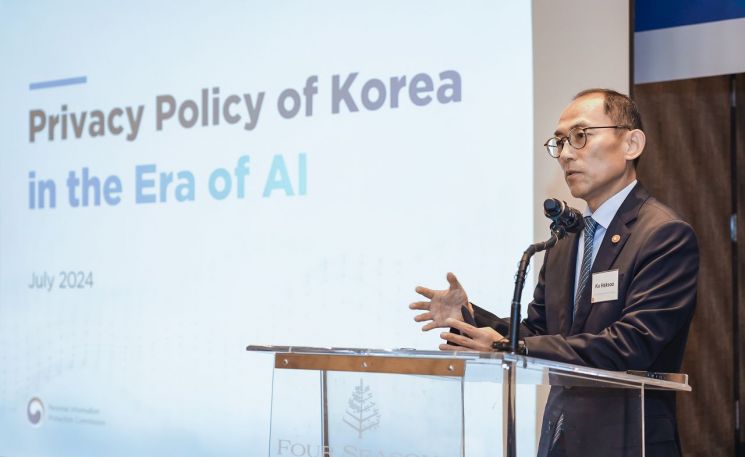
On the 18th, Chairman Ko appeared as a special speaker at a policy seminar hosted by the American Chamber of Commerce in Korea (AMCHAM) held at the Four Seasons Hotel in Jongno-gu, Seoul.
He noted that one month after his inauguration in October 2022, ChatGPT was released and AI technology entered everyday life, saying, "I thought AI was the destiny given to me."
He stated, "My most important role is to properly set the direction on how to view AI, data, and privacy issues and to provide guidance," adding, "I am collaborating with experts in various fields such as policy, technology, and law."
The Personal Information Protection Commission has been preparing guidelines necessary for corporate management, including guidelines for the use of unstructured data issued last February and recently, AI learning guidelines for publicly available personal information.
He explained, "Currently, we are examining appropriate measures for data collection and utilization by mobile video processing devices such as delivery robots in collaboration with companies like Baedal Minjok, Kakao Mobility, and 42dot."
In the rapidly changing AI era, he emphasized the need to shift from a rule-based approach to a principle-based approach in line with technological changes and expressed support for companies possessing new technologies.
Chairman Ko said, "If you want to launch new products or services but find it difficult or uneasy to determine whether there are any issues under the Personal Information Protection Act, please come to the Commission." He added, "Since last year, we have been piloting a system where companies and the Commission create solutions together, and it has been officially operating since April this year."
He acknowledged that there are constraints on data crossing borders during global research and development (R&D) processes. He said, "Seoul National University Hospital is trying to conduct R&D by uploading data on the same cloud system with foreign research institutions, but legal constraints require legislative amendments."
He continued, "We are considering how to revise laws regarding cross-border data transfers. However, it seems that discussions with the European Union (EU) will be concluded in November in a way that allows data exchange." He added, "We are also exploring ways to freely exchange data with major countries such as California in the United States, the United Kingdom, and Japan, which have significant trade relations."
After the lecture, during the Q&A session, when asked about his 'philosophy on personal information protection,' Chairman Ko responded, "When I am usually asked whether I am a 'personal information protectionist or a utilizationist,' I say the question itself is wrong."
He emphasized, "If we only protect personal information, neither the law nor the Commission would be necessary. The reason we consider protection is because there will be utilization later." He stressed, "It is important both to ensure that citizens do not feel anxious about personal information leaks and to avoid unnecessary restrictions on corporate innovation."
He added, "I think the common keyword that ties these together is 'trust,'" and stated, "Once trust is built, we can move in the most flexible direction possible."
© The Asia Business Daily(www.asiae.co.kr). All rights reserved.

















