Securing Customers in Secondary Battery, Auto Parts, and Logistics Industries
Expanding Customers in Semiconductor, Bio, and Food & Beverage Sectors
Utilizing Digital Twin, etc... Productivity Up↑ Defect Rate Down↓
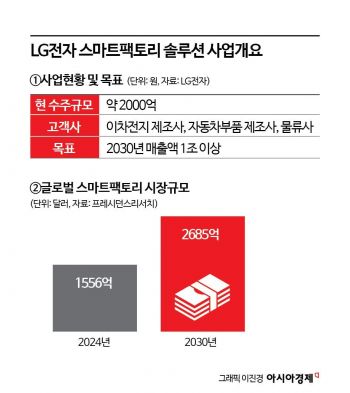
LG Electronics plans to develop its smart factory solution business into the trillion-won range within six years. The company aims to increase the current order scale of around 200 billion won to trillion-won level sales, securing new growth engines. This is part of CEO Cho Joo-wan's '2030 Future Vision,' expanding the business-to-business (B2B) sector, one of the three major growth drivers presented last year. Smart factory solutions refer to systems that enable flexible factory design and quality inspection through artificial intelligence (AI).
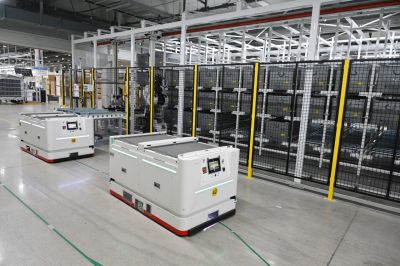 Refrigerator production line at LG Smart Park in Changwon, Gyeongnam, applying smart factory solutions. [Photo by LG Electronics]
On the 18th, LG Electronics announced that it plans to increase the smart factory solution business sales outside the group, currently at 200 billion won, to the trillion-won level by 2030.
Smart factory solutions include ▲ production system design, monitoring, and operation using digital twins ▲ equipment and process management, industrial safety, and quality inspection based on big data and generative AI ▲ industrial robots. These solutions enhance factory productivity while reducing defect rates.
LG Electronics explained that the manufacturing and production data accumulated over the past 10 years amounts to 770 terabytes (TB). This is equivalent to storing about 197,000 high-definition 4GB movies. The company also possesses various core production element technologies necessary for building smart factories. LG Electronics' Production Technology Institute has filed over 1,000 patents related to smart factory solutions. AI and digital transformation (DX) are linked with manufacturing data, know-how, and production element technologies.
Smart factory solutions can also reduce even minute production errors. For example, at LG Electronics' refrigerator production line in Changwon, a delay of just 10 minutes a day can disrupt the production of 50 refrigerators. Assuming each unit costs 2 million won, the loss amounts to 100 million won. Considering this, LG Electronics plans to provide comprehensive solutions covering factory planning, design, construction, and operation.
One notable advantage is the ability to create a virtual factory identical to the real one before actual factory design, enabling real-time digital twin simulation. This allows for previewing factory production and logistics flows to improve production efficiency and detect bottlenecks, defects, and failures in the production line in advance. Additionally, factory big data is used to increase yield (the ratio of good products). Sensors installed throughout the factory detect abnormal signals caused by equipment aging, and based on big data, the causes and corrective actions are determined. Using large language model (LLM)-based generative AI, anyone can easily operate the system by voice. For example, saying "Abnormal vibration in equipment A at 2 PM" records the abnormal signal on the server. Saying "Tell me about recent abnormal vibrations and corrective measures" provides information on defect types and previous corrective histories in order of likelihood.
Furthermore, LG Electronics developed a real-time detection system based on vision AI to enhance safety. This solution learns the normal operating state of the factory and detects abnormal situations, temperature changes, and defects. It can distinguish workers who are not properly wearing safety helmets or vests, as well as detect equipment and product abnormalities.
Applying smart factory solutions to LG Electronics' factories has increased productivity and reduced defect rates. At LG Smart Park in Changwon, Gyeongnam, selected as a Lighthouse Factory (innovative factory) by the World Economic Forum, productivity improved by 17% and energy efficiency by 30% after smart factory implementation. Quality costs caused by defects were reduced by 70%.
Jung Dae-hwa, President of LG Electronics' Production Technology Institute, emphasized, "We will provide optimal smart factory solutions at every stage from factory planning to design, construction, and operation."
© The Asia Business Daily(www.asiae.co.kr). All rights reserved.


















