Publication of 'Land Ownership Status Statistics as of the End of 2023'
Despite last year's economic downturn and falling house prices, the amount of land owned by people in their 60s and 70s has increased. By steadily purchasing land, they now hold more than half of the land owned by individuals. On the other hand, the ownership share of those aged 30 and below was found to be less than 5%. More than six out of ten citizens were surveyed to have no land at all.
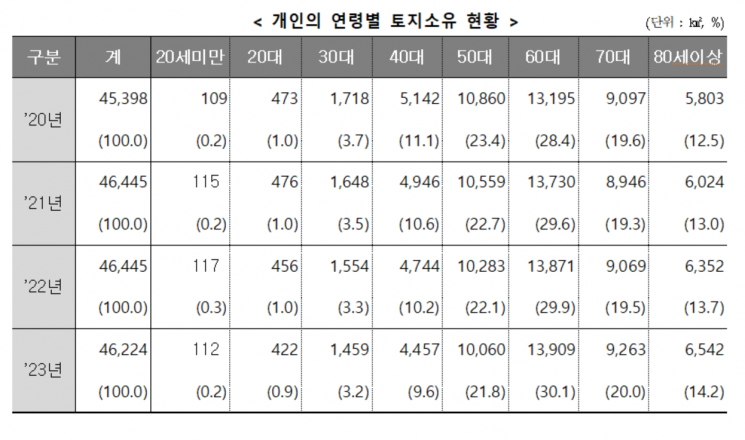 Land Ownership Status by Individual Age Group. [Data Provided by the Ministry of Land, Infrastructure and Transport]
The Ministry of Land, Infrastructure and Transport announced the '2023 Year-End Land Ownership Status Statistics' on the 18th, which contains these findings. According to this data, 19.03 million citizens own land, accounting for about 37.1% of the total population. This means that six out of ten people do not own any land.
The number of citizens owning land has been steadily increasing. The number of landowners rose from 18.05 million in 2020 to 18.77 million in 2022.
The total land owned by individuals was recorded at 46,224 km². Land owned by corporations amounted to 7,327 km², while non-corporate entities (such as Jongjung and religious organizations) owned 7,818 km².
Looking at individual land ownership by age group, those in their 50s to 70s owned the most land. As of the end of last year, the land ownership status by age showed that people in their 60s owned 30.1%. This was followed by those in their 50s with 21.8%, and those in their 70s with 20.0%.
Last year, the amount of land owned by individuals increased only among those in their 60s and 70s compared to the previous year. Land owned by people in their 60s accounted for 30.1% (13,909 km²) of the total, up from 29.9% (13,871 km²) in 2022. The ownership by those in their 70s also rose from 19.5% (9,069 km²) to 20.0% (9,263 km²) during the same period. The land ownership amount and share for all other age groups decreased compared to 2022.
By land use zone, individual-owned land was highest in agricultural and forest areas, accounting for 48.8% (22,563 km²) of the total. Management areas made up 31.3% (14,464 km²), and green areas accounted for 12.6% (5,818 km²).
For corporations, agricultural and forest areas comprised 32.2% (2,361 km²) of their land holdings. Management areas accounted for 27.3% (1,999 km²), and green areas made up 14.8% (1,081 km²). Non-corporate entities' land was composed of 56.8% (4,442 km²) agricultural and forest areas, with management areas at 21.9% (1,714 km²) and green areas at 11.9% (930 km²).
The land ownership status statistics are compiled based on cadastral electronic data registered by local governments nationwide. These statistics are used for real estate policy and academic research. Detailed data from the '2024 Land Ownership Status Statistics' will be available from the 18th on the Ministry of Land, Infrastructure and Transport’s Statistics Nuri and the Statistics Korea National Statistical Portal.
© The Asia Business Daily(www.asiae.co.kr). All rights reserved.

















