Public-Private Council Held Only 11 Meetings in 5 Years
Game Industry and Users Strongly Oppose
“Gaming is a disease?”
Jung (27), who has been enjoying League of Legends (LOL) for nine years, was baffled upon hearing that the World Health Organization (WHO) had registered gaming disorder as an international disease. Jung said, “Addiction to the point of being unable to carry out daily life would require treatment, but it seems unclear from what level gaming should be considered an addiction,” adding, “Looking at people around me who have gaming as a hobby, it is not uncommon for them to be deeply immersed in gaming on weekends or days off.”
Kim Minji (26) said, “As the status of e-sports rises, simply treating it as a disease because it is addictive seems like a serious leap in logic,” expressing concern that “the gaming industry might shrink as a result.”
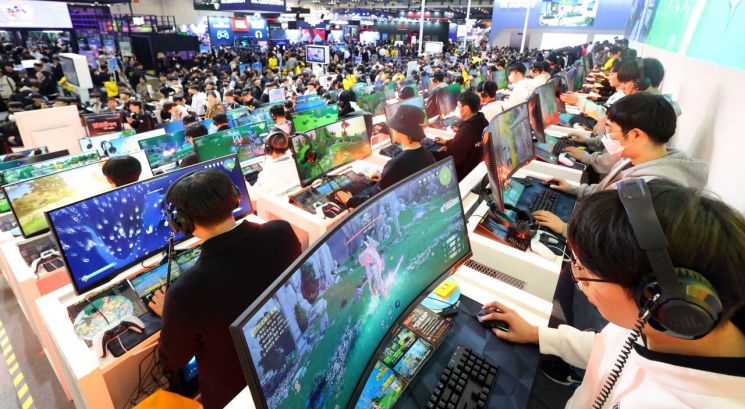 Visitors enjoying games at G-Star 2023, the largest domestic game exhibition held at BEXCO in Busan last March. [Image source=Yonhap News]
With the draft of the Korean Classification of Diseases (KCD) scheduled to include gaming disorder next year, social consensus has yet to be reached. Although a public-private consultative body was formed, only 11 meetings have been held over five years with no progress.
According to Article 22 of the Statistics Act on the 18th, when international standard classifications related to industry, disease, or cause of death are announced by the United Nations or the World Health Assembly, Korea is required to prepare its own standard classification based on them. In 2019, WHO enacted the “International Classification of Diseases, 11th Revision” (ICD-11), which assigned a disease code to gaming disorder. Although the ICD content is only a recommendation to WHO member countries, Korea has conventionally adopted ICD content into the Korean Standard Classification of Diseases and Causes of Death.
The pros and cons of introducing a disease code for gaming disorder are evenly matched. The Ministry of Health and Welfare views that by conducting epidemiological surveys on gaming disorder to understand the actual state of gaming addiction and clarifying diagnostic criteria, it could actually help the development of the gaming industry. On the other hand, the gaming industry and users strongly oppose it, citing ▲lack of a unified definition and terminology for gaming disorder ▲absence of diagnostic criteria explaining gaming disorder ▲insufficient research on negative outcomes and persistence caused by gaming disorder.
Currently, a partial amendment bill to the Statistics Act has been submitted to the National Assembly. Kang Yujeong, a member of the Democratic Party of Korea, proposed a bill to reduce the binding force of the current Statistics Act, which mandates unconditional adoption of international standard classifications, and to make it mandatory to collect opinions from stakeholders and experts. Kang pointed out, “If gaming disorder is introduced as a disease code, the domestic gaming industry is expected to shrink by about 8.8 trillion won in two years,” adding, “There will also be a reduction of 80,000 job opportunities, causing significant social and economic damage.”
Lee Dongyeon, a professor in the Department of Korean Arts at Korea National University of Arts, advised, “There have been almost no opportunities for active discussion of each party’s position on the introduction of the disease code within the public-private consultative body,” adding, “More research is needed to prepare objective evidence necessary for the decision by the target year of 2026, and public forums and National Assembly hearings should be held to gather public opinion. At the same time, tasks such as introducing rational and objective decision-making methods and procedures for the domestic adoption decision must be implemented.”
© The Asia Business Daily(www.asiae.co.kr). All rights reserved.

















