Religious Circles Step Up for 2030 Unmarried Men and Women to Find Matches
Jogyejong's 'Naneun Jeollo' and Protestant's 'Love in God' Gain Spotlight
As the government declared a ‘national population emergency’ and activated an emergency response system to address the low birthrate issue, the religious community’s efforts to help unmarried men and women in their 20s and 30s find partners have become a hot topic.
 Young participants of Love in God from Oryun Church held one-on-one round meetings last month at the Grand Walkerhill Hotel in Gwangjin-gu, Seoul.
 [Photo by Oryun Church]
On the 17th, the Social Welfare Foundation of the Jogye Order of Korean Buddhism announced that it will hold a special July 7th program of the unmarried men and women meeting temple stay “I am at the temple” from August 9 to 10 at Naksansa Temple in Yangyang, Gangwon Province. “I am at the temple” is a meeting program conducted by the Jogye Order in cooperation with the Ministry of Health and Welfare to overcome the low birthrate problem. It was planned to provide education for forming a positive view of marriage and opportunities for meetings through temple stays for unmarried men and women in their 20s and 30s. In the earlier June program “I am at the temple, Korean Culture Training Center,” among 248 male and female applicants, 30 participants were selected, and seven couples were formed, attracting attention. Additionally, “I am at the temple” was recognized for its contribution to solving the low birthrate problem and greatly helping improve public awareness, receiving a presidential citation at the 13th Population Day ceremony on the 12th.
There is a phrase called “church oppa.” Churches have long served as places where young men and women naturally meet. The Christian community that coined the term “church oppa” is also making notable moves. The Christian magazine channel “Love Grow Letter,” with 80,000 subscribers, has been organizing Christian group blind dates called “Love Koinonia” since May. Through applications from working professionals or graduate students attending healthy churches affiliated with sound denominations, the channel has recruited participants for three blind date events so far, conducting one-on-one meetings where participants meet each other alternately at the same time and place.
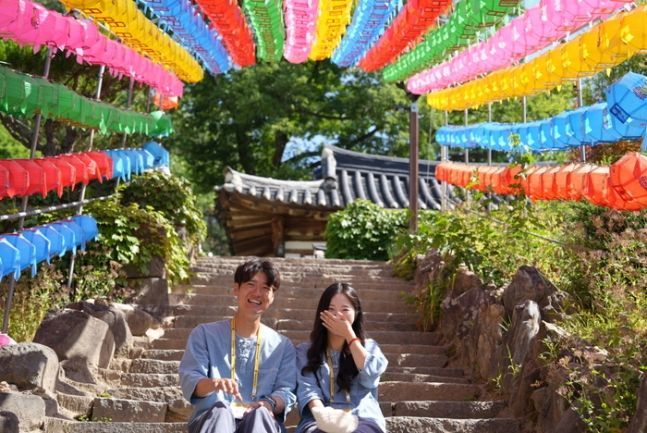 Participants of 'I Am Jeollo' held in Gongju last May. [Photo by Jogye Order Social Welfare Foundation]
The meeting program “Love in God” at Oryun Church in Gangdong-gu, Seoul (Pastor Joo Kyung-hoon) is also very popular. Started in 2019 and having completed its 5th matching this year, the program has grown into a large-scale event with a total of 250 participants. Originally launched by deacons who were former members of the church’s youth group for the benefit of juniors, the program opened its doors to outside churches due to overwhelming demand.
Participants attend lectures on biblical views of marriage for three weeks, followed by four weeks of one-on-one meeting time. Young people who faithfully participate in the first three weeks receive “blessing tickets” and “date tickets” that allow them to give gifts to someone they like. Another unique aspect of the seven-week program is that participants do not reveal their real names to each other; instead, they use nicknames, and until matching, they are prohibited from using their own cars to avoid flaunting wealth. Couples who become official partners are given the opportunity to attend the “Yeonjigonji School,” a marriage preparation school.
Couple matching programs cannot be the ultimate solution to the low birthrate problem. However, experts advise that matching programs are cost-effective projects considering the budget and manpower invested. Especially in East Asian cultures where having children is closely tied to marriage, programs that facilitate natural meetings within religious communities can be an important solution.
Myojang Sunim, CEO of the Social Welfare Foundation of the Jogye Order of Korean Buddhism, who planned “I am at the temple,” explained, “Overcoming the low birthrate problem must start with understanding the importance of marriage and family. The religious community should strive to expand meeting opportunities to naturally encourage a marriage culture and spread positive perceptions about marriage and childbirth. Seeing the cases emerging through ‘I am at the temple’ also confirmed the high level of trust people have in religion.”
© The Asia Business Daily(www.asiae.co.kr). All rights reserved.
![Clutching a Stolen Dior Bag, Saying "I Hate Being Poor but Real"... The Grotesque Con of a "Human Knockoff" [Slate]](https://cwcontent.asiae.co.kr/asiaresize/183/2026021902243444107_1771435474.jpg)

















