IMF Releases World Economic Outlook Report
"New Tariffs Increase Inflation Risks"
Growth Rate Maintained at 3.2% This Year... Revised Up to 3.3% Next Year
The International Monetary Fund (IMF) has warned that high interest rates could persist for a long time due to tariff hikes in major countries, including the United States, which is holding a presidential election this year. If import prices rise and inflation rebounds, it could hinder central banks' moves to lower benchmark interest rates. The IMF also expressed concerns about economic policies that could lead to expanded fiscal deficits, such as tax cuts.
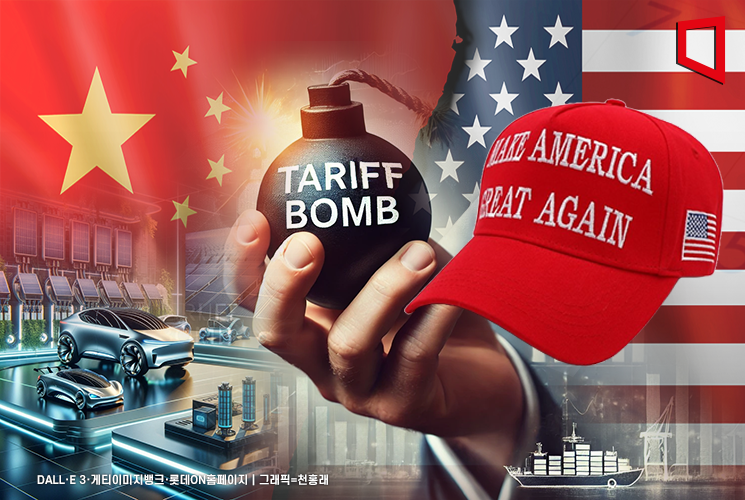
In its World Economic Outlook (WEO) report released on the 16th (local time), the IMF warned that new tariffs and trade barriers could push up prices as countries face election years.
The IMF stated, "As trade tensions escalate and policy uncertainty expands, the risk of rising inflation is increasing," adding, "This also raises the likelihood that high interest rates will persist for a longer period."
The epicenter of these concerns is former President Donald Trump, the "Tariff Man," who is running as the Republican candidate in the upcoming November U.S. presidential election. Trump has announced that if he returns to the White House, he will impose a universal tariff increase of 10 percentage points on all imports and an ultra-high tariff of 60 percentage points on Chinese imports. Tariff hikes are likely to lead to higher product prices and a general rebound in inflation. President Joe Biden, who is seeking re-election, has a tariff policy similar to Trump's. Earlier, the Biden administration significantly raised tariffs in May on Chinese electric vehicles, batteries, critical minerals, and semiconductors.
The European Union (EU) is also joining the tariff hike movement. The EU plans to raise tariffs on Chinese electric vehicles up to 47.6%, citing unfair subsidies. China is likely to retaliate with counter-tariffs on products imported from the EU, including pork, raising concerns about a global trade war.
The IMF sees a high possibility that inflation will continue to slow down, but with service prices and wages rising, the pace of disinflation (slowing inflation) is slower than expected. In this context, such tariff increases could lead to a sustained high interest rate environment.
The IMF pointed out that policies that could cause fiscal deficits and government debt expansion, including tax cuts, could also hamper the economies of various countries. In France, the left-wing coalition New Popular Front (NFP) became the largest party following the general election, and in the UK, the Labour Party won a majority in the general election, leading to a change in government. There are concerns that the rise of left-wing parties could worsen public debt issues in both countries.
In the U.S., former President Trump, who currently has a high chance of winning, has promised large-scale tax cuts, including reductions in corporate and income taxes, raising concerns that federal government debt could increase further. Above all, if the U.S. increases bond issuance due to fiscal deficits, interest rates will rise, affecting the entire world with high interest rates. The debt burden on developing countries will increase even more.
Pierre-Olivier Gourinchas, IMF Chief Economist, said, "It is worrisome for countries like the U.S. to maintain fiscal policies that steadily increase the debt-to-GDP ratio even in a state of full employment," adding, "This poses risks not only to the U.S. but also to the global economy."
The IMF said, "There is a significant possibility of major changes in economic policies due to elections in the U.S. and other countries this year," adding, "This could have negative effects on the rest of the world, increasing uncertainty."
Meanwhile, the IMF maintained its global economic growth forecast for this year at 3.2%, as presented in April. The growth rate for next year was raised by 0.1 percentage points to 3.3%.
Looking at individual countries, the U.S. growth forecast for this year was lowered by 0.1 percentage points to 2.6%, due to signs of a slowdown in the labor market. The Eurozone (20 countries using the euro) raised its growth forecast by 0.1 percentage points to 0.9%, considering the service industry and exports. China is expected to grow by 5% this year, and India by 7%, raising their forecasts by 0.4 and 0.2 percentage points respectively. The South Korean economy is expected to grow by 2.5% this year, up 0.2 percentage points from the previous forecast.
© The Asia Business Daily(www.asiae.co.kr). All rights reserved.

















