Financial Services Commission Chairman's Keynote Speech at 'Information Security Day' Seminar with Financial CEOs
Increasing Digital Dependence... "Shift from 'Convenience-Centered Development' to 'Responsible Development'"
"Promote Active Security Culture, Strengthen Corporate Capabilities in Security Incident Response"
Government to Revise Regulations Including Disaster Recovery Center Installation
Five Awarded for Meritorious Service Including NH Nonghyup Bank CEO Lee Seok-yong and Hana Securities President Kang Seong-muk
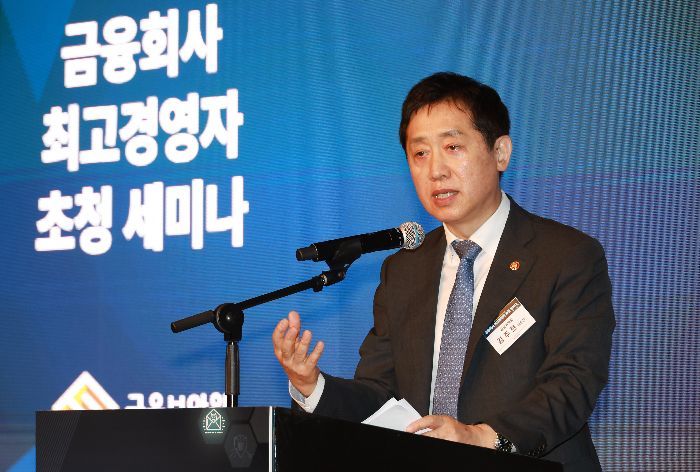 On the morning of the 17th, Kim Ju-hyun, Chairman of the Financial Services Commission, attended the 13th Information Security Day commemorative seminar hosted by the Financial Security Institute at the Grand Ballroom of The Plaza Hotel Seoul in Jung-gu, Seoul. After delivering the keynote speech on the direction of financial security amid digital financial innovation, he presented awards to CEOs and Chief Information Security Officers (CISOs) of financial companies who contributed to the advancement of financial security and information protection.
"As the reliance on digital technology in finance increases, so do the threats to financial security. We must shift the paradigm of financial security to an autonomous and proactive form and ultimately move toward strengthening digital operational resilience."
On the 17th, Kim Ju-hyun, Chairman of the Financial Services Commission, stated this in his keynote speech at the 'Information Security Day Commemorative Seminar for CEOs of Financial Companies' hosted by the Information Security Agency at The Plaza Hotel in Jung-gu, Seoul. He said, "Due to the qualitative and quantitative growth of digital financial services, digital technology has become inseparable from finance and an essential strategy for the survival of financial companies." He added, "Until now, digital financial innovation has been based on 'convenience-centered development,' but now we must move toward 'responsible development' along with financial security to earn trust."
He emphasized that the financial sector must respond to increasingly sophisticated cyberattack technologies and various financial security threats arising from deepening technological dependence by reorganizing principle-based security systems, spreading a proactive security culture such as participating in the 'Bug Bounty' program, and strengthening digital operational resilience. The Bug Bounty program rewards individuals who discover and report security vulnerabilities in software or websites after evaluation.
The financial authorities have revised the Electronic Financial Supervisory Regulations to be 'principle-based' to respond to rapidly changing security threats. The network separation regulation will be gradually improved to allow more flexibility. This is based on the judgment that uniform security regulations are insufficient to cope with the rapidly increasing financial security threats.
Chairman Kim said, "The government will improve the system to strengthen the roles and responsibilities of CEOs and boards of directors in the financial security field, and actively support the early establishment of autonomous security by providing guidelines and consulting to prevent confusion in the financial industry during the transition to an autonomous security system."
He also urged that ultimately financial security should move toward strengthening digital operational resilience. Digital operational resilience refers to a company's capability to continuously provide critical services in response to security incidents, prevent, recover from, and learn from operational disruptions.
Chairman Kim stated, "We must face the reality that security activities cannot be 100% perfect and strengthen recovery capabilities to quickly resume operations in case of security incidents." He explained, "The government is promoting amendments to the Electronic Financial Supervisory Regulations to expand mandatory targets, such as installing disaster recovery centers and setting business recovery time objectives."
The European Union (EU) plans to implement the Digital Operational Resilience Act (DORA) starting January next year, and related policies are also being pursued in the United States, the United Kingdom, Singapore, and other countries. He added, "We will review global trends such as the EU's Digital Operational Resilience Act to check for any shortcomings in the domestic financial sector and, if necessary, promote legislation, amendments, and policy establishment."
Meanwhile, Chairman Kim awarded commendations to five individuals for their contributions to financial security. Among them were Lee Seok-yong, CEO of NH Nonghyup Bank, who established the first AI-based personal information misuse monitoring system in the financial sector; Kang Sung-mook, President of Hana Securities, who contributed to improving business safety by strengthening information system vulnerability checks; and Kwon Woong-won, Executive Director of Samsung Life Insurance, who helped prevent security incidents by enhancing the information security management system, all of whom received the Financial Services Commission Chairman's Commendation.
Additionally, Park Kyu-ha, Executive Director of KB Kookmin Card, who established and operated the financial sector's first cloud computing security system, and Kim Jae-young, Executive Director of NICE Information & Telecommunication, who promoted the advancement of a Zero-Trust-based remote work environment, were also recognized for their contributions. The awardees were selected based on exemplary cases that contributed to improving the reliability and stability of the financial information protection industry across various financial sectors.
© The Asia Business Daily(www.asiae.co.kr). All rights reserved.

















