National Assembly Public Administration Committee Holds Legislative Hearing for Pros and Cons Debate
Professor Dongjin Lee "Severe Consumption Contraction... Measures Needed"
Professor Byunhoon Seok "Waste of Costs in Issuing Local Gift Certificates"
The National Assembly's Public Administration and Security Committee (PAS Committee) held a legislative hearing on the "Special Measures Act for Overcoming the Livelihood Crisis (Livelihood Recovery Support Fund Act)." The bill includes provisions to provide all citizens with local gift certificates worth between 250,000 and 350,000 KRW. The nationwide support payment was a general election pledge of former Democratic Party leader Lee Jae-myung, and the Democratic Party adopted the Livelihood Recovery Support Fund Act as its first party policy in May.
On the afternoon of the 16th, the PAS Committee discussed the Livelihood Recovery Support Fund Act at the National Assembly. Four professors attended the hearing as witnesses. Professors Lim Ji-bong of Sogang University Law School and Jang Young-su of Korea University Law School exchanged opinions on whether the Livelihood Recovery Support Fund Act qualifies as a "dispositive law." Professors Lee Dong-jin of Sangmyung University Department of Economics and Finance and Seok Byung-hoon of Ewha Womans University Department of Economics spoke about the bill's "economic effects."
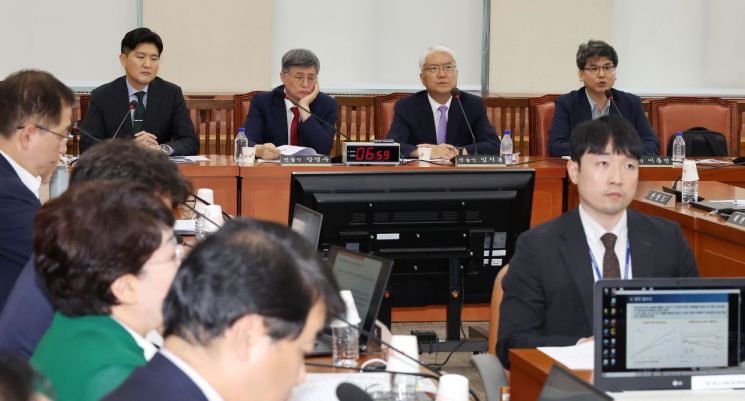 On the afternoon of the 16th, witnesses are speaking at the legislative hearing of the National Assembly's Public Administration and Security Committee on the "Special Measures Act to Overcome the Livelihood Crisis." [Image source=Yonhap News]
Professor Lee said, "The issue of consumption contraction in our country is quite serious," adding, "Welfare is determined by consumption, and leaving this unattended is absolutely unacceptable." He continued, "The burden of household debt is large, and the decrease in real wages has been even greater," and argued, "At this time, many countries are implementing cash support policies that can have income compensation effects." Furthermore, he added, "I hope that not only this bill but also more aggressive measures will be prepared additionally so that we never experience consumption stagnation like in the past again."
People Power Party lawmaker Bae Jun-young addressed Professor Lee, saying, "No one dislikes receiving money, but public opinion shows that 51% of the people are against the payment." He added, "People know this is a case of 'josam-mosa' (a trick where the outcome is the same but the timing is changed)," and said, "Although there may be a slight consumption stimulation effect initially, paradoxically, prices rise and loan interest rates increase afterward, ultimately reducing consumption." He also criticized, "Consumers open their wallets only when consumer prices fall," and "If prices rise due to the support payment, consumption contraction is inevitable."
Professor Seok emphasized, "Research results estimate that the consumption increase effect of the 2020 disaster relief fund was between 22% and 42% of the support amount," adding, "Since household debt has recently increased and loan interest rates have risen, the consumption stimulation effect is likely much reduced compared to 2020." He also said, "This time, the support is provided not in cash but as local gift certificates, which is expected to cause many side effects," and explained, "If local gift certificates are issued simultaneously in multiple regions, the effect of drawing consumption from neighboring regions to the issuing region disappears."
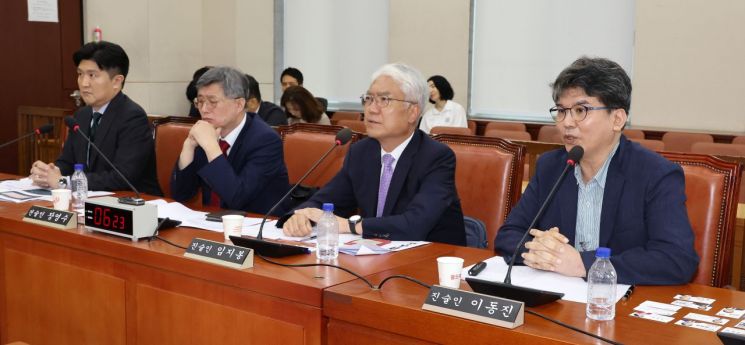 From the left, Seok Byung-hoon, Professor of Economics at Ewha Womans University; Jang Young-soo, Professor at Korea University Law School; Lim Ji-bong, Professor at Sogang University Law School; Lee Dong-jin, Professor of Economics and Finance at Sangmyung University.
 [Image source=Yonhap News]
Democratic Party lawmaker Lee Sang-sik questioned Professor Seok, saying, "When the 2020 disaster relief fund was provided, then Future United Party leader Hwang Kyo-ahn insisted, 'Since time is urgent, the president should deposit 500,000 KRW directly into bank accounts.' How do you explain this?" Professor Seok replied, "I am not in a position to judge, so I do not know the intention behind that."
There was also some debate regarding the costs of issuing local gift certificates. Yong Hye-in, leader of the Basic Income Party, said, "Professor Seok presented data stating that 10% of the face value is required as issuance costs for local gift certificates," adding, "This includes incidental costs due to the discount rate, so it seems to be a misquotation." Professor Seok retorted, "The amount does not include costs related to the discount rate, promotion, and distribution," and asserted, "There will be additional fiscal waste factors beyond the 10% issuance cost."
© The Asia Business Daily(www.asiae.co.kr). All rights reserved.


















