"That is the real Trump."
Paul Krugman, Nobel laureate and distinguished professor at the City University of New York, warned in a column he contributed to the New York Times (NYT) on the 15th (local time), "Don't miss Project 2025. That is the real Trump." He focused on 'Project 2025,' expected to be at the center of policy operations in a potential second Trump administration, as the possibility of former President Donald Trump's return to power grows following the assassination attempt.
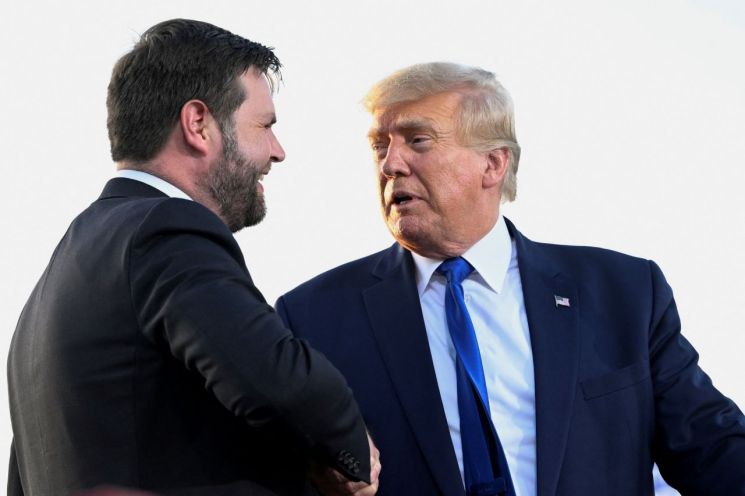 Former U.S. President Donald Trump, the Republican presidential candidate, and Senator J.D. Vance, confirmed as his running mate.
 [Image source=Reuters Yonhap News]
First, Professor Krugman stated, "I will not speculate on the impact of the assassination attempt on former President Trump last Saturday (the 13th) on the 2024 presidential election," but added, "I will observe one thing. Some political right-wingers argue that criticism of former President Trump, who tried to overturn the last election results through this attack, and claims that he is a threat to democracy, are themselves inappropriate."
He said these two claims are "simultaneously true," emphasizing that political violence like this assassination attempt is unacceptable, but the efforts by former U.S. President Trump and his hardline supporters to undermine American democracy are also an intolerable problem.
The Project 2025 that Professor Krugman raised as an issue in this column is a kind of policy proposal prepared by the conservative think tank, the Heritage Foundation. He introduced it by saying, "If former President Trump wins the election this November, it is designed to ensure that MAGA (Make America Great Again) proceeds smoothly," and "This blueprint aims to provide both the governing agenda and appropriate personnel on the first day of a conservative administration."
The main points of Project 2025, already known locally, include restricting freedom of expression as stated in the Constitution's amendments, abolishing LGBTQ rights, reducing medical and healthcare services, and concentrating federal government authority in the president.
When asked how radical the agenda of Project 2025 is, Professor Krugman referred to recent controversial remarks by Kevin Roberts, chairman of the Heritage Foundation. Earlier this month, Roberts sparked controversy by saying that if the left cooperates, it would be a bloodless revolution and that the U.S. is at the center of a "second revolution."
Former President Trump distanced himself from this last week, saying he "knows nothing" about it. However, Professor Krugman sarcastically noted, "Many involved in this project are former Trump administration officials and aides," and "In 2022, former President Trump attended the Heritage Conference and said they were 'laying the groundwork and making detailed plans for exactly what we will do.'" He predicted that if Trump wins the election, detailed policy decisions will be left to many people as in his first administration, and evaluated that "Project 2025 is a guideline that could very well happen in a second Trump term."
In particular, what Professor Krugman took issue with is the 'Taking the Reins of Government' section at the very beginning of the 900-page policy compendium. He said, "There are many things to oppose, but the most important is at the very front," and expressed concern that "(this section) basically demands replacing a significant portion of the federal workforce, which is mainly composed of career civil servants, with political appointees who can be freely hired or fired."
Professor Krugman pointed out that similar moves were confirmed during the late Trump administration, such as the implementation of the 'Schedule F' executive order, which allowed firing civil servants opposing the government's policy at any time. He criticized, "This would replace career civil servants with partisan loyalists," and said, "President Joe Biden revoked this, but Project 2025 will reverse it in some form, probably on a larger scale." Comparing it to the 19th-century spoils system, he noted, "Many appointees lacked experience and competence in performing their duties," and "Constant replacement was an open invitation to cronyism and corruption."
Amid accumulated problems of this spoils system, when Charles Guiteau, who was denied a public office reward, assassinated President James Garfield in 1881, the Pendleton Act was introduced two years later. Professor Krugman emphasized, "(The Pendleton Act) created a professional civil service system where most employees cannot be fired or demoted for political reasons," and "Today, the need to shield from partisan pressure is much stronger." He pointed out that when the bill passed Congress in 1883, federal government spending accounted for only about 2% of the U.S. economy, but today that scale is nearly ten times larger, and its influence through regulation is enormous.
Especially, Professor Krugman criticized, "Imagine now a significant part of the government becoming politicized," and said, "It is all too easy to imagine a shameless president abusing power to reward friends and punish opponents." He also reminded readers to recall that former President Trump publicly stated during the early COVID-19 pandemic that he might not help states with governors who did not support him.
If former President Trump wins this November and Project 2025 is implemented, Professor Krugman warned that this kind of coercion will be carried out on a large scale. He said the rest of Project 2025's contents are also threatening and promised to cover them in future columns. He emphasized that despite former President Trump's cunning attempts to distance himself from Project 2025, it will provide an idea of what a second Trump administration might look like and urged readers to pay close attention.
© The Asia Business Daily(www.asiae.co.kr). All rights reserved.
![Clutching a Stolen Dior Bag, Saying "I Hate Being Poor but Real"... The Grotesque Con of a "Human Knockoff" [Slate]](https://cwcontent.asiae.co.kr/asiaresize/183/2026021902243444107_1771435474.jpg)
















