Introducing behind-the-scenes photos including bullet trajectory shots
Trajectory clearly captured to the left of Trump's head
"There was blood on his face. I kept taking pictures." A veteran photographer from The New York Times (NYT), who personally captured photos showing the bullet trajectory at the scene of the shooting of former U.S. President Donald Trump, shared behind-the-scenes stories.
According to the NYT on the 14th (local time), the day before, a photo clearly showing the bullet trajectory to the left side of former President Trump's head during a campaign rally in Butler, Pennsylvania, was captured by Doug Mills, the NYT's White House photographer. Mills is a veteran photographer who has covered U.S. presidents since Ronald Reagan.
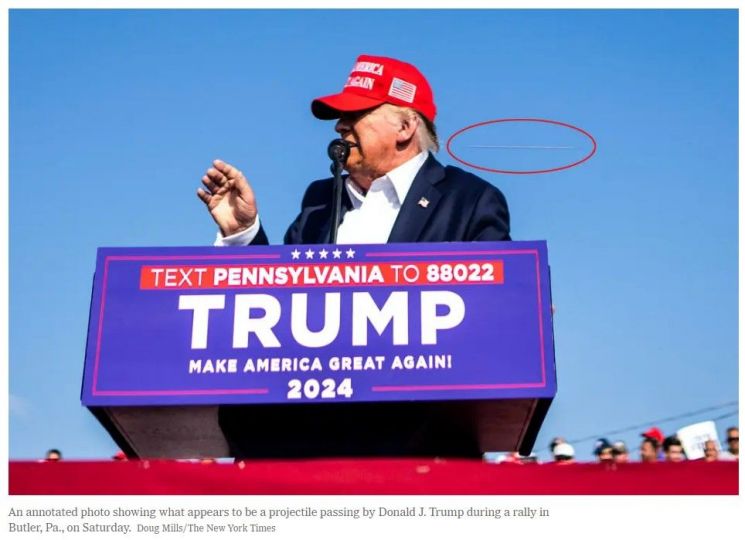
At the time of the shooting, he was part of the press pool on site, positioned right in front of Trump as he was giving his speech. Mills, who is not very familiar with the sound of gunfire, said, "When I saw him slump behind the podium, I knew something was wrong," and added, "To me, the sound (of the gunshot) sounded like a motorcycle or farm equipment. I didn’t immediately think it was a gunshot."
It was only after the loud noise and the Secret Service (SS) agents rushed onto the stage that he realized, "Oh my God, he was shot." Mills described the chaos at the time: "There was a lot of confusion and screaming. I heard someone say 'Get back,' and someone else shouting 'Active shooter.'" He also said, "When he stood up, he looked completely angry. He looked pale, and I could see blood on the side of his face."
Having photographed former and sitting U.S. presidents for over 40 years, Mills instinctively looked for the nearest stairs immediately afterward. He said, "I thought I needed to go that way. Everyone was pushing, shoving, and yelling," and added, "I ignored all that and tried to capture the historic moment. That’s what we do. Everyone who was there as a pool photographer that day."
He said, "My instincts kicked in with my photojournalism DNA," and recalled, "There was a moment when Trump’s aides shouted, 'Doug, get down.' I thought I might get shot," but added, "I don’t know why, but I just kept doing my job." He continued, "It’s really tragic that an innocent person at a democratic rally lost their life," and expressed gratitude that former President Trump was not more seriously injured.
Right after the attacked former President Trump left the scene in a sport utility vehicle (SUV), the SS and police told Mills and other reporters on site, "This is a crime scene, everyone out," and guided them to a tent beside the stage. Mills said he only realized the reality of the situation when he saw members of the Trump campaign crying angrily inside the tent. He immediately sent the photos to the NYT newsroom. After speaking with an editor and confirming his safety, he also texted his wife and daughter. He recalled that the parking lot at the scene was so blocked that it was difficult to leave, and he stayed in his car organizing his work until 10:30 p.m.
However, Mills did not initially think the photos he took at the shooting scene would cause such a big impact. In his first call with the editor, he reported, "He (Trump) was speaking, and suddenly he reached to his ear?that was all." Mills said, "At first, I didn’t think about the bigger picture," and added, "It wasn’t until around 8 or 9 p.m. last night that I thought, 'This is a historic image.' I’m grateful that my colleagues and I weren’t hurt and that I captured that moment."
In an interview with CNN, he said, "At first, I didn’t know what I had captured," explaining, "When I transferred the photos to my laptop, I saw the bullet flying behind former President Trump’s head. It was only in that one frame?there was nothing in the frame before or after." Earlier, an agent formerly with the Federal Bureau of Investigation (FBI) evaluated the photo Mills took, saying it "shows the movement of air caused by the projectile." Mills also took photos of former President Trump bleeding and raising his fist in the air after the attack. At the time, he was shooting with a Sony digital camera capable of up to 30 frames per second.
Despite being a veteran photographer affiliated with the progressive-leaning NYT, Mills has been regarded as a preferred photographer by former President Trump. During the North Korea?U.S. summit held in Hanoi, Vietnam, Trump personally requested Mills to send files of photos showing him walking with North Korean leader Kim Jong-un to the White House. It is also reported that Trump thanked Mills separately after seeing the photos he took at the inauguration.
Before joining the NYT, Mills worked at the Associated Press (AP) and collaborated with AP photographer Ron Edmonds. Edmonds, who passed away last month, won the Pulitzer Prize in 1981 for photos capturing the assassination attempt on former President Ronald Reagan outside a hotel. When asked by the NYT if he thought of Edmonds after taking these photos, Mills said, "Edmonds was my mentor. He was there the day Reagan was shot, and we talked about it many times," adding, "One thing he said was, 'When the shots rang out, I moved forward, not backward.' That’s what I think I did yesterday." He continued, "I remember him saying, 'I hope you never have to go through something like this,' and sadly, history has repeated itself."
© The Asia Business Daily(www.asiae.co.kr). All rights reserved.

















