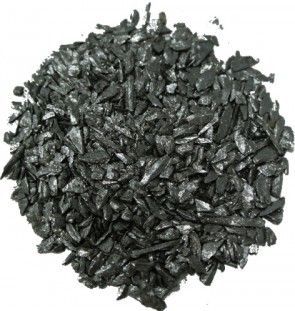
Among the top 10 global lithium-ion battery anode material markets, 9 are Chinese companies. The only Korean company to make the list was POSCO Future M, which ranked joint 9th.
According to the '2024 Q1 Lithium-ion Battery 4 Major Materials Quarterly Market and Supply Chain Analysis' report recently published by energy market research firm SNE Research, the global anode material market leader is China's BTR, holding a 24% market share.
SNE Research reported that the total anode material shipment volume in Q1 this year was approximately 239,000 tons. Among them, BTR supplied the most at 57,000 tons, followed by Shanshan in second place with a 15% market share. Third place went to China's Zichen with a 9% share, and joint fourth place was held by China's Shangtai, Shinzoom, and Kaijin, each with an 8% share.
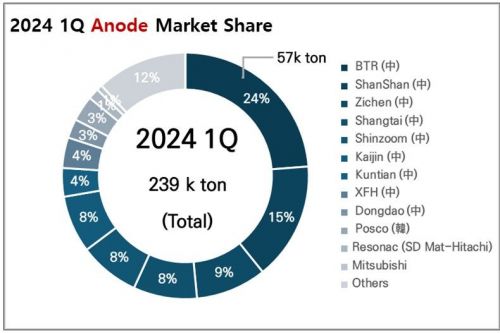
In the first quarter, Chinese companies swept the top 8 positions in the global lithium-ion battery anode material market, with POSCO Future M being the only Korean company to rank joint 9th alongside China's Dongdao.
The market share of Chinese companies in the global anode material market has expanded from 87.5% in 2021 to 92.6% in 2023. Consequently, Korea's dependence on China in the anode material sector exceeds 90%. According to the Korea International Trade Association, last year Korea relied on China for 97.2% of natural graphite and 95.3% of artificial graphite imports.
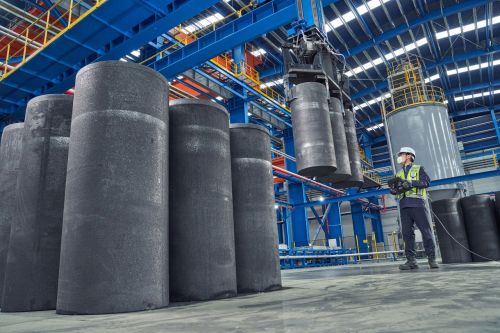
Lithium secondary battery anode materials mostly use natural graphite or artificial graphite, with a small amount of silicon mixed in.
Under the U.S. Inflation Reduction Act (IRA), to receive up to $7,500 in tax credits when purchasing electric vehicles, battery components must not be sourced from foreign entities of concern (FEOC) such as China starting in 2024, and critical minerals used in batteries must not be sourced from FEOCs starting in 2025. Considering the difficulty of replacing Chinese graphite, the U.S. Treasury Department classified graphite as a 'critical mineral that is realistically untraceable' and postponed the application until 2026.
Meanwhile, the average price of anode materials in the first half of 2024 was $4.5 per kilogram for artificial graphite and $5 for natural graphite. In the past, artificial graphite was more expensive than natural graphite, but due to excessive factory expansions, the price of artificial graphite has dropped and currently reversed. SNE Research explained, "Prices of anode materials such as artificial graphite, natural graphite, and silicon are expected to decline or remain stable throughout this year due to weak secondary battery sales demand, with a certain rebound anticipated between 2025 and 2026."
© The Asia Business Daily(www.asiae.co.kr). All rights reserved.


















