Nationwide Installation Rate Only 5.87%
Even Priority Management Areas at 17.8%
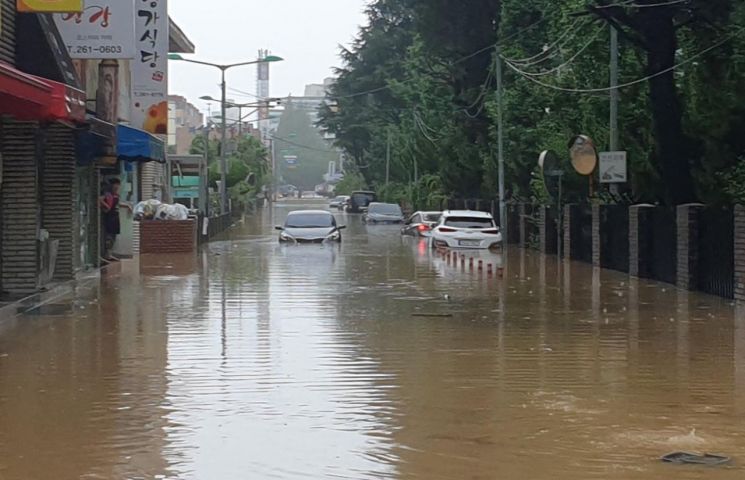
Incidents of pedestrians falling into open manholes due to manhole covers being lifted by backflow rainwater during heavy rains are recurring. However, safety device installations to prevent such accidents remain insufficient, raising concerns that current measures are inadequate to prevent accidents during the rainy season.
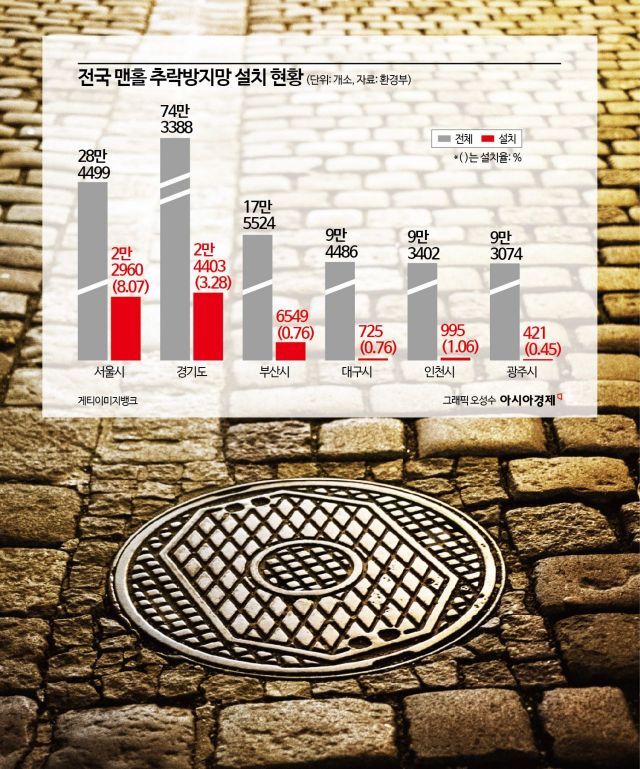
According to the Ministry of Environment, as of May this year, there were a total of 203,059 manholes equipped with fall-prevention nets nationwide, accounting for only 5.87% of the total 3,454,891 manholes. Among priority management areas, 56,762 manholes had fall-prevention nets installed, representing 17.8% of the total 318,425 manholes in those areas. 'Priority management areas' refer to locations requiring constant management, such as regions where stormwater concentrates within drainage basins, areas with poor surface flow, and regions previously affected by flooding damage.
The installation rates in major local governments also fell below 10%. By local government, Seoul had the highest rate at 8.07%, while Gyeonggi (3.28%), Incheon (1.06%), and Daegu (0.76%) all fell short of 5%.
Accidents where manhole covers are lifted due to water pressure can lead to casualties. In August 2022, in Dogok-dong, Gangnam-gu, Seoul, a fatal accident occurred when a manhole cover opened and a woman in her 50s and her brother in his 40s, who were walking to avoid the rain, fell into the manhole and died. Since this accident, there have been continuous calls for safety devices to prevent manhole fall accidents. The fall-prevention net is a mesh-type safety device placed over the manhole cover to prevent falls even if the cover opens. It is designed to withstand the weight of seven adult men, thereby preventing safety accidents.
In December 2022, the Ministry of Environment included the installation of fall-prevention facilities inside manholes in the 'Sewerage Design Standards' and began preparing countermeasures. According to the Ministry's guidelines, fall-prevention facilities must be installed under manhole covers in areas where rapid increases in sewage volume during rainfall are expected to cause manhole cover displacement. Accordingly, since last year, local governments have been installing fall-prevention nets in their jurisdictions using their own budgets and other resources.
However, the installation rate remains insufficient. In Seoul, the overall installation rate exceeds 8%, but the installation rate in priority management areas (38.3%) is still less than half. A Seoul city official stated, "Most manhole cover opening accidents occur in low-lying areas where rainwater accumulates, so fall-prevention nets are being installed mainly in priority management areas with high flood risk," adding, "Since installation costs are not insignificant, the overall installation rate is slow."
Experts advise that, in the short term, fall-prevention nets should be installed while, in the long term, drainage capacity should be continuously increased. Professor Gong Ha-seong of the Department of Fire and Disaster Prevention at Woosuk University said, "In the short term, fall-prevention devices for manholes should be installed nationwide," and added, "In the long term, manhole covers should be designed to close again even if they open, and drainage capacity should be continuously increased to respond to climate change."
© The Asia Business Daily(www.asiae.co.kr). All rights reserved.


















