Core Technologies of Carbon Capture, Utilization, and Storage (CCUS)
Silver nano catalysts essential for Carbon Capture, Utilization, and Storage (CCUS) technology, which is gaining attention to achieve the 2050 carbon neutrality goal, have been developed through joint research by domestic government research institutes and companies.
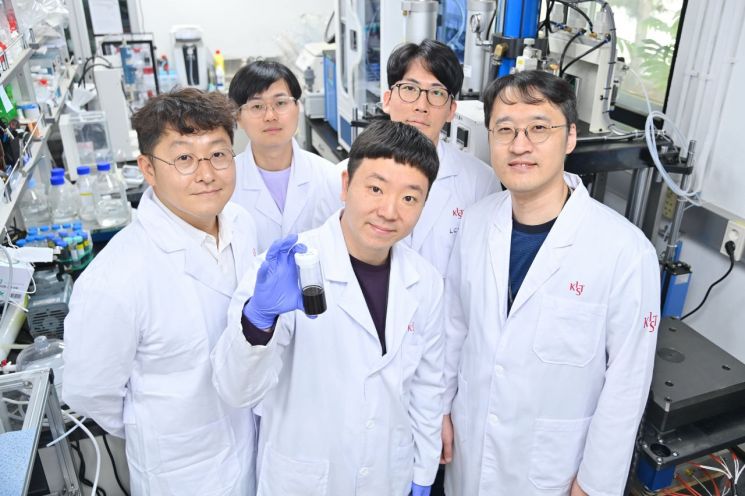 The KIST research team developed a hydrophobic silver catalyst that prevents electrolyte flooding, enhancing the electrochemical CO2 conversion performance. Photo by KIST
The Korea Institute of Science and Technology (KIST, President Oh Sang-rok) announced on the 14th that Dr. Oh Hyung-seok and Dr. Lee Woong-hee from the Clean Energy Research Center, in collaboration with Dr. Hwang Kyu-won’s team from the Semiconductor Technology Research Division and Dr. Noh Tae-geun’s research team from LG Chem, have developed a silver nano catalyst with hydrophobic lipid organics bonded to its surface that can suppress electrolyte flooding in carbon dioxide capture devices.
Silver nano catalysts are actively researched due to their excellent performance in converting CO2 into carbon monoxide, a raw material for petrochemical products such as plastics. Electrolytes, which are essential mediators in electrochemical carbon capture technology that converts CO2 emitted from thermal power plants, refineries, and petrochemical factories into useful compounds, are key factors affecting reaction speed and efficiency. However, the electrolyte flooding phenomenon, where excessive electrolyte flows over the reduction electrode in CO2 electrolysis devices, hinders the delivery of CO2 to the electrode catalyst layer and poses a barrier to the commercialization of CCUS technology.
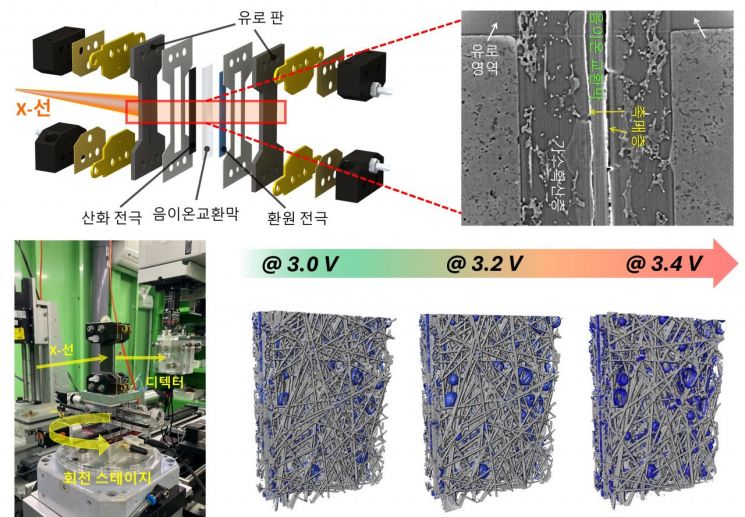
To solve the electrolyte flooding problem, the research team developed a new silver nano catalyst by bonding lipid organics to the surface of silver nanoparticles, imparting hydrophobicity that does not easily bond with water molecules while controlling the surrounding reaction environment. The synthesized silver nanoparticles have an icosahedral structure approximately 7 nanometers (nm; one billionth of a meter) in size, with hydrophobic lipid organics uniformly bonded to the particle surface. Furthermore, it showed high CO2 conversion activity even with a catalyst amount of 0.3 mg, which is less than the conventional 1 mg per unit area.
Utilizing the newly developed catalyst is expected to reduce catalyst costs and extend replacement cycles by enabling long-term electrochemical CO2 conversion with a smaller amount of catalyst, thereby lowering the production cost of carbon monoxide through carbon capture. The joint research team plans to conduct applied research on electrochemical CO2 conversion demonstration systems to enable application in large-scale production facilities such as petrochemical processes.
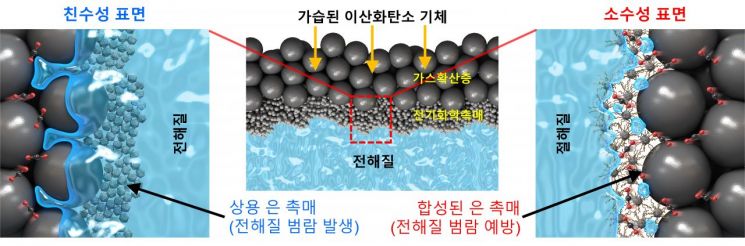 Schematic diagram comparing the flooding extent of commercial silver catalysts and synthesized silver catalysts. The surface of the commercial silver catalyst, which is hydrophilic, experiences electrolyte flooding at high overpotentials, whereas the surface of the synthesized silver catalyst, which is hydrophobic due to lipid organic matter bonded on the surface, does not experience electrolyte flooding even at high overpotentials. Photo by KIST
Dr. Oh Hyung-seok, a principal researcher at KIST, stated, “This is meaningful in that we proposed a catalyst synthesis strategy considering both internal and external factors in electrochemical systems,” and added, “The research results conducted together with LG Chem will accelerate the demonstration and commercialization of electrochemical CO2 conversion technology in the future.”
This research was supported by the Ministry of Science and ICT (Minister Lee Jong-ho) and conducted under KIST’s major projects, the Carbon to X project (2020M3H7A1098229), and the Creative Convergence Research Project (CAP21011-100). The research results were published in the international journal Nature Communications (IF: 14.7, JCR field: 5.6%).
© The Asia Business Daily(www.asiae.co.kr). All rights reserved.



















