SMEs "Bankruptcies and Closures Surge in Economic Situation... Regrettable Outcome"
Small Business Owners "Irresponsible Decision Ignoring Reality"
"Need to Consider Differential Application of Minimum Wage" in Unison
Regarding the minimum wage surpassing 10,000 won next year, small and medium-sized enterprises (SMEs) and small business groups expressed regret, stating that "the situation will become more difficult." Although the increase is not large, the fact that it has exceeded 10,000 won means that the labor cost burden on small-scale self-employed individuals, who are already at their limit, has increased further. The industry has strongly demanded a freeze, citing the weakened payment capacity of SMEs and small businesses.
On the 12th, the Korea Federation of SMEs issued a statement saying, "Considering the economic situation where more than half of SMEs cannot pay loan interest with operating profits and bankruptcies and closures are rampant, it is regrettable that the freeze requested by the SME sector was not implemented."
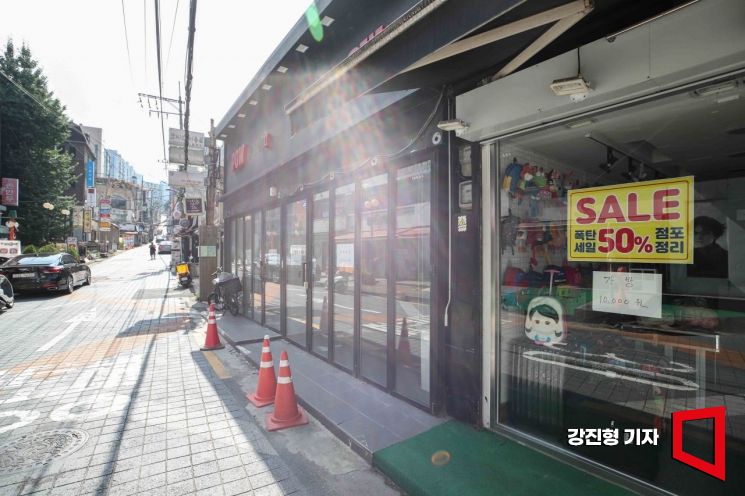 As small business owners continue to face management difficulties amid high inflation, the expansion of support funds for small businesses has become urgent. On the 28th, empty storefronts were seen scattered throughout the commercial area near Ewha Womans University in Seodaemun-gu, Seoul. Photo by Jinhyung Kang aymsdream@
It added, "During the deliberation period, the SME sector supplemented previous criticisms that the differentiated application plan was not specific. Despite presenting an improved proposal, the Minimum Wage Commission once again insisted on a single minimum wage system, which we believe is an irresponsible decision that ignores reality."
Previously, SME and small business groups requested differentiated application by industry for at least three sectors?convenience stores, restaurants, and taxi transportation?when setting the minimum wage, but this was not accepted.
The Korea Federation of SMEs stated, "In vulnerable industries subject to differentiated application, the sales of SMEs and small businesses have decreased while costs have increased, worsening profitability. Under these circumstances, the current high minimum wage is impossible to comply with," and emphasized, "Differentiated application of the minimum wage considering the payment capacity by industry is absolutely necessary."
The Korea Federation of Small and Medium Business also expressed regret in a statement. The federation said, "Small businesses, which account for 95.1% of domestic enterprises, are at their limit in payment capacity due to declining sales and high-cost structures."
It continued, "We have urged differentiated application and a freeze on the minimum wage, considering the management conditions of small businesses that cannot even afford the minimum wage. However, not only was this rejected, but the amount was also increased. This is an irresponsible act that ignores the reality of small business owners who bear the wage payment burden," criticizing the decision.
Furthermore, it argued, "The unbearable rise in labor costs ultimately forces 'solo management' and inevitably leads to a reduction in workers' jobs. The recent sharp increase in the number of self-employed without employees over the past few years proves this."
In this regard, Lee Myung-ro, head of the Human Resources Policy Division at the Korea Federation of SMEs and a user member of the Minimum Wage Commission, predicted, "Because the absolute level has already risen and accumulated, even a slight increase will make the situation very difficult."
Cha Nam-su, head of Policy and Public Relations at the Korea Federation of Small and Medium Business, said, "For small business owners, the difference between the four-digit 9,000 won range and the five-digit 10,000 won range is significant," adding, "It will be a factor that reduces consumer purchasing motivation."
The mid-sized enterprise sector emphasized the need for discussion on changing the minimum wage determination method.
A representative of the Korea Federation of Mid-sized Enterprises said, "In a situation where the payment capacity of companies has significantly deteriorated due to continuous economic downturn, the decision to set the minimum wage at the 10,000 won level, which labor has long demanded, without freezing it, may rather act as an obstacle that exacerbates difficulties for companies and workers," and added, "We must seek progressive measures to alleviate the burden, such as differentiated application by industry, so as not to erode the vitality of companies, which are the core drivers of the economy. More fundamentally, we should actively promote a transition to a minimum wage determination method based on autonomous negotiation between labor and management."
© The Asia Business Daily(www.asiae.co.kr). All rights reserved.
![Clutching a Stolen Dior Bag, Saying "I Hate Being Poor but Real"... The Grotesque Con of a "Human Knockoff" [Slate]](https://cwcontent.asiae.co.kr/asiaresize/183/2026021902243444107_1771435474.jpg)
















