37th Hankyung CEO Jeju Summer Forum Lecture
If China’s Intermediate Goods Exports Decline, 40 Trillion Won Could Evaporate
Each Company Must Identify and Prepare for 'ESG Vulnerabilities'
Scope 3 Disclosure May Affect Transactions with Japan
Jaehum Park, Partner at EY Han Young's Environmental, Social, and Governance (ESG) Impact Hub, stated on the 12th, "To enhance corporate value, it is important to continue investing in ESG risk across all committees within the board of directors."
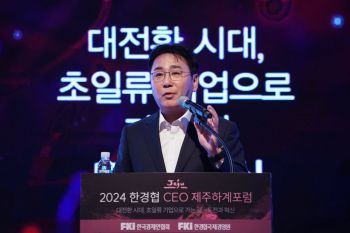 Park Jae-heum, Partner at EY Han Young ESG Impact Hub, is giving a presentation on the theme "An Era Where the Term ESG Disappears" at the '2024 Korea Economic Association CEO Jeju Summer Forum' held on the 12th at Lotte Hotel Jeju.
 [Photo by Korea Economic Association]
Partner Park made these remarks during a lecture at the '2024 Korea Economic Association (KEA) CEO Jeju Summer Forum' held by the Korea Economic Association at Lotte Hotel Jeju in Seogwipo City. The lecture topic was "An Era Where the Term ESG Disappears."
Partner Park said that while the term ESG may change, the importance of sustainable management will continue to grow. He emphasized, "There are criticisms about the bubble around ESG bursting, but I believe it has become an era of authenticity. It is important for the industry to focus not on the superficial meaning of the ESG term but on the essence of ESG."
Partner Park pointed out that disruptions in trade of intermediate goods from China could emerge as a risk for Korean companies from a supply chain perspective. He advised companies to identify which areas among E, S, and G they are vulnerable in and respond by reorganizing their supply chains accordingly.
He cited a report titled "Economic Damage to Countries Due to Supply Chain Restructuring" published last year by the Korea Institute for International Economic Policy. According to a scenario where the share of intermediate goods trade with China decreases to the 2002 level as of 2022, South Korea's real Gross Domestic Product (GDP) would decline by 1.83%. The year 2002 is when China joined the World Trade Organization (WTO). Applying South Korea's real GDP of approximately 1,996 trillion won as of last year, this translates to about 36.5 trillion won of real GDP evaporating.
He identified "standardization, participation, and authenticity" as the three key words related to sustainable corporate value. He diagnosed that all aspects of Environment (E), Social (S), and Governance (G) are becoming "standardized." Although various institutions create diverse ESG indicators, the keywords are narrowing down to carbon reduction (environment), human rights due diligence guidelines (social), and refinement of environmental and social control processes (governance).
He noted that the amount of carbon emissions during the product manufacturing process has become important. He said, "In Japan, a Scope 3 (mandatory disclosure of greenhouse gas reductions at the supplier, distribution, and consumer stages) disclosure system is in place," adding, "Korean companies trading with Japan may face difficulties in this regard."
Partner Park mentioned that ESG has more qualitative indicators than quantitative ones, making it difficult to create metrics. He said we are currently at the early stage of establishing standards. Using climate change as an example, he stated that companies need to derive detailed "ESG material issues" tailored to each company and industry, considering their specific characteristics.
He said that although corporate ESG management costs are increasing, they are gradually shifting from a "zero-sum" to a "positive-sum" game. In particular, to enhance corporate value from an ESG perspective, continuous investment in ESG risks across all committees within the board of directors is necessary. He said, "To effectively respond to the diverse demands of stakeholders, companies must strengthen ESG-related expertise and improve organizational culture."
© The Asia Business Daily(www.asiae.co.kr). All rights reserved.

















