Greater Impact of Uncontrollable External Events
Pandemic and War Cause Supply Chain Disruptions and Changes in Consumption Patterns
However, Large-Scale Economic Stimulus Contributes to High Inflation
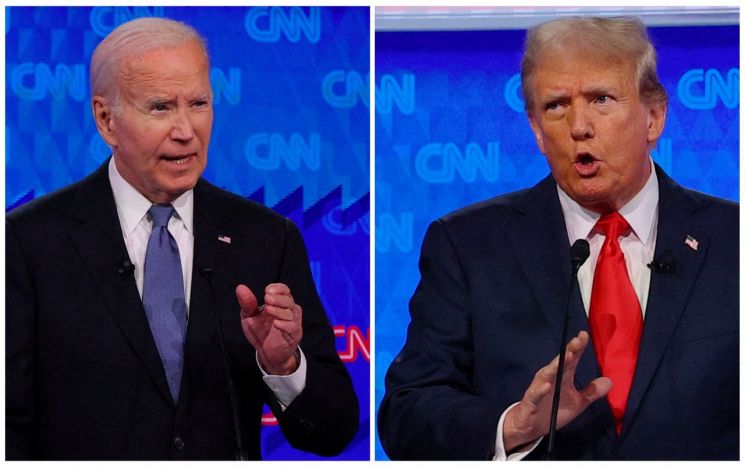
In the last presidential debate, U.S. President Joe Biden and former President Donald Trump blamed each other for inflation, but economists believe that neither is responsible, CNBC reported on the 11th (local time).
Earlier, in last month's debate, former President Trump criticized President Biden, saying, "He caused inflation," and added, "I essentially handed him a country with no inflation." In response, President Biden countered that the low inflation during the Trump administration was because "the economy was in a recession."
According to CNBC, inflation noticeably surged in early 2021 when President Biden took office. During former President Trump's term, the U.S. experienced a sharp rise in unemployment and a decline in consumer spending, resulting in the Consumer Price Index (CPI) being close to zero in early 2020. Economists point out that the reason both candidates' claims seem valid is due to negative external factors such as the COVID-19 pandemic.
Mark Zandi, chief economist at Moody's Analytics, said, "I don't think Trump and Biden should be held responsible for high inflation," adding, "The responsibility lies with the pandemic and the Russia-Ukraine war." The pandemic caused global supply chain disruptions, and Russia's invasion of Ukraine led to a sharp rise in global oil and food prices, greatly fueling inflation. The International Monetary Fund (IMF) announced in October 2022 that inflation had reached "the highest level in decades."
CNBC noted, "The pandemic upended the typical dynamics of supply and demand," explaining, "Workers were pushed out of workplaces due to illness, and Chinese factories and ports handling goods were shut down, destroying global supply chains." It also analyzed that "Americans, who used to spend money on services like dining out, travel, and movies, shifted their consumption patterns to purchasing more goods such as furniture and home office desks as they spent more time indoors." Furthermore, the broad reopening of the U.S. economy led to a sudden release of pent-up consumer demand, which also contributed to rising inflation.
However, there is also a view that the two former and current U.S. presidents are not entirely blameless. It is analyzed that their administrations contributed to inflation by increasing government spending during the pandemic. President Biden approved a $1.9 trillion stimulus package in March 2021. Former President Trump also implemented approximately $3 trillion in stimulus packages in two rounds in 2020.
Michael Strain, director of economic policy studies at the American Enterprise Institute (AEI), said, "These accommodative fiscal policies had positive effects such as a strong job market and low unemployment," but he also evaluated that "the scale was larger than what the U.S. economy needed at the time and contributed to driving up prices and demand by putting too much money into consumers' pockets."
Meanwhile, last month, the U.S. CPI rose 3% year-over-year, continuing a three-month slowdown. It fell short of both the market forecast (3.1%) and the previous month's figure (3.3%). Notably, the slowdown in the housing cost inflation rate, which accounts for one-third of the CPI components and has been cited as a main cause of sticky prices, drew attention. The market expects the Federal Reserve (Fed) to begin a pivot (policy shift) in September and to cut interest rates twice within the year.
© The Asia Business Daily(www.asiae.co.kr). All rights reserved.
![From Bar Hostess to Organ Seller to High Society... The Grotesque Con of a "Human Counterfeit" [Slate]](https://cwcontent.asiae.co.kr/asiaresize/183/2026021902243444107_1771435474.jpg)
















