Selling Price 3099 Yuan... Slightly Higher Than in Korea
Samsung Electronics' recently unveiled wearable device, the 'Galaxy Ring,' is attracting attention from Chinese consumers. Some expect that Samsung, whose market share in China has fallen to the 1% range, might find an opportunity to restore its pride.
According to local media including China's Guancha.cn on the 11th, the Galaxy Ring, a ring-shaped device from Samsung Electronics, is priced at around 3,099 yuan (approximately 586,000 KRW) in the Chinese market. This is about 17% higher than the Korean retail price of 499,400 KRW. As in Korea, it is available in three colors?Titanium Black, Titanium Silver, and Titanium Gold?and nine sizes ranging from 5 to 13.
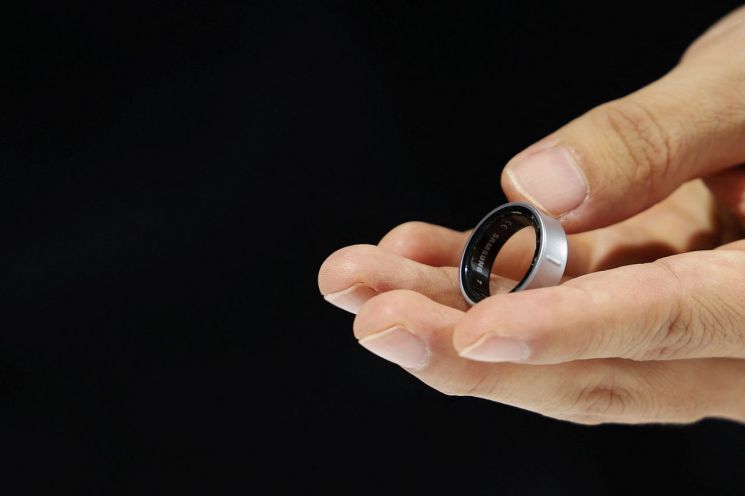
In the Chinese market, there is significant interest in the Galaxy Ring's performance. Consumers are intrigued by its built-in artificial intelligence (AI) sensors that not only monitor everyday health but also independently generate detailed health reports on sleep, activity, heart rate, and more. An iPhone user told Hong Kong's South China Morning Post (SCMP), "I am very curious about how much this device for health tracking can replace a smartwatch."
However, reactions to the somewhat high price are mixed. The Galaxy Ring weighs 3g, and its price is higher than that of a gold ring of the same weight (2,094 yuan), based on the local 24K pure gold price on that day. Some consumers commented, "It's more expensive than a pure gold ring." A netizen on a Chinese social networking service (SNS) wrote, "It looks cool but is too expensive," adding, "I will consider buying it when a domestic company releases a successor."
Some are focusing on whether the launch of the Galaxy Ring can help Samsung Electronics rebound its market share in China. Until 2013, Samsung was one of the leading smartphone suppliers in the Chinese market, holding a 20% share. However, since then, rapid growth of local companies, Samsung's lack of strategy for the Chinese market, the deployment of the Terminal High Altitude Area Defense (THAAD) system, and worsening relations between the two countries have caused its market share to plummet to the 1% range. Samsung Electronics is recently exploring cooperation measures, such as integrating Baidu's AI chatbot 'Ernie' into the Galaxy S24.
Meanwhile, Chinese smartphone manufacturer Honor announced in February that it is developing a smart ring.
© The Asia Business Daily(www.asiae.co.kr). All rights reserved.
![Clutching a Stolen Dior Bag, Saying "I Hate Being Poor but Real"... The Grotesque Con of a "Human Knockoff" [Slate]](https://cwcontent.asiae.co.kr/asiaresize/183/2026021902243444107_1771435474.jpg)
















