Visiting the Daegia Factory in Jiangsu Province
Producing in China for Export to Southeast Asia and the Middle East
"Producing 300,000 Units This Year, Exporting 170,000 Overseas"
"Last year we hit the 'bottom,' and now we are on the rise again."
On the 27th of last month, Jeong Sang-min, the responsible manager at Mobis Module Plant 3 in Yancheng, China, said he clearly feels that the local finished car business has rebounded since last year. This plant produces modules, which are semi-finished products combining automotive parts, and sends them to the final assembly line of Wueda Kia nearby.
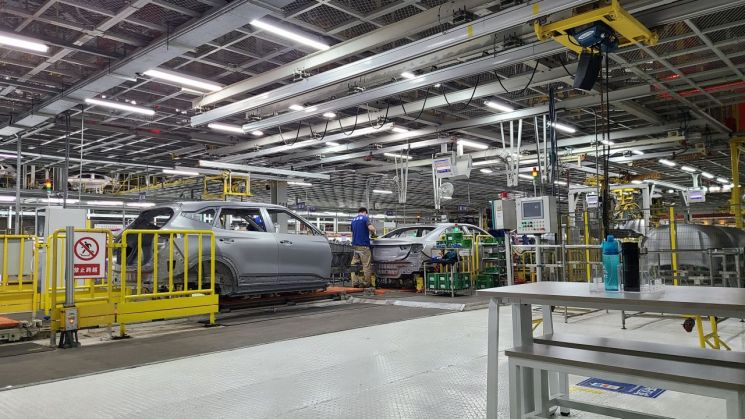
As the local sales volume of Kia finished cars in China decreased, both Kia and Mobis, which supplies modules and parts to Kia, have steadily reduced production volumes since 2017. Wueda Kia’s finished car production volume last year was 151,700 units. Around 2016, they produced over 600,000 units in China alone, all sold locally, but compared to that time, production has dropped to about a quarter. Mobis also saw its hourly production rate (UPH) fall from about 68 around 2016 to about 26 now, less than half.
Kia entered China in 2002 through a joint venture with Dongfeng, a Chinese finished car company, and the Wueda Group based in Jiangsu Province. Along with Hyundai Motor, part of the same group, China grew into the largest overseas production base and biggest demand market. However, in 2016, diplomatic tensions over the deployment of the Terminal High Altitude Area Defense (THAAD) system caused Korean car companies to struggle with local sales. Hyundai and Kia’s local market share, which once approached double digits, has now fallen to the 1% range. In recent years, some factories have been sold or transferred to joint ventures.
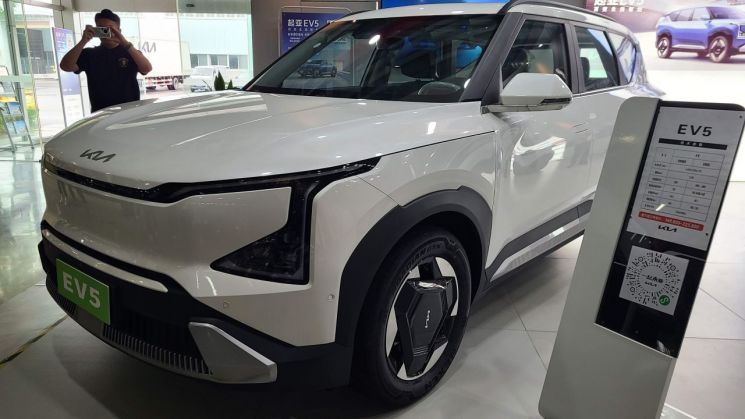 Kia's EV5 produced at the Yancheng plant in China. It was the first dedicated electric vehicle launched in China.
 [Photo by Choi Dae-yeol]
At the headquarters level, the strategy has been refined over the past two years to increase exports to neighboring countries rather than focusing on the Chinese domestic market. This is because the Chinese new car market has rapidly shifted toward eco-friendly vehicles such as electric cars, making it difficult to overhaul existing internal combustion engine production lines all at once. Last year, Kia sold about 83,000 units, roughly half of its Chinese plant production, to local consumers, while 86,100 units were exported to nearby Southeast Asia, the Middle East, and other overseas regions. Domestic sales decreased by 13% compared to the previous year, but exports more than doubled.
Just three or four years ago, all models produced at the Chinese plant were for the local market, but now it has become an export hub. Kia set its production target for the Yancheng plant at 300,000 units this year. Among these, exports are expected to exceed 170,000 units, well over half. The number of export models will increase from three last year to six, and export destinations will expand from 74 countries to 80 locations.
Hyundai Motor is also increasing its export ratio. Last year, only about 0.2% of vehicles produced at its Chinese plant were exported, but this year, exports accounted for more than 12% through the first quarter. Hyundai Motor also operates locally through a joint venture with the state-owned Beijing Automotive Group.
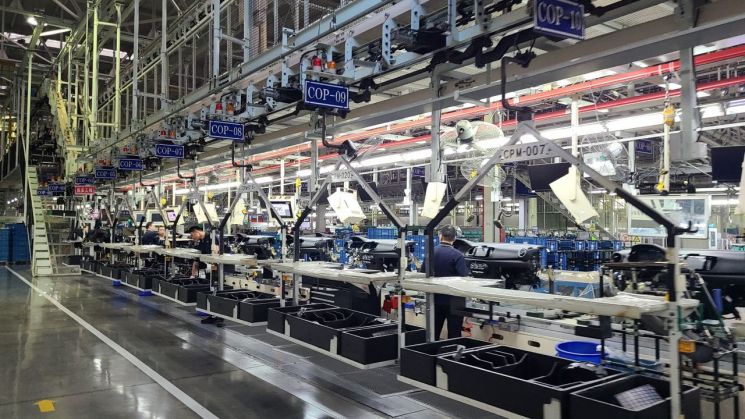 Mobis Module 3 Plant Cockpit Module Production Line in Yancheng, Jiangsu Province, China [Photo by Choi Dae-yeol]
With growing local demand for electric vehicles, Kia was the first to introduce the EV5, a compact electric sports utility vehicle (SUV), in China. It was developed considering the local market situation, using BYD batteries and Chinese company motors. An employee at Kia’s Yancheng plant said, "Some processes have been improved in collaboration with local companies to create an intelligent new energy vehicle dedicated plant," adding, "The EV5, which began production in November last year, is recognized as a cost-effective electric vehicle with long driving range and price competitiveness."
※ This article was produced with the assistance of the Korea Press Foundation and China Xinhua News Agency.
© The Asia Business Daily(www.asiae.co.kr). All rights reserved.
![User Who Sold Erroneously Deposited Bitcoins to Repay Debt and Fund Entertainment... What Did the Supreme Court Decide in 2021? [Legal Issue Check]](https://cwcontent.asiae.co.kr/asiaresize/183/2026020910431234020_1770601391.png)

















