Labor Sector 11,000 Won vs Management Sector 9,920 Won
Persistent Gap Between Labor and Management...1,080 Won Difference
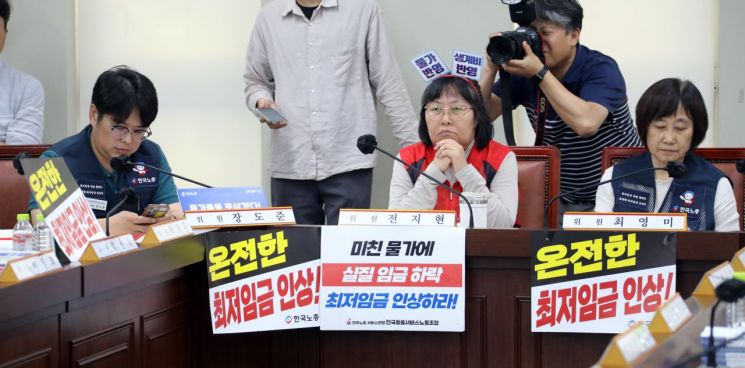
The labor and management sectors have each proposed their third revised minimum wage for next year, at 11,000 won and 9,920 won respectively. Although the gap has narrowed compared to the initial proposals, there remains a significant divide between the two sides.
The Minimum Wage Commission held its 10th plenary meeting at the Government Complex Sejong on the 11th to continue discussions on the minimum wage level for next year. The meeting, which began around 3 p.m., extended late into the night.
The labor side proposed a third revised minimum wage for next year of 11,000 won, an 11.6% increase from this year's minimum wage, while the management side proposed 9,920 won, a 0.6% increase. This represents a movement of 1,600 won and 60 won respectively from their initial proposals. Compared to the second revised proposals, the labor side lowered theirs by 150 won, while the management side raised theirs by 20 won.
The gap, which was 2,740 won at the time of the initial proposals, narrowed to 1,080 won in the third revised proposals, but the positions still show a large difference.
At the meeting, Im I-seon, Vice Chairperson of the Korean Confederation of Trade Unions (KCTU), criticized the management side, saying, "The management's proposal to raise the minimum wage by only 10 won in the (first) revised proposal is mocking." She added, "Nowhere in the Minimum Wage Act does it state that the ability to pay can be a criterion for determining the minimum wage," and accused the management of "using the difficulties of self-employed and small business owners as a shield to block minimum wage increases."
Another labor representative, Ryu Ki-seop, Secretary-General of the Federation of Korean Trade Unions (FKTU), stated, "The deliberation on the minimum wage increase should strictly be for the benefit of minimum wage workers," urging the management to present a realistic increase proposal and requesting the public interest commissioners to prioritize the livelihood stability of low-wage workers in their deliberations.
In response, Ryu Ki-jung, Executive Director of the Korea Employers Federation, emphasized, "The minimum wage has already reached a very high level, and even an increase rate similar to the past would have a significant impact on the market," stressing that "the decision should be made at a level close to a freeze so that small and medium-sized enterprises and small business owners can survive."
Lee Myung-ro, Head of the Human Resources Policy Division at the Korea Federation of SMEs, also expressed concern, saying, "If the minimum wage is raised at a high rate, it will cause significant damage to small and medium-sized enterprises, small business owners in critical situations, and vulnerable job seekers."
The minimum wage is decided by narrowing the gap through revised proposals after the labor and management sectors submit their initial demands. If the gap cannot be closed through revised proposals, the public interest commissioners set a 'deliberation promotion range' or vote on a mediation proposal to determine the minimum wage.
The Ministry of Employment and Labor must publish next year's minimum wage in the official gazette by the statutory announcement date of the 5th of next month. Considering the objection procedures, the Minimum Wage Commission should decide the minimum wage by the 16th, which is 20 days before the announcement date, but many expect the minimum wage to be decided on or after the 18th, surpassing the deadline again this year.
© The Asia Business Daily(www.asiae.co.kr). All rights reserved.
![Clutching a Stolen Dior Bag, Saying "I Hate Being Poor but Real"... The Grotesque Con of a "Human Knockoff" [Slate]](https://cwcontent.asiae.co.kr/asiaresize/183/2026021902243444107_1771435474.jpg)
















