8,434 Cases Occurred from January to May This Year
Massive Damage but Weak Punishment
Office worker Lee (30) received a call last month from a number starting with ‘010’. Lee was momentarily startled upon hearing that he had been reported and almost fell victim to voice phishing. Lee said, “I almost got tricked this time.”
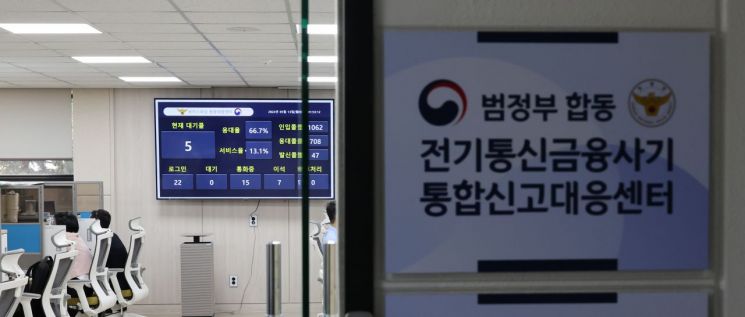 The Joint Government Integrated Reporting and Response Center for Electric Communication Financial Fraud located in Jongno-gu, Seoul. [Image source=Yonhap News]
Recently, as voice phishing techniques have been advancing day by day, the number of victims has been increasing again. There are calls to fundamentally block voice phishing damage and strengthen punishment for criminals.
According to the police on the 12th, from January to May this year, there were 8,434 cases of voice phishing damage, with losses amounting to 256.3 billion KRW. Compared to the same period last year, the number of cases increased by 15%, and the amount of damage increased by 50%.
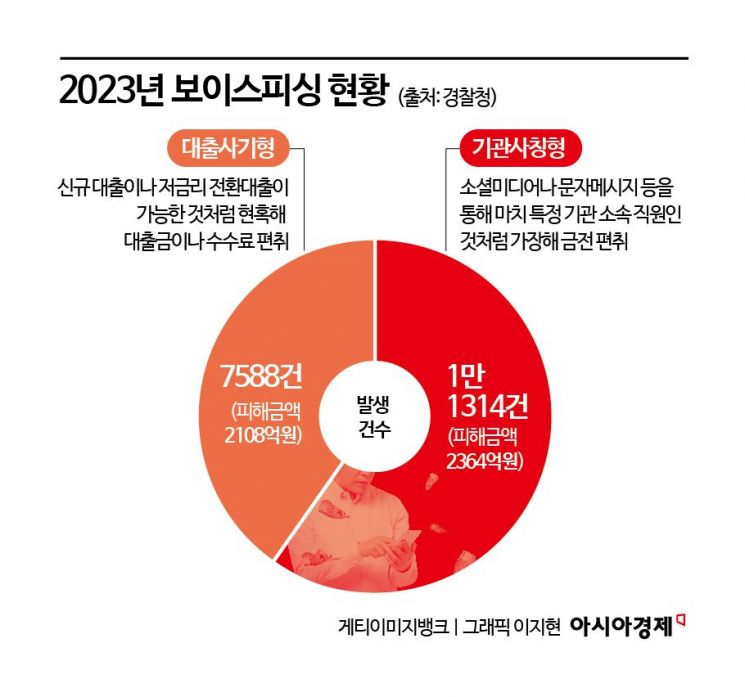
Voice phishing damage peaked at 37,667 cases in 2019, decreased to 18,902 cases last year, but is now rising again. Looking at the number of cases by type of voice phishing, impersonation of institutions such as prosecutors, police, and the Financial Supervisory Service decreased by 15%, but loan-related fraud surged by 61%. Considering the domestic economic situation, criminals are using loan interest reduction and other incentives as bait.
Although the scale and amount of voice phishing damage are enormous, punishments remain weak. On the 3rd, the Seoul Eastern District Court sentenced A (41), a current bank employee involved in opening mule accounts for a voice phishing organization, to one year in prison, and on the 9th, the prosecution filed an appeal against the first trial sentence. The amount of damage caused by voice phishing using the mule accounts opened by A reached 6.2 billion KRW.
On the 26th of last month, the Seoul Eastern District Court sentenced Jeon (34), who was indicted for embezzling 89.33 million KRW from 16 victims, to three years in prison. Jeon deceived victims with cunning lies such as “If you deposit credit rating adjustment fees and insurance premiums, you can get a loan for ordinary citizens,” and “If you send money, you can get a low-interest loan through government-supported loan products.”
A bill to amend the Special Act on Prevention of Telecommunications Financial Fraud and Refund of Damages has been submitted to the National Assembly. On the 8th, Yang Bu-nam of the Democratic Party proposed a bill requiring financial companies to temporarily suspend withdrawal of deposits from accounts when more than 10 million KRW is deposited from a person with whom there was no prior transaction relationship. On the same party, Park Jung proposed a bill in June to drastically increase the punishment for voice phishing to up to 10 years of imprisonment and impose fines up to ten times the criminal proceeds.
Professor Kwak Dae-kyung of Dongguk University’s Department of Police Administration said, “There is a need for measures to fundamentally block voice phishing damage,” adding, “Voice phishing targets dozens, hundreds, or thousands of people, and it does not end at once but continuously creates new victims, so heavier punishment is necessary.”
© The Asia Business Daily(www.asiae.co.kr). All rights reserved.


















