Democratic Party Policy General Assembly Adopts Franchise Law as Party Position
Promotion Law, Formation of Federation and Granting of Negotiation Rights
The Democratic Party of Korea has adopted a bill to amend the Franchise Business Act, granting collective bargaining rights to franchisees, as its party stance. Additionally, the 'Partial Amendment to the Act on the Promotion of Franchise Business (Franchise Business Promotion Act),' which allows franchisors to form associations to negotiate transaction conditions, has re-emerged in the 22nd National Assembly. The franchise industry is opposing this, calling it "a de facto law to establish a democratic labor union for franchisees."
According to political circles on the 11th, the Democratic Party held a policy members' meeting that day and adopted eight bills, including the Franchise Business Act, as party stances.
Currently, six bills have been proposed that grant collective bargaining rights to franchisees. These bills include ▲ the introduction of a registration system for franchisee organizations ▲ sanctions for refusal to negotiate with franchisee organizations ▲ prohibition of unfair practices and retaliatory measures by franchisors.
This bill was pushed by opposition parties, including the Democratic Party, until the end of the 21st National Assembly. Last year, the opposition passed the amendment unilaterally and early this year succeeded in passing the bill for direct submission to the plenary session.
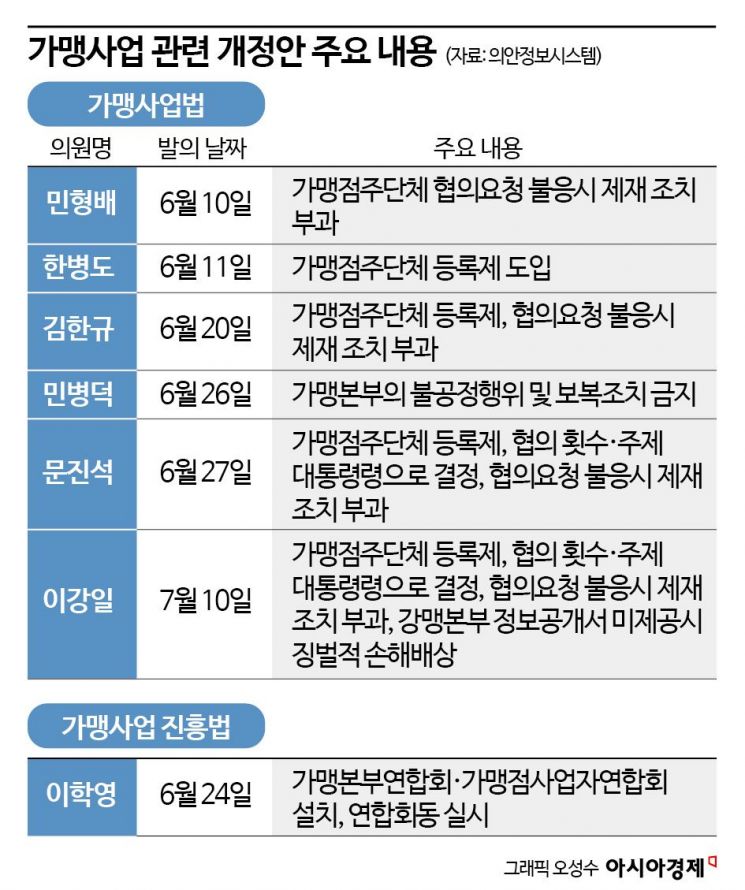
The bill is expected to pass within the year. Min Byung-duk, who led the amendment of the Franchise Business Act, currently serves as the senior deputy chair of the Democratic Party's Policy Committee. Furthermore, the Euljiro Committee of the 22nd National Assembly, which held its launch ceremony on the 8th, has set a policy to prioritize the passage of the 'six laws for win-win cooperation,' including the amendment to the Franchise Business Act and the enactment of the Online Platform Act.
In addition, a newly proposed law has been introduced to provide a legal basis for franchisee organizations to form associations and negotiate collectively. On the 26th of last month, Democratic Party lawmaker Lee Hak-young introduced the Franchise Business Promotion Act containing such provisions. This bill allows franchisors and franchisees to each form associations. Moreover, these associations can negotiate transaction conditions with franchisors on behalf of franchisee organizations upon request.
The franchise industry is opposing the bill, calling it a "law to establish a democratic labor union for franchisees." A franchise industry official pointed out, "When these laws are combined, the association where all franchisees gather would be like a federation such as the Korean Confederation of Trade Unions or the Federation of Korean Trade Unions; the subcommittees within the association by business type would resemble industrial unions; and the company-specific franchisee organizations under them would be like enterprise unions, effectively creating a structure similar to labor unions."
The Franchise Business Promotion Act was also proposed in the National Assembly in 2021 but was discarded after a single discussion in the Industry, Trade, Small and Medium Enterprises Committee's bill review subcommittee due to the expiration of the term.
At that time, the Korea Franchise Association submitted recommendations to the National Assembly regarding this bill, pointing out issues such as ▲ the proliferation of small associations and uncoordinated business operations ▲ conflicts between the association's proxy negotiation rights and the Franchise Business Act ▲ lack of regulations on the extent of representation by associations ▲ concerns about adverse effects when a minority of franchisees attempt negotiations against the majority through associations ▲ and the high possibility that associations could be granted powers similar to labor unions leading strikes if they pursue specific agendas.
An official from the distribution industry said, "The relationship between franchisors and franchisees is based on contracts. If the relationship between business entities is turned into that between employers and employees, confusion is inevitable."
© The Asia Business Daily(www.asiae.co.kr). All rights reserved.
![Clutching a Stolen Dior Bag, Saying "I Hate Being Poor but Real"... The Grotesque Con of a "Human Knockoff" [Slate]](https://cwcontent.asiae.co.kr/asiaresize/183/2026021902243444107_1771435474.jpg)
















