Resolution of the July Monetary Policy Direction Meeting
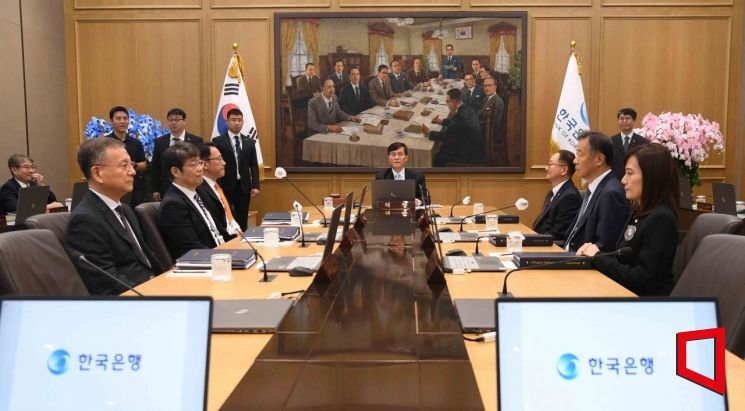 Lee Chang-yong, Governor of the Bank of Korea, is presiding over a meeting at the Monetary Policy Committee held at the Bank of Korea headquarters in Jung-gu, Seoul, on the 11th. Photo by Joint Press Corps
The Monetary Policy Committee of the Bank of Korea decided on the 11th to keep the base interest rate steady at 3.50% for the 12th consecutive time, stating, "It is necessary to further confirm whether the trend of slowing inflation continues, and attention should be paid to the impact of foreign exchange market volatility and the increase in household debt on financial stability." The committee added, "Future monetary policy will maintain a sufficiently tight stance while closely examining the trade-offs among policy variables such as the slowing inflation trend, growth, and financial stability, and will consider the timing of interest rate cuts."
In the resolution of the monetary policy direction meeting held that morning, the Bank of Korea's Monetary Policy Committee stated, "Domestic inflation is expected to continue its slowing trend due to a moderate recovery in consumption and the base effects of last year's sharp rise in international oil and agricultural product prices."
The committee said, "The consumer price index (CPI) inflation rate is expected to gradually decline to the low 2% range, and the annual inflation rate is likely to slightly underperform the May forecast of 2.6%. Core inflation is expected to gradually slow to around 2%, with the annual rate aligning with the May forecast of 2.2%."
Regarding the domestic economy, it stated, "Exports are expected to continue increasing, and consumption is gradually recovering, resulting in moderate growth. This year's growth rate is expected to generally align with the May forecast of 2.5%. Future growth paths will be influenced by the pace of IT sector expansion, consumption recovery trends, and monetary policies of major countries."
The committee added, "Monetary policy will be operated with attention to financial stability while ensuring that inflation stabilizes at the target level over the medium term."
Below is the full text of the monetary policy direction resolution
The Monetary Policy Committee decided to maintain the Bank of Korea's base interest rate at the current level (3.50%) until the next monetary policy direction decision. It deemed it appropriate to maintain the current tight stance while reviewing domestic and external policy conditions, as it is necessary to further confirm the continuation of the slowing inflation trend and to pay attention to the impact of foreign exchange market volatility and the increase in household debt on financial stability.
The global economy continued a moderate growth trend and a slowing inflation trend. In international financial markets, long-term government bond yields fluctuated significantly influenced by changes in expectations regarding the timing and extent of the U.S. Federal Reserve's rate cuts, as well as political situations in the U.S. and Europe. The U.S. dollar maintained strength due to differentiated monetary policies between the U.S. and other advanced countries. Going forward, the global economy and international financial markets are expected to be influenced by the slowing inflation trends in major countries, the degree of differentiation in monetary policy operations, developments in Middle East risks, and political situations in major countries.
Domestically, although export improvements continued, internal demand adjusted, causing sectoral differentiation to persist and growth to slow. Employment was generally favorable, but the increase in the number of employed persons narrowed. The domestic economy is expected to show moderate growth as exports continue to increase and consumption gradually recovers. This year's growth rate is expected to generally align with the May forecast of 2.5%. Future growth paths will be influenced by the pace of IT sector expansion, consumption recovery trends, and monetary policies of major countries.
Domestic inflation continued to slow due to the sustained monetary tightening stance. In June, the consumer price inflation rate fell to 2.4% due to a reduced rise in agricultural and processed food prices, while core inflation (excluding food and energy) remained at 2.2%, the same as the previous month. Short-term inflation expectations (general public) decreased to 3.0%. Domestic inflation is expected to continue its slowing trend due to moderate consumption recovery and base effects from last year's sharp rise in international oil and agricultural prices. Consumer price inflation is expected to gradually decline to the low 2% range, with the annual rate likely to slightly underperform the May forecast of 2.6%. Core inflation is expected to gradually slow to around 2%, with the annual rate aligning with the May forecast of 2.2%. Future inflation paths will be influenced by movements in international oil prices and exchange rates, trends in agricultural prices, and adjustments in public utility charges.
In financial and foreign exchange markets, long-term government bond yields declined as expectations of shifts in domestic and foreign monetary policy stances were priced in early, and the won/dollar exchange rate rose due to the added effect of weakness in neighboring currencies such as the yen and yuan. Household loans continued to increase, mainly in housing-related loans. Housing prices continued to decline in provincial areas but rose more sharply in the Seoul metropolitan area. Risks related to real estate project financing (PF) remain latent.
The Monetary Policy Committee will operate monetary policy with attention to financial stability while ensuring that inflation stabilizes at the target level over the medium term as it monitors growth trends. The domestic economy is expected to gradually converge to the target inflation level as growth moderately improves and inflation continues to slow. However, given uncertainties in the inflation path, it is necessary to further confirm the continuation of the slowing inflation trend and to monitor the impact of the foreign exchange market, Seoul metropolitan housing prices, and household debt on financial stability. Therefore, future monetary policy will maintain a sufficiently tight stance while closely examining the trade-offs among policy variables such as the slowing inflation trend, growth, and financial stability, and will consider the timing of interest rate cuts.
© The Asia Business Daily(www.asiae.co.kr). All rights reserved.
![Clutching a Stolen Dior Bag, Saying "I Hate Being Poor but Real"... The Grotesque Con of a "Human Knockoff" [Slate]](https://cwcontent.asiae.co.kr/asiaresize/183/2026021902243444107_1771435474.jpg)
















