AI Boom Drives M7 Soaring
US Stock Market Hits All-Time High
Wall Street No Longer Predicts Bear Market
MarketWatch "Growing Skepticism About AI Revolution"
As the stocks of the 'Magnificent 7 (M7),' referring to the seven major U.S. big tech companies, continue their soaring rally, voices cautioning against investors' excessive confidence in artificial intelligence (AI), the key driver behind these stock gains, are growing louder. Although big tech companies are investing huge costs in building AI infrastructure, the profits generated from this are inevitably limited.
U.S. Stock Market Soars Amid AI Boom
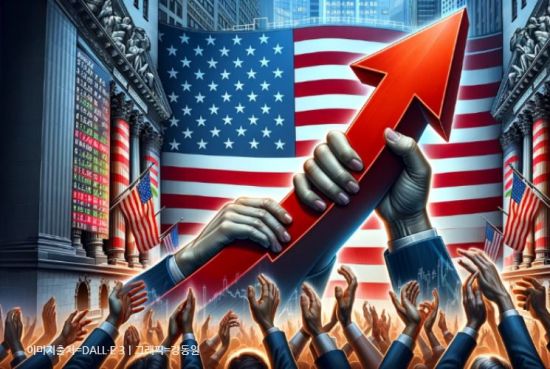
On the 10th (local time) in the New York stock market, M7 stocks all closed higher. Apple, which reclaimed the top spot in market capitalization on the 9th, showed a seven-day consecutive upward trend. Tesla's stock, which had at one point fallen more than 40% year-to-date, rose for 11 consecutive trading days, pushing its year-to-date gain to 5.97%. Nvidia's stock rose 2.69% that day, approaching its all-time high of $140.76 reached on the 20th of last month, while Amazon and Alphabet stocks rose 0.23% and 1.17%, respectively, approaching the $200 mark.
M7 companies are the most aggressively riding the AI wave, and with the Federal Reserve's potential rate cut in September added to the mix, their stock prices have surged sharply. According to Barron's, the average increase in M7 stock prices this year until the previous day reached 45%. On that day, both the Nasdaq and S&P 500 indices again hit record highs. Currently, no investment banks on Wall Street are predicting a bear market in the U.S. stock market. Even Marco Kolanovic, JP Morgan's global market chief strategist who was virtually the only one advocating a bearish view this year, has left Wall Street.
The Chicago Board Options Exchange (CBOE) Volatility Index (VIX), known as the 'fear index,' traded at 12.85 that day, which is much lower compared to 66.04 in March 2020 during the COVID-19 pandemic and 33.40 in April 2022 during the Russia-Ukraine war and global high-intensity tightening period.
MarketWatch: “AI Revolution, Upon Closer Look, Skepticism”
Meanwhile, MarketWatch reported that skepticism about the AI revolution, which has been a key driver of this year's stock market success, is spreading among analysts. There is an analysis that if the market emphasizes that stock prices are overvalued due to excessive optimism about AI, a correction is inevitable.
Jim Covello, head of Goldman Sachs Global Equity Research, estimated in a memo that companies will spend $1 trillion on AI-related capital expenditures over the next few years and said, “I am skeptical whether AI technology will be as profitable or impactful as the optimists claim.” He explained, “To justify this enormous cost, AI must demonstrate the ability to solve complex problems, but it does not seem to have reached that stage yet.”
British Barclays expressed a similar view. Barclays' equity research analyst team stated in a memo, “Hyperscalers (large-scale cloud service providers) are planning new data center constructions that exceed expected demand,” emphasizing, “During the dot-com era, (wired communication) companies also invested huge costs in installing fiber optic cables.”
Citigroup warned that investor sentiment around AI-related stocks is excessive and advised clients to realize profits on Nvidia and AMD stocks. Citi pointed out, “Looking at estimates for free cash flow growth over the next five years, many major AI stocks have reached their peak prices.”
The Wall Street Journal (WSJ) published an article titled “The time has come for AI to generate profits for companies, but whether it is possible remains questionable,” noting, “Industry-wide technology leaders have spent a lot of money on generative AI over the past year and now believe they must generate profits beyond efficiency, but the timing remains uncertain.”
Research results suggesting that AI's impact on the economy will be limited are also emerging. Daron Acemoglu, a professor at the Massachusetts Institute of Technology, predicted that AI will only raise the U.S. gross domestic product (GDP) by 0.9% over the next 10 years.
© The Asia Business Daily(www.asiae.co.kr). All rights reserved.
![User Who Sold Erroneously Deposited Bitcoins to Repay Debt and Fund Entertainment... What Did the Supreme Court Decide in 2021? [Legal Issue Check]](https://cwcontent.asiae.co.kr/asiaresize/183/2026020910431234020_1770601391.png)
















