Even a 2.5% Increase Like Last Year Means 10,000 Won
"Labor Cost Per Employee Nearly 10 Million Won Per Month"
With the minimum wage expected to exceed 10,000 won next year, the convenience store industry is strongly opposing the move. Some convenience store owners are raising their voices, saying that the introduction of a so-called 'nighttime surcharge system' to increase prices of products sold at night is inevitable.
According to the Minimum Wage Commission on the 10th, at the 9th plenary meeting held the day before, worker and employer representatives demanded a minimum wage increase to 12,600 won and a freeze at 9,860 won, respectively, for next year. After one revision, both sides adjusted their proposals to 11,200 won and 9,870 won, respectively.
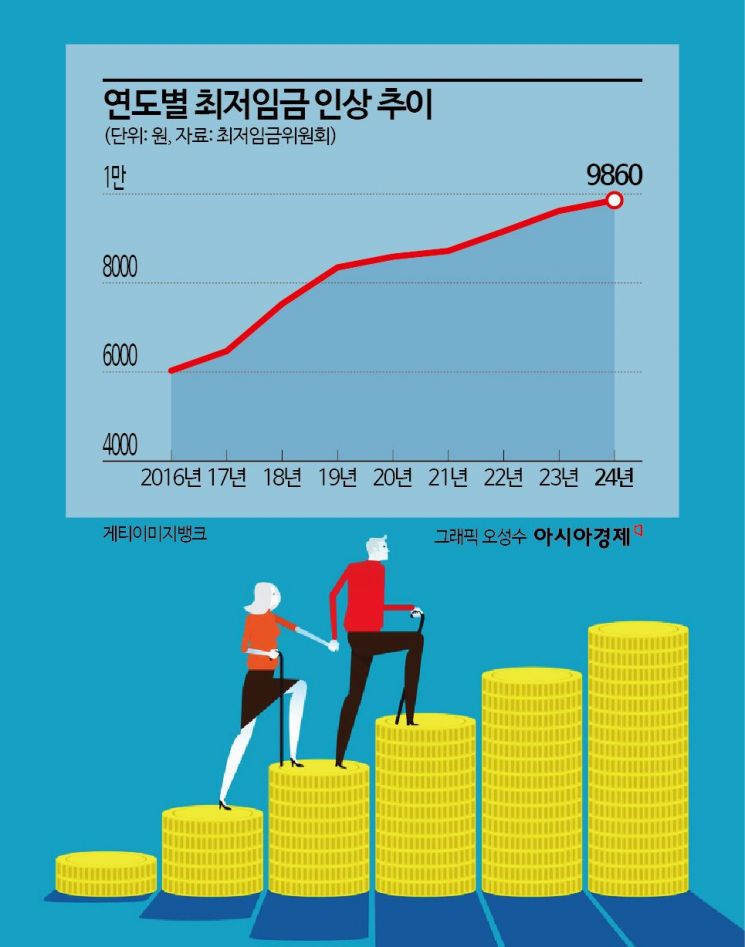
The convenience store industry expects the minimum wage to exceed 10,000 won next year. The minimum wage was raised by 5.05% in 2022, 5% in 2023, and 2.5% this year. If the minimum wage continues to rise at this rate, a 5% increase this year would result in 10,363 won, and a 2.5% increase would be 10,116 won.
Store owners anticipate that if the minimum wage exceeds 10,000 won, labor costs per person will surpass 10 million won per month. Convenience stores must bear weekly holiday pay (about 20% of the hourly wage) and the four major insurances (9%) when employing one person. Weekly holiday pay is legally paid when working more than 15 hours per week.
According to the National Convenience Store Franchise Owners Association (Jeonpyeonhyeop), the actual hourly wage burdened by store owners is currently 12,800 won per hour. If one person works per hour at a 24-hour convenience store, labor costs amount to about 9.21 million won per month. Gyesanghyuk, chairman of Jeonpyeonhyeop, pointed out, "Including severance pay and nighttime allowances, labor costs per person will exceed 10 million won per month next year."
Convenience store owners argue that the introduction of a 'nighttime surcharge system' is inevitable if the minimum wage continues to rise. Jeonpyeonhyeop has also argued in 2022 and last year that product prices at convenience stores should be raised at night. However, the convenience store headquarters showed reluctance, and the nighttime surcharge system was not introduced. Chairman Gye said, "Taxis receive nighttime surcharges, and IPTV installation fees also charge surcharges at night," adding, "Ultimately, the sales prices for self-employed business owners will also increase at night."
Some restaurants in Japan impose late-night surcharges. According to Japan's TBS, the gyudon chain 'Sukiya,' which operates 24 hours, has been adding a 7% late-night fee for orders from 10 p.m. to 5 a.m. since April this year.
© The Asia Business Daily(www.asiae.co.kr). All rights reserved.
![Clutching a Stolen Dior Bag, Saying "I Hate Being Poor but Real"... The Grotesque Con of a "Human Knockoff" [Slate]](https://cwcontent.asiae.co.kr/asiaresize/183/2026021902243444107_1771435474.jpg)
















